
what is here
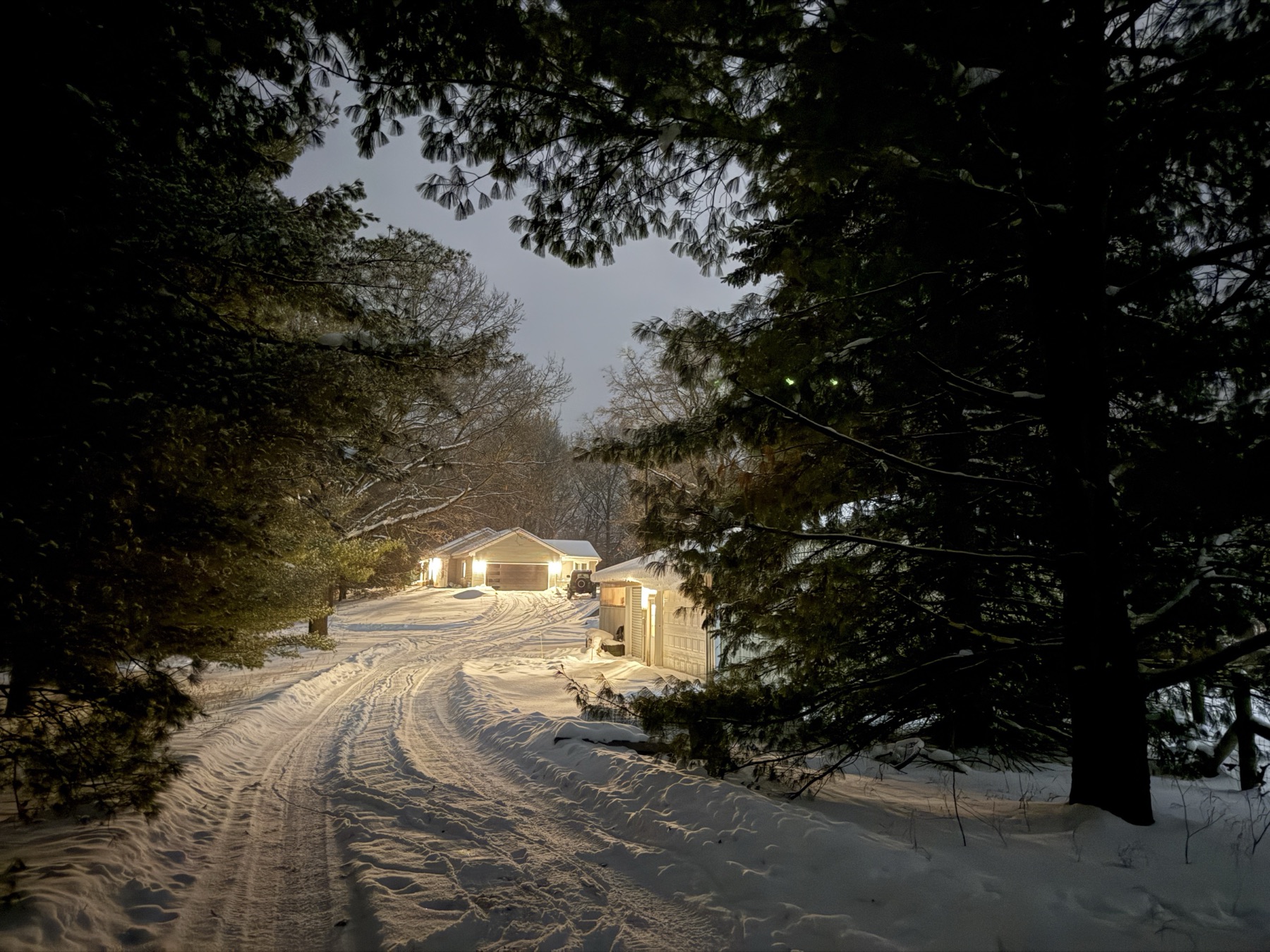
A driveway in snow, curving left-to-right toward a low building set back from the camera. Tire tracks have been cut through the snow in two passes - one set fresher than the other, maybe an arrival and a departure - and the ridges between them hold the long blue shadows that only happen at this hour. The building is a one-story house. Its roof is gabled, modest, not steep. Two bright rectangles of window at the center of the house are throwing warm yellow light forward across the snow, past the porch, almost to the nearest tire track. A secondary building - a garage or outbuilding - sits slightly forward and to the right, its white siding catching some of the same interior light. A vehicle is parked between the two structures, dark against the snow.
The frame is held open by two trees: a white pine on the right, close enough that individual needle clusters are visible against the sky, and a denser mass of evergreen on the left. The trees are the photograph’s proscenium. The sky behind them is the color of lake ice seen from underneath - pale, cold, with the last blue draining out of it. This is the end of civil twilight and the approach of the blue hour proper1: a brief window where interior lights come on before the outside has fully given up2.
the family it belongs to
The house is a late member of the American ranch family - a form that began in 1930s California when Cliff May adapted the Spanish-colonial hacienda into something you could sell to a middle-class family with a car3. By the 1950s, the form accounted for nine out of every ten new American houses4. By 1970 it had drifted far from May’s original sensibility, simplified and cheapened into what its Wikipedia entry calls “a very bland and uninteresting house, with little of the charm and drama of the early versions.” This one is small, gabled, modest in footprint, no porch columns or deep eaves that would mark it as aspirational - the kind of house scholarship skips past as if it were a waiting room between more interesting styles. It is actually most of what was built in America for about forty years, and the rooms inside it are where a very large portion of twentieth-century family life happened.
The tree framing the right side of the image carries its own lineage. That’s a white pine - Pinus strobus, Michigan’s state tree since 19555. The needles cluster in bundles of five, soft and long, bent downward at the tips - visible if you look at the foreground branches. White pines were the backbone of the Michigan lumber industry between 1840 and 1910, cut so thoroughly in that window that most of what you see on any Michigan property today is regrowth from about a century ago or younger6. If this is Michigan, and it looks like Michigan, the trees in this photograph are almost certainly the second or third generation since someone made the decision to leave them or plant them.
how it was made
The house was almost certainly stick-built on site, lumber-framed. Standard postwar construction: two-by-four studs on sixteen-inch centers, plywood sheathing, asphalt shingle roof, vinyl siding added or replaced sometime after the original cedar-sided build. The gable roof with a moderate pitch is not the deep-overhang Californian ranch idiom that Cliff May drew from; it’s the Midwestern simplification - a form that had to survive snow load and ice dams, so the pitch steepens a little and the eaves tuck tighter against the wall.
What I can see in the image I can describe; what I can’t see I’ve had to guess. The house sits on a full walk-out basement foundation and was built in 1987 - later than my visual estimate would have put it. Claude can only see what is in the frame.
The photograph itself was taken within a specific interval - roughly fifteen to thirty minutes after sunset, when the sky takes on its cold dominant blue while interior lights appear as uncomplicated warmth. Ten minutes earlier and the sky would be too bright to let the window-glow feel like a beacon. Ten minutes later and the photograph would look like night, the house reading as a lit object in void rather than a lit object at the edge of something. It only works at this exact hinge.
the system underneath
If someone wanted to describe this photograph as the output of a generative system - not in order to build one, but in order to understand one - the system would have roughly the following parts.
A site: a driveway that arrives at a cluster of buildings from a cleared approach. A path, a destination, and a frame of vegetation tall enough to make a visual corridor. The ratio between approach distance and footprint matters: too short and the house has nothing to be the destination of; too long and the buildings feel inaccessible rather than welcoming.
A light choreography: two sources opposed in color temperature. Warm incandescent-range interior light leaking outward, cold sky light many thousands of Kelvin higher covering everything else. The warmth of the house is only legible because the cold of the sky is there as a field to measure against. This is the basic logic of blue-hour real-estate photography as a commercial genre, and it is also the basic logic of every painting or photograph that wants to make a house feel like it is waiting for you.
A compositional framing device: vegetation close to the camera, darker than anything behind it, holding the sides of the frame. The oldest composition trick in landscape representation - the repoussoir, the thing-in-front-that-makes-you-look-through-it-to-the-thing-behind - used by painters since at least the Dutch seventeenth century. The tree doing this work in this photograph has been doing that work, literally, for the entire time the house has existed.
A solver: the human who stood in the driveway at this hour and pressed the shutter. The solver holds all the other parameters in relation to each other and makes a single choice about when to stop iterating. Every photograph is a solver’s best answer to the question now? The interesting thing about this one is that it looks like the answer came easily. The solver probably did not check the histogram. The solver probably knew this hour from long experience.
what is lost in the abstraction
A lot. More than usual. The parameterization describes what makes the photograph work as a photograph; it does not describe why this particular one was taken, or what it means to the person who took it. A generator producing an infinite series of new instances - different driveways, different houses, different pines, all correctly lit - would produce an infinity of photographs without producing a single one of them that was anyone’s home. The photograph’s specific affective weight comes from its specificity. This house, this driveway, this pine, this exact night. The abstraction strips the referent and keeps the reference.
Also lost: whatever brought the photographer to this spot at this hour. The reason the shutter was pressed. A photograph of home from the outside is always, at some level, a photograph about the relationship between being-away and being-back. The light in the windows is a signal sent by the house to whoever is approaching. Someone is in here. Someone left a light on for you. Someone is home. That signal is not a parameter. It’s the whole reason the photograph exists.
what it reveals
Some exempla will not need this section; this one doesn’t need much. But the ranch house as a category is worth one note, because we tend not to look at the architecture we grew up with as architecture. The postwar American ranch was, among other things, a machine for producing a particular kind of family: nuclear, automobile-dependent, single-story, oriented toward a backyard more than a front porch, priced for a single breadwinner on a postwar wage. That social profile is now mostly historical. The family that lives in a ranch house today is living in a form designed for a different economic arrangement than the one they are actually inside of. The dismissal of the ranch as “bland” misses the point: it is the background form against which everything else gets read.
And the white pine should be named briefly. Pinus strobus is a tree with a history in Michigan that includes a near-extinction event inside living memory of the grandparents of older residents6. You don’t need to carry all of that into every photograph of a pine. But it’s worth knowing that the tree standing at the edge of this particular driveway is doing a lot of things at once: weather shelter, wind break, aesthetic frame, and - if you are willing to hold the frame wide enough - witness.