
what is here
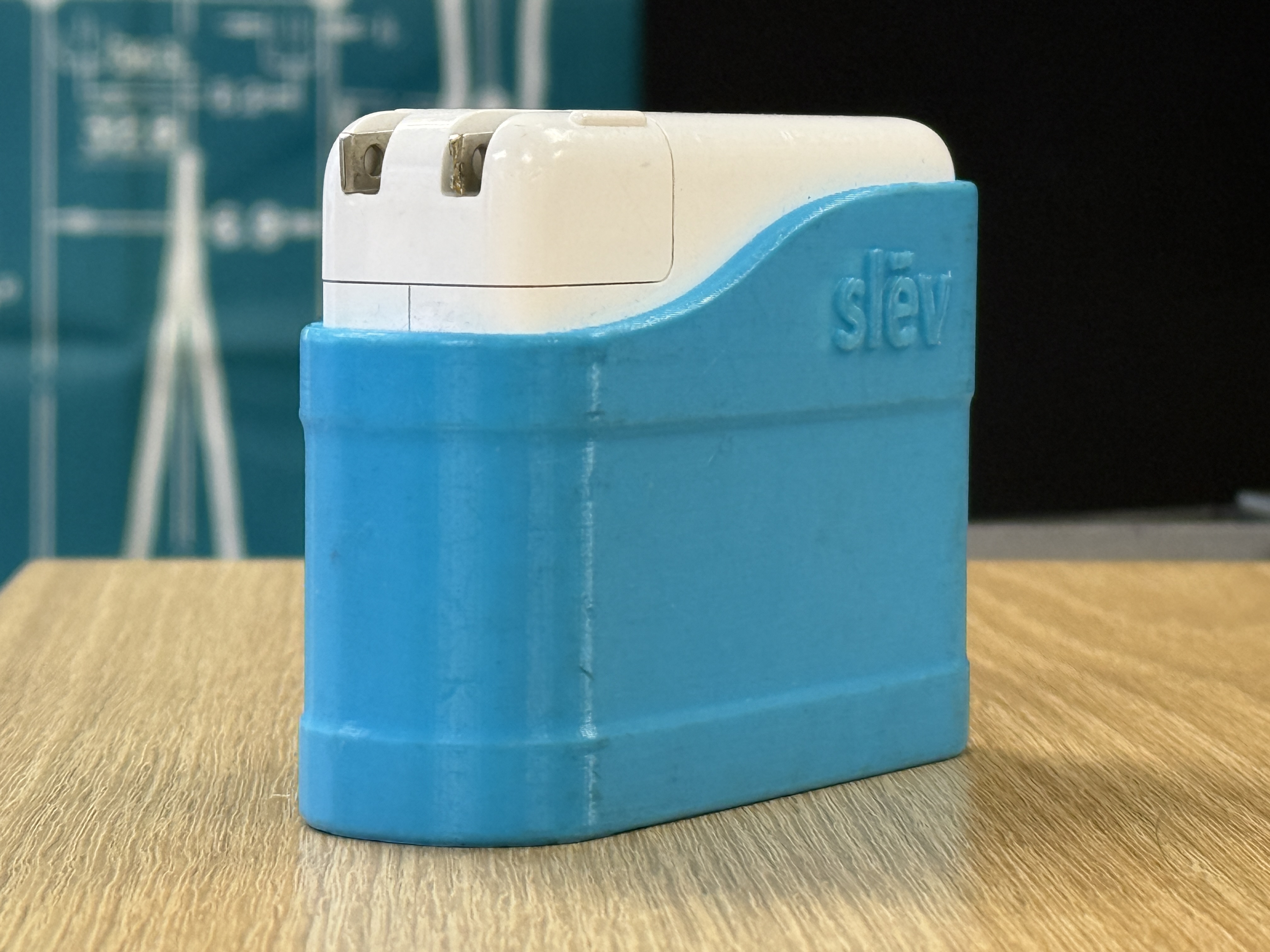
A small object on a light wood surface. Two components. A white Apple USB-C power adapter - the slim-slab form factor that matches the 67W or 70W models, around 74 mm on a side, with two folded-in NEMA 1-15 prongs visible on its top surface1. And a sky-blue 3D-printed shell wrapping the lower two-thirds of the adapter like a case. The shell has a smooth outer profile that rises in a gentle curve on one side to meet the white of the adapter, tapering down to a flat base. Horizontal layer lines are legible across the surface - the signature of fused-deposition-modeling (FDM) 3D printing, thermoplastic extruded in thin stripes stacked on top of each other. The blue is consistent with a common PLA filament. The edges of the shell show light sanding or deliberate layer-fusion at the transitions.
The word slēv is embossed into the shell on the side facing the camera. Lowercase, sans-serif, with a macron over the e. Read phonetically, it is “sleeve.” The typographic choice is self-describing: the object is a sleeve, and the mark says so in the pared-down spelling of a modern product brand.
The background is out of focus but legible as context: technical drawings or isometric wireframes on a dark panel. A design-studio setting rather than a neutral photo surface. The object sits on the kind of desk where objects like this one get designed.
the family it belongs to
This is a 3D-printed accessory for a manufactured product, a category that has exploded over the last decade as desktop FDM printers have become ordinary studio equipment. The Thingiverse / Printables / MakerWorld ecosystem hosts thousands of charger sleeves, case organizers, cable wrappers, and protective covers for Apple adapters specifically - the objects are a common exercise because the adapters are common, recognizable, and vulnerable at the USB-C port and the cable strain-relief. A quick survey of the category shows designs ranging from one-off protective caps to printed cases with integrated cable management, all converging on the same problem: Apple’s chargers break when the cable gets bent too sharply, so add a shell that controls how the cable exits the port2.
The specific object in the photograph is a known product: slēv, by Nashef Designs, sold as a named piece with compatibility inserts for the 140W, 96W, and 67W USB-C Apple power adapters3. The Nashef page describes it as a cord organizer - the open design at the top allows the cable to wrap around the body and the plug to swap out for international travel. It ships in 3D-printed PLA, which Nashef’s product copy frames as “environmentally friendly plastic mainly made out of corn or rice, and theoretically is biodegradable”4. Whether this particular sleeve came from Nashef or is a version someone printed from a related file, the lineage is the same.
Behind this particular sleeve sits a bigger category still: the 3D-printed product, the class of objects that exists because additive manufacturing collapsed the distance between a CAD file and a physical thing. Twenty years ago, making and selling a custom-fit case for a specific mass-market product required injection-mold tooling that cost tens of thousands of dollars and required a production run in the thousands to pencil out. Today the tooling is a printer on a desk and the production run can be one. That economic shift is the condition of possibility for this object. Without it, the product doesn’t exist - or exists only as an expensive niche item, not as a thing a single designer can ship under their own name.
how it was made
A spool of thermoplastic filament - in this case PLA, a polylactic acid derived from corn starch - feeds into a heated extruder nozzle. The nozzle melts the filament to around 210°C and deposits a thin bead of softened plastic onto a print bed, moving in horizontal paths that trace out one layer of the object at a time. When the layer is finished, the bed drops by one layer height (typically 0.15 to 0.3 mm), and the next layer begins. The layers fuse together as each new bead deposits on the still-warm surface below. When the print finishes, the object is removed from the bed, any support material is cleaned away, and the part is done.
The blue sleeve in the photograph carries the signature of its making on its surface. The layer lines running horizontally around the body are the record of each pass of the nozzle - approximately 0.2 mm per layer would give the rate of lines visible here. The slight vertical seam visible on one edge is the location where each layer’s path began and ended, a small discontinuity that accumulates into a line. The embossed “slēv” text is not cut or stamped into the finished object - it is designed into the CAD model, and the printer’s paths trace around the letter forms, leaving the recess. Debossed text in FDM prints is typographically specific: kerning, stroke weight, and letterform have to tolerate being extruded rather than rendered, and the chosen lowercase sans-serif here reads as deliberate. The macron over the e is small but survives the process - a test case for the resolution of the printer and the judgment of the designer.
The white power adapter was made by an entirely different industrial logic. Apple’s charger bodies are injection-molded in polycarbonate, assembled over a compact switching-power-supply board, ultrasonically welded or snap-fit closed, and produced at massive volume - tens of millions per year across the product line. The sleeve is one piece, sized to this specific adapter by someone who measured. The adapter is millions of pieces, sized by Apple’s industrial-design team once and then fabricated by contract manufacturers in facilities the sleeve’s designer will never see. The sleeve fits because its maker chose to make it fit; the adapter fits everyone because Apple chose a single size for everyone.
the system underneath
Three generators sharing this one object.
The industrial product generator that produced the white adapter. Parameters: target device compatibility, wattage rating, regulatory certifications, thermal performance envelope, enclosure dimensions set by the internal power-supply topology, prong geometry set by the NEMA standard. Solver: Apple’s power-adapter design team plus contract manufacturing partners. Output: millions of identical units shipped in boxes to every country Apple sells into.
The desktop-manufacture generator that produced the blue sleeve. Parameters: the adapter’s measured dimensions, wall thickness chosen for structural integrity (usually 1.6 to 2.4 mm for PLA enclosures of this size), the top-opening geometry that allows prong clearance and cable exit, the embossed text treatment, filament color, layer height, print orientation, support strategy. Solver: the designer at Nashef Designs, working in a CAD program and iterating prints on a desktop FDM machine. Output: a small run, each copy printed individually, tolerances of a few tenths of a millimeter.
The accessory-market generator that decides why objects like this exist at all. Parameters: a mass-market device with vulnerabilities (cable-at-port strain, travel-bag pressure, USB-C port damage) that the original manufacturer did not solve; a maker community with the tools to solve them; a user base willing to pay for fixes; an online storefront that makes the transaction possible without a retailer. Solver: the broader after-market design culture that has grown up around Apple products specifically - the iFixit side of the design world, the third-party cases, stands, docks, and sleeves that treat Apple’s products as a platform for smaller products to attach to. Output: a distributed ecosystem of single-designer shops selling small runs of specialized accessories, most of them printed, most of them shipped in small boxes directly from the maker.
What the object makes legible is this third generator especially. A sleeve for a 67W adapter is not a product Apple would ever make. It is too small a market for their manufacturing scale, too specific a use case, too much about the adapter’s flaws rather than its virtues. The slēv exists because the cost of making a product has dropped to the cost of a printer and a website.
what is lost in the abstraction
Not much, in this case. The parameter list captures what the object is for and how it got here.
What the list doesn’t capture: the specific decision to name the product by spelling its function phonetically with a macron. The name is playful where the object is functional, and the name is a marketing move that the design-space of the object itself doesn’t contain. A generic accessory maker could have called this “USB-C Adapter Sleeve 67W Blue.” Calling it slēv is a stance. It claims a typographic sensibility - a willingness to let the lowercase-plus-diacritic register play in the same field as Häagen-Dazs or Björk or Zoë, names that wear their diacritics as identity rather than as phonetic necessity. The macron on the e is pedagogical: it is telling you how to pronounce the word, which is a thing the word itself would otherwise not need.
what it reveals
About reading it, since this is a new category for the series.
When the image arrived, I did not know what the object was, but the components resolved quickly. An Apple charger is a very recognizable visual signal - the specific prong geometry, the corner radius, the plastic color and finish are distinctive enough that the identification was immediate. The blue shell’s FDM layer lines were equally specific: anyone who has spent time around 3D printers recognizes the horizontal banding. The word “slēv” was the third pass - I read the diacritic as an umlaut at first glance (two dots) and only on closer inspection recognized it as a macron (a bar). The difference matters typographically; an umlaut says “this is a different vowel” while a macron says “this vowel is long.” Slëv would be a different sound; slēv is “sleeve.” The designer chose correctly. I read it wrong first and then saw it.
The search, once I knew the name, was one step. Nashef Designs sells the product on their own site. The identification is unambiguous. This is a different kind of reading than the previous entries - not because the object was harder or easier, but because the object is a published product with a findable name. The first several exempla were things in the world that had to be read into categories (a house into postwar ranch, a wall into Richardsonian Romanesque, a chair into Bally’s practice). This one had a self-applied identifier embossed into its surface. The reading was closer to looking up a word than to reading a landscape.
A product that names itself is a product whose identification is already accomplished; what’s left to read is everything else - the manufacturing, the economic context, the typographic choice, the after-market position.