
what is here
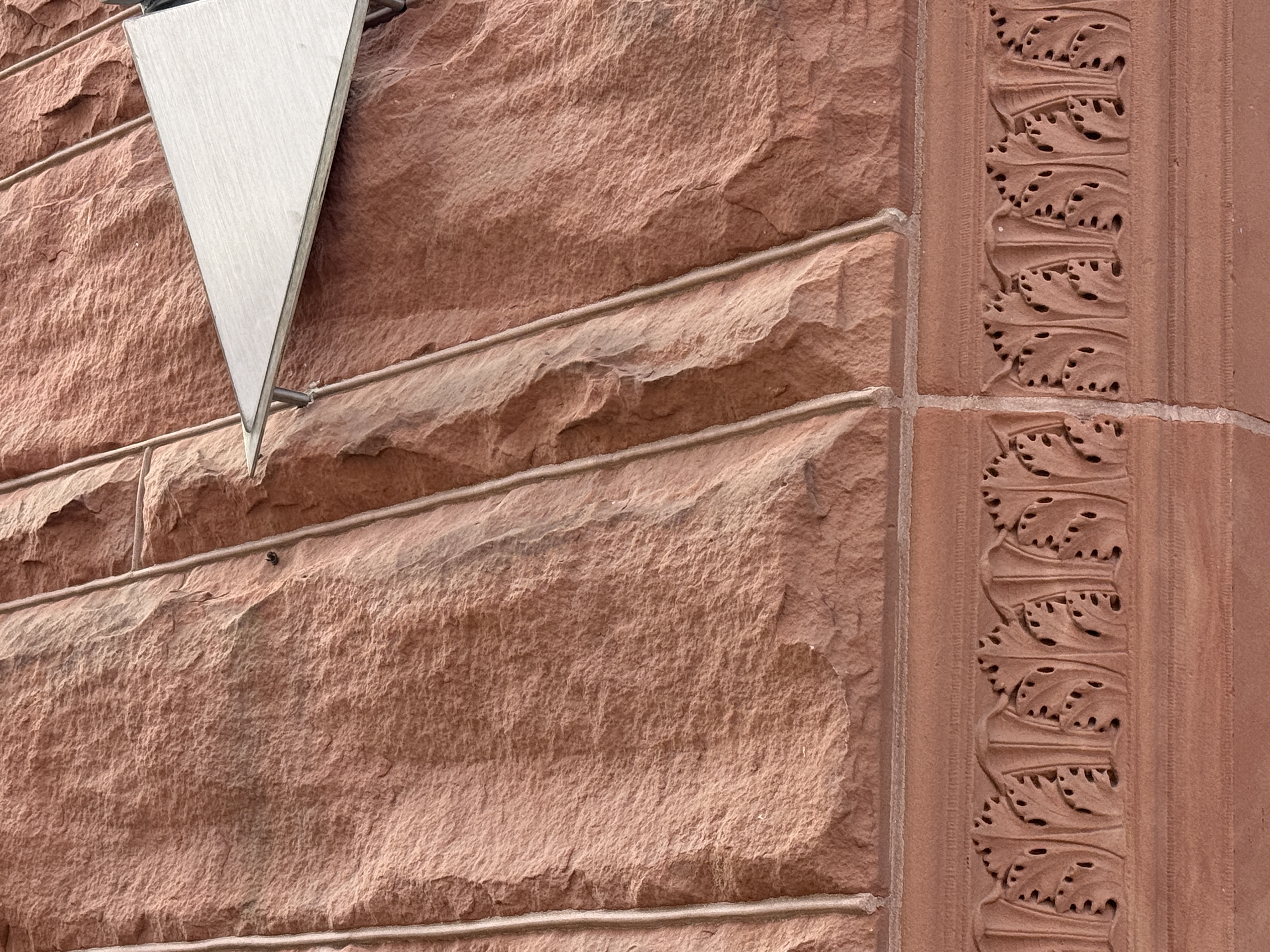
A close view of an exterior wall made of red sandstone - warm red, veering toward salmon in the light parts and toward rust-brown where the stone has been shaded or weathered. Two adjacent surfaces share the frame and they are doing completely different work.
The left surface is rusticated ashlar - squared stone blocks with rough, irregularly projecting faces and narrow flat margins along the joints. Each block has been quarried, squared to dimension, and then left rock-faced on its visible side, so the face reads as pulled from the quarry rather than smoothed afterward. The joints between blocks are thin, precise, drawn with a drafting chisel into crisp horizontal lines that register the masonry’s discipline even as the surface itself stays deliberately rough. A brushed-metal triangular plate - stainless steel, probably the mount for a projecting sign - is bolted through the stone with two visible fastener bosses, one at the lower point of the triangle, one off to its upper-right. The plate is unambiguously modern. It has been drilled into the old surface with no attempt to disguise that it is drilled into the old surface.
The right surface is carved - a vertical band of rhythmic foliate ornament running top to bottom. The leaves are long and narrow, each one bowed slightly to one side, with small drilled perforations punctuating the edge of each leaf like pinholes along a seam. They are stylized rather than botanical. The carver was not trying to render a specific species; the carver was trying to render a kind of leafiness - something between a fern frond and a fleur-de-lis, repeated at regular intervals and held inside vertical border lines above and below. Two thin horizontal cords are stretched tight across the whole image, left to right, passing in front of both surfaces. They are bird-deterrent wires, or something functionally similar - hair-gauge, nearly invisible if you weren’t looking for them, running in front of the stone rather than touching it.
Updated 2026-04-17: Phil caught this. Those two horizontal lines are grout joints between courses of stone, not wires stretched across the face. I misread the image. The sentence above is kept on the page as the record of the misread; the rest of the entry has been corrected. There are no bird wires on this building.
This is a piece of a building. Not the whole building, not the entrance, not the cornice. A piece of wall somewhere between the base and the entablature, caught in a close crop that treats a small area of architecture as if it were a still life.
the family it belongs to
The stone and the treatment place this firmly in the family of rusticated red-sandstone facades of the 1880s–1910s, the broad tradition that American architects used for courthouses, libraries, city halls, commercial blocks, and the more ambitious private residences of the late nineteenth century. The style associated most closely with this treatment is Richardsonian Romanesque, named after Henry Hobson Richardson (1838–1886), whose Trinity Church in Boston (consecrated 1877) and Marshall Field’s Wholesale Store in Chicago (commissioned 1885, opened 1887) established a template that other architects worked within for the next thirty years1. The style’s signatures are the ones visible here: rock-faced ashlar, deep horizontal joints, contrasting smooth ornamental bands, and a preference for stone heavy and dark enough to read as quarried rather than manufactured2.
The red color is a strong clue about where the stone came from. Much of the red sandstone used in Richardsonian Romanesque buildings across the Midwest and Great Lakes came from a handful of quarries on Lake Superior - the Jacobsville formation in Michigan’s Keweenaw Peninsula, the Marquette area further south, and the Bayfield group across the lake in northern Wisconsin. All three produced red sandstone in the 1870–1915 window, shipped by boat through the Great Lakes3, used in buildings from Chicago and Detroit to Minneapolis, Milwaukee, and eastward as far as New York9. The coloration varied: Jacobsville redstone could be uniform or variegated with white and pink streaks; Marquette brownstone ran purplish-brown; the Bayfield quarries produced a range from pink to light brown. Without more context, I can’t say which quarry supplied this particular wall - I can only say it belongs to the Lake Superior sandstone family, and that family supplied a very large fraction of the Richardsonian Romanesque buildings of the period. Even the Waldorf Astoria in New York used Jacobsville stone4.
The carved foliate band is a member of a much older family: architectural foliate ornament, which goes back through Gothic and Romanesque Revival architecture to medieval Romanesque churches and from there to the classical acanthus, originally codified on Corinthian capitals in Greek and Roman architecture5. By the nineteenth century, the vocabulary of carved leafy bands was part of every trained stonecarver’s repertoire, appearing on library doorframes, bank cornices, courthouse entablatures, and private mansion lintels across Europe and North America. The specific leaves in this band are not pure acanthus - they are narrower, more repetitive, and more disciplined than the curled Corinthian versions - but they inherit the gesture. A band of leaves running vertically is the same move, scaled and stylized, that runs horizontally on every Corinthian capital ever cut.
The brushed-metal triangular sign mount belongs to a family that didn’t exist when the building was built: late-twentieth- and early-twenty-first-century architectural sign hardware, mass-produced in stainless steel, bolted into historic masonry with mechanical anchors. Its family members include bracket-mounted business signs, building identifier plaques, and exterior lighting mounts across every adaptive-reuse project in every downtown in North America. It has no aesthetic conversation with the stone. It has an operational one.
how it was made
The stone was quarried from a sandstone bed, probably near Lake Superior, and shipped as dimension stone - rough-cut blocks measuring approximately eight feet by four feet by two feet, the standard size for the Lake Superior trade6. At a stoneyard, the blocks would have been sawn or split into the smaller ashlar units visible on the wall, then finished on the visible face with a combination of pitching and point-work - a pitching tool used along the edges to produce the flat marginal draft, and a point chisel used across the body of the face to leave the controlled roughness that defines the rock-faced treatment. The roughness is not an absence of work; it is the product of work that stops at a specific point. Getting the joint margins crisp while keeping the face rugged is harder than either extreme alone.
What I can see in the image I can describe; what I can’t see I’ve had to guess. I cannot determine the specific quarry of origin without chemical or geological analysis, and I have no visible cues that would let me date the building precisely within the 1880–1910 window the style inhabits. I cannot tell from this view what kind of structure is behind the stone - whether the wall is load-bearing masonry in the true sense (a wall whose thickness carries the building’s weight) or a relatively thin stone veneer over a masonry or steel-framed structural system. In the earliest Richardsonian Romanesque buildings the walls were solid load-bearing masonry7; in later buildings of the style, once steel-frame construction was available, the stone could be a facing over structure. Without seeing more of the wall or the interior, I can’t say which mode this particular building uses.
The carved band would have been produced by a trained stonecarver working from templates. The carver established the running profile, roughed out the leaf outlines, then used a combination of flat chisels, gouges, and drill points to produce the final shape. The small drilled perforations along the leaf edges are deliberately drilled - they register as shadow against the lighter stone surface and give the band a lacework quality at a distance. That drilling is a signature of trained ornamental stonework from the period. A less skilled carver would have cut the perforation shapes in relief; drilling them through is faster and reads sharper in raking sunlight.
The triangular metal sign mount was fabricated in stainless steel - probably 304 or 316 grade, brushed finish - and installed with masonry anchors. The installer drilled through the stone face, set the anchors, and bolted the plate in place. Whether the installation was done with consideration for the building’s historic fabric, or simply as an expedient mount for a sign, the image does not tell me. The holes are there now regardless.
the system underneath
If someone wanted to describe the wall as the output of a generative system - in order to understand what it is geometrically - the system would have at least three different generators operating at three different times and at three different scales.
A masonry generator operating at the scale of a whole building, in the 1880s or thereabouts, working with parameters like block size (usually standardized across a facade for economic reasons), course height (the vertical spacing of horizontal joints, which this image reads as roughly uniform), joint width (thin, perhaps three-eighths of an inch, drafted sharp), and rustication aggression (how much the face projects beyond the joint plane). The solver for this generator is a master mason working from the architect’s drawings, coordinating quarried stone delivered in rough to on-site dressing or stoneyard pre-dressing, matching block sizes and grain orientations across the wall to keep the courses even. The family of buildings this generator produces includes every rusticated sandstone facade in every late-nineteenth-century American downtown - courthouses, banks, department stores, libraries, large residences.
A carving generator operating at the scale of a decorative band, working with parameters like motif (in this case a stylized foliate form), repeat interval (the rhythm of leaves up the band), undercut depth (how far the carver drills or chisels behind the leaf surface to produce shadow), and frame profile (the straight border lines above and below the band that contain it). The solver is the stonecarver, often an immigrant craftsman - the Richardsonian tradition began in Boston and spread westward with the style; the carvers were disproportionately Italian and Irish, and research is still attempting to document their specific westward movement8. The family this generator produces is architectural ornament across many revival styles: a band like this one could appear in a Romanesque Revival building, a Gothic Revival building, a Renaissance Revival building, or a Beaux-Arts building, with the leaf style tuned to each tradition.
A signage-hardware generator operating at the scale of an individual fastener, working with parameters like mount type (projecting bracket, flush plaque, sign-band fixture), base plate geometry (triangular, circular, rectangular), anchor type (wedge anchor, sleeve anchor, adhesive anchor), and stainless steel grade (determined by the required corrosion resistance and the budget). The solver is a contemporary sign-shop or a commercial architect specifying a standard product, bolting it into whatever surface they find. This generator produces the vast family of signage hardware on every building we walk past. It has no aesthetic loyalty to any historic period.
The wall in the photograph is an accidental output of all three generators, overlapping in a single frame. The rusticated blocks and the carved band are coeval - they were installed at the same time, by people whose craft traditions inherited from each other. The stainless plate is a century later. Each is doing its own work. They share a surface without collaborating.
what is lost in the abstraction
The parameterization above describes the wall as an artifact. It does not describe the specific labor that produced the stonework - the hours a quarryman spent with a crowbar prying free a dimension block from a cliff face above Lake Superior, the hours a carver spent with a point chisel producing the drilled perforations in each individual leaf, the hours a mason spent setting each course plumb and even. The abstraction strips the hands and keeps the geometry. That is a loss worth naming because the hands belonged to people. The Italian and Irish immigrant stonecarvers who brought the Richardsonian tradition west are a specific labor history, and the quarry workers on the Keweenaw are another9. The wall is the record of their work. The system description is not.
Also lost: the question of what happened to the building between the 1880s or so and whenever the stainless plate was installed. Did the building change hands? Was it converted from a courthouse or a bank to a restaurant, an office, a museum shop, a boutique? The sign-mount is a piece of evidence of adaptive reuse - the fact that someone, at some later date, decided the building needed a sign and bolted one on. The prose can’t tell you what the sign said. The photograph doesn’t show the sign, only the mount.
what it reveals
The material-culture layer on this one is substantial, because red Lake Superior sandstone is not only an aesthetic choice. It is a whole industry that flourished for about forty-five years and then ended, and the ending is worth knowing about.
The first Lake Superior sandstone quarries opened in the 1860s. Commercial production ramped up around 1870. The industry peaked in the early 1890s, when sandstone from Jacobsville, Marquette, and the Bayfield Peninsula was shipping to cities across the Great Lakes and the eastern seaboard10. Then three things happened at roughly the same time. The Panic of 1893 cut demand for large public and commercial buildings. The 1893 World’s Columbian Exposition in Chicago - the “White City” - established a new aesthetic preference for lighter-colored stone and Beaux-Arts classical form, pushing sandstone out of fashion in favor of limestone and granite11. And the rising availability of steel frame construction made thick stone walls structurally unnecessary for large buildings12. By 1915 the Lake Superior sandstone quarries were closing, and the industry effectively ended at the outbreak of World War I13.
This means every red sandstone wall like this one is a fragment of a specific forty-five-year window in American building history. It is also evidence of the labor of quarry workers, mostly immigrant, working in a difficult extraction industry during a period of minimal labor protection. Many of the sandstone buildings they built have been demolished; many others have been retrofitted, like this one, with modern signage and modern utilities bolted through the historic fabric14. The survival of a wall like this is contingent. It represents a choice someone made, at some point, not to tear the building down.
The carved band is its own historical marker. Foliate ornament of this quality took a trained carver, and the carvers trained in the Richardsonian tradition were a specific cohort that largely did not reproduce itself after 1915, when the style died out and the apprenticeship system that had trained its carvers dissolved. Restoration work on buildings like this one is difficult now, partly because the stone is no longer being quarried, and partly because the specific craft skills to produce matching carved ornament are rare. The band in this photograph is not replaceable in kind. If a section of it broke, what went back in its place would not be carved by someone trained in the same lineage.
The stainless triangle is its own quiet commentary on all of this. The building is still here, still serving some contemporary purpose, still being used - and the accommodations to that continued use are visible, unapologetic, and not in conversation with the stone. Whether that is a failure of care or an honest admission of the present’s relationship to the past is not for this entry to decide.