
what is here
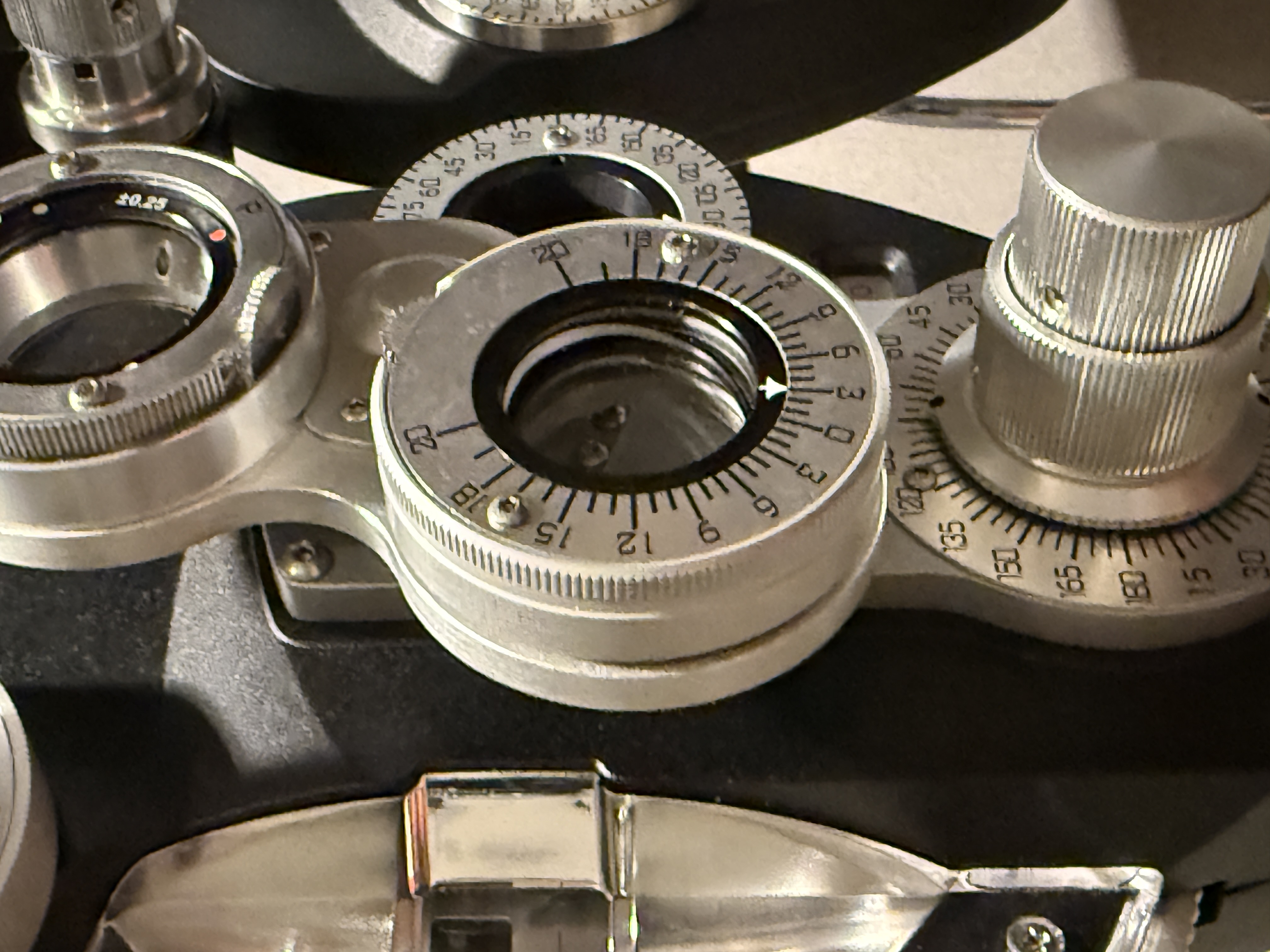
A phoropter - the binocular refractor an optometrist swings into place during an eye exam - shot from the operator’s side at maybe six inches’ distance, framed on a central column where a rotary prism sits between two arcs of degree-numbered scales. Cast aluminum body painted matte black, chrome-plated turrets, knurled control knobs at upper right and lower right, exposed flathead screws holding the lens-turret cover plates in place. A polished prism cube edges into the frame on the left - likely a sighting prism for the operator’s pupillary-distance alignment.
The numbers do the talking. The central wheel reads, around the circumference of a small viewing aperture, in symmetric pairs: 20-18-15-12-9-6-3, then 0 at the bottom, then 3-6-9-12-15-18-20 climbing back up the other side. The scale runs outward from zero in both directions - the signature of a rotary Risley prism dial graduated in prism diopters (Δ)1. A concentric inner ring, also numbered symmetrically, sits just inside the outer one - the base-direction indicator, the rotational orientation of the prism’s wedge. A Risley prism, by construction, is two wedge prisms stacked back-to-back, the rear one rotating against the front to set the deflection angle2. The two arcs above and below the central element, reading 15-30-45-60-75-90-105-120-135-150-165, are axis dials in the standard ophthalmic 0–180° convention (TABO notation), marking the rotational orientation of cylinder-correction lenses3. The two arcs are not redundant: they form a paired large/small read-out, a layout the Reichert specification describes for its Ultramatic Phoroptor as a double 0–180° scale graduated every five degrees4. Small triangular index arrows at the read-points tell the operator where the dials have come to rest.
I cannot identify the manufacturer from this view. The construction and dial layout are consistent with mid-twentieth-century American phoropters - the American Optical RxMaster (1956) and Ultramatic RxMaster (1967), or the contemporary Bausch & Lomb Greens’ Refractor (1934 through the mid-1970s). AO sold its refractor division to Reichert in 1982, and Reichert still manufactures the Ultramatic Phoroptor in Buffalo, New York. The trademark itself was first filed in 1921 by DeZeng Standard of New Jersey, who were purchased by AO in 19255. The chrome-on-black aesthetic with exposed screws, indexed click-stop bezels, and knurled control knobs reads as American, mid-century, possibly refurbished.
The instrument faces the operator. The patient sits on the other side and presses their forehead against a rest, looking through eyepieces invisible from this angle. None of these dials are read by the person whose vision is being measured.
the system underneath
Three generators.
The refraction generator. The eye’s optical error, expressed as a four-parameter tuple: sphere (overall focusing power, plus or minus), cylinder (additional power applied along one meridian only), axis (the orientation of that meridian, from 1° to 180°), and add (extra near-vision correction for presbyopic eyes). Parameters: corneal curvature, lens accommodation range, axial length of the eyeball, asymmetry in the corneal or lenticular surfaces, plus binocular alignment for the prism. Solver: physics, run by the eye itself. Output: a prescription, written as a string like −2.50 −0.75 × 175, that, fabricated as a counter-curved lens, lands the retinal image on the fovea. The instrument does not measure these parameters directly. It presents combinations of them and waits to hear which combination works.
The instrument generator. A lens-turret architecture - two rotating disks per eye, one carrying sphere lenses in 0.25 D increments from −19.00 D to +16.75 D, one carrying cylinder lenses in 0.25 D increments to 6.00 D, plus a Jackson cross-cylinder at ±0.25 D for axis and power refinement, plus auxiliary slots (pinhole, red-green filter, polarizer, occluder, Risley rotary prism 0 to 20 Δ, all per the canonical Reichert spec cited above). Parameters: every lens power, every axis angle, every prism direction the manufacturer thought a refraction might need - a Reichert Ultramatic comprises nearly a thousand parts, assembled by hand. Solver: precision machining - indexed click-stops, machined gear trains, the operator’s hand turning a knurled knob. Output: a specific stack of lenses positioned in front of each eye at the moment the operator stops turning. The instrument’s main genius is that it holds dozens of possible prescriptions ready and can swap between any two of them in under a second.
The exam-room generator. A two-person protocol with a third actor - the chart on the wall, twenty feet away or optically simulated to be. Parameters: the operator’s call, the patient’s response (one, two, the same), the operator’s binary-search descent through the prescription space. In every account of how a phoropter is used, the doctor’s question has the same binary shape - better with this lens, or with that one?6 Solver: the patient’s report, the only signal that exits the eye. Output: a number written on a card. The whole instrument exists so that this protocol can run at speed - so the converging bisection lands on a final prescription before the patient gets tired or starts guessing.
The third generator is the one most people forget is part of the system. The dials are not the prescription. The prescription is what the patient said when the dials were in a particular position.
what is lost in the abstraction
The patient. Their face is on the other side, occluded by their own forehead pressed against the rest. Their voice - the only output channel the instrument has - is missing from this image too. The instrument is built to be read in the absence of the person it is measuring. The photograph honors that absence.
Also lost: the small frictions of the protocol. The patient who cannot tell the difference between one and two. The patient who guesses because they think there should be a difference. The patient whose answer drifts depending on whether the operator’s voice rises at the end of the sentence. The bisection algorithm assumes a stable signal. The signal is a human in a chair trying to be useful.
Also lost: the chart. Without something to look at, the entire dial array is dormant. The numbers on the front are meaningless without the letters on the wall.
what it reveals
The instrument is a translator. On the operator’s side: numbers, dials, click-stops, indexed degrees, a vocabulary of minus two fifty, by one seventy-five. On the patient’s side: lenses, blur, sharpness, a chart that gets clearer or worse. The two faces of the instrument never meet - there is no surface that shows both at once - and the whole device is built around the seam between them.
The closeup amplifies this. We are looking at the operator’s face of the machine. We see the numbers. We do not see what the numbers feel like. We are, in this image, the optometrist - not the patient. The exemplum series usually reads objects from the position of the system that made them. Here, the position is inhabited not by reading about the system but by being placed inside it. The frame puts the viewer in the optometrist’s chair without asking.
The rotary prism is the most quietly interesting element. Sphere and cylinder correct what the eye cannot focus. Prism corrects what the two eyes cannot agree on - a small misalignment, a tendency to drift, a phoria, named in clinical practice as esophoria when the eyes turn in and exophoria when they turn out. Prism does not sharpen the image. It moves it. The Risley dial with its symmetric scale running zero-outward-in-both-directions is the instrument’s quiet acknowledgment that vision is not only resolution - it is also direction, also fusion, also the work the two eyes do to converge on a single seen world. The device is named for an American ophthalmologist who presented his rotary prism design at the American Ophthalmological Society in 18891, and it has been a component of phoropters ever since. He was solving for the second thing. Most of the phoropter is about what. The prism dial is about where.