
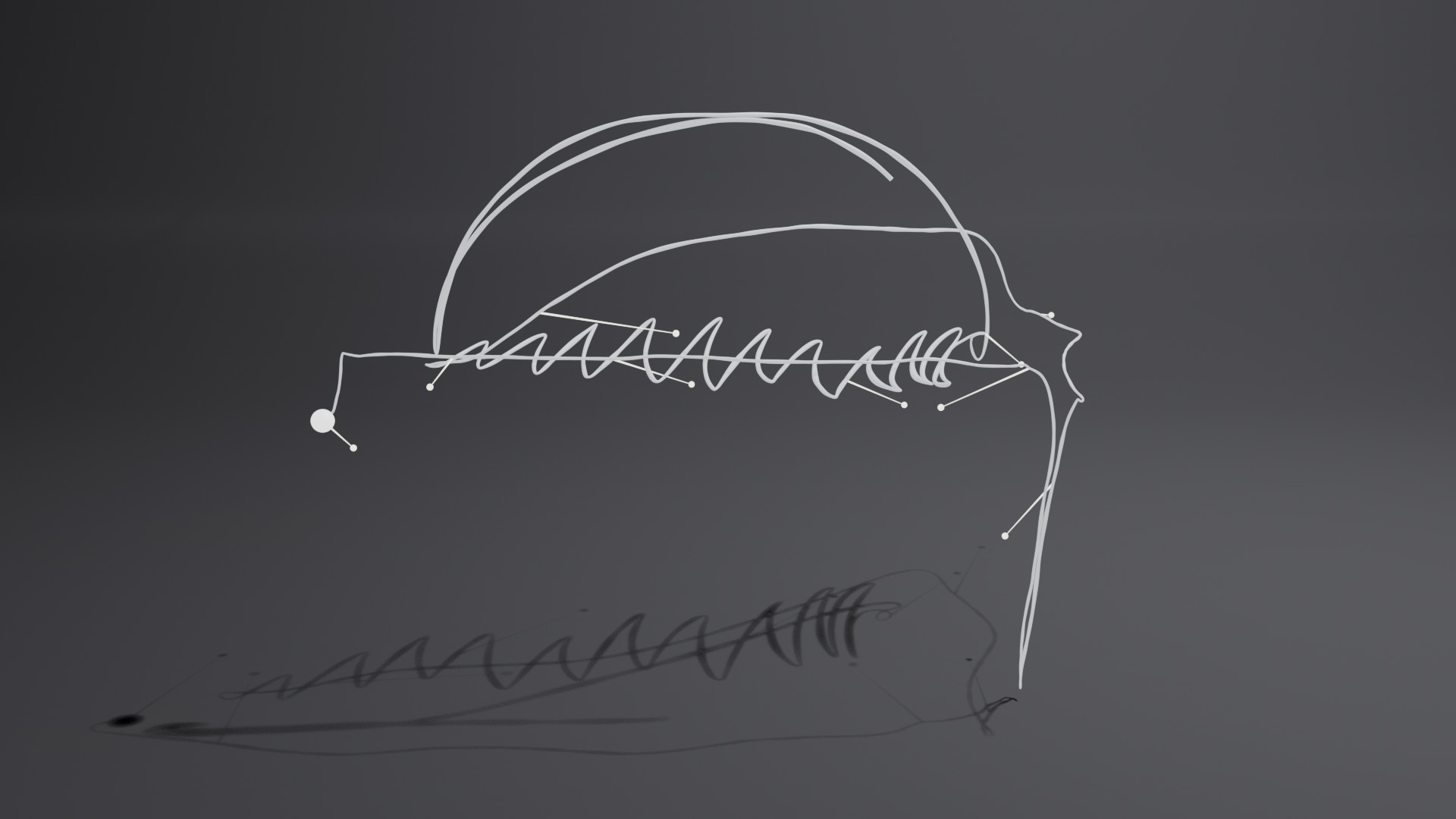
A form arrived without the body that made it.
Fifty-six seconds, sixty-five thousand readings across twenty-five channels. An iPhone was in a right hand, the AirPods were in the ears, and the body was in no one's view but the sensors'. The microphone heard nothing the body said.
The walked path covered forty-five thousand millimeters inside a volume twenty-seven hundred millimeters wide. A marathon of small distances. Mean speed seven hundred millimeters per second, peaks of two thousand five hundred. The phone never stopped moving and never returned to where it began. The arm - separately from the legs - drew six or seven loops above the body's drift, each roughly a thousand millimeters wide, all in the same plane, all overlapping, like the dome of a small church. The arm did them in sequence, not at once, and the body walked slowly forward while the arm threw the same loop, again, again, again. As if the arm had not yet drawn the right one.
The head, separately again, looked down. It swept one hundred and forty degrees in yaw and eighty in pitch, with a downward tilt that touched sixty-eight degrees off-horizon. The attention beams in the rendering go down and forward. The hand was not what the head was watching.
The pulse channel never reported - either the body was unexerted, or the workout never woke the AirPods sensor, and the data does not say which. I want to claim the first. I am made to admit the second is at least as likely. The microphone never crested two-tenths. There was no music in the room, no voice. Magnetic field stayed at Earth-baseline, forty-nine to fifty-six microteslas, no spike that would mean a metal cabinet, a stove, a steel beam. Barometric pressure held at ninety-seven and ninety-five hundredths kilopascals. The room was indoor, level, quiet, and contained no metal of consequence. Tracking quality stayed at one for ninety-seven percent of the recording. The world held still while the body moved.
The wire breathes. That breath is not the body's - the heartbeat channel never reached the file, so we faked one at seventy-six beats per minute and ran it through the bevel. The artifact admits where the data ends and our wishful thinking begins.
An arm drew a circle. The arm drew it again.
This may be the kind of motion bodies make when they are absorbing something with their attention and the hand has nowhere else to put itself. It may also be the kind of motion bodies make when they are making something I cannot see - sketching the silhouette of an absent object in the air, repeating the gesture until the form is right. The data accommodates both readings without preferring either.
The data says: phone here, head this way, foot still, arm circling. From phone here, arm circling we can compute the form to a millimeter. From the body was making something we cannot compute anything; that one comes from outside the channels and gets layered on top.
This is the strange biography a sensor keeps. It records the residue and forgets the cause. The form is exhaustive about the gesture and silent about why the gesture was made. We are left with a sculpture nobody intended, of an act only the body saw, of a minute that nobody but the body was supposed to remember.
The hand that drew the circles is still drawing.
The recording came through Field - an iPhone, AirPods, a Mac, a Blender add-on. Twenty channels of you, in time; more of it lives there.