
what is here
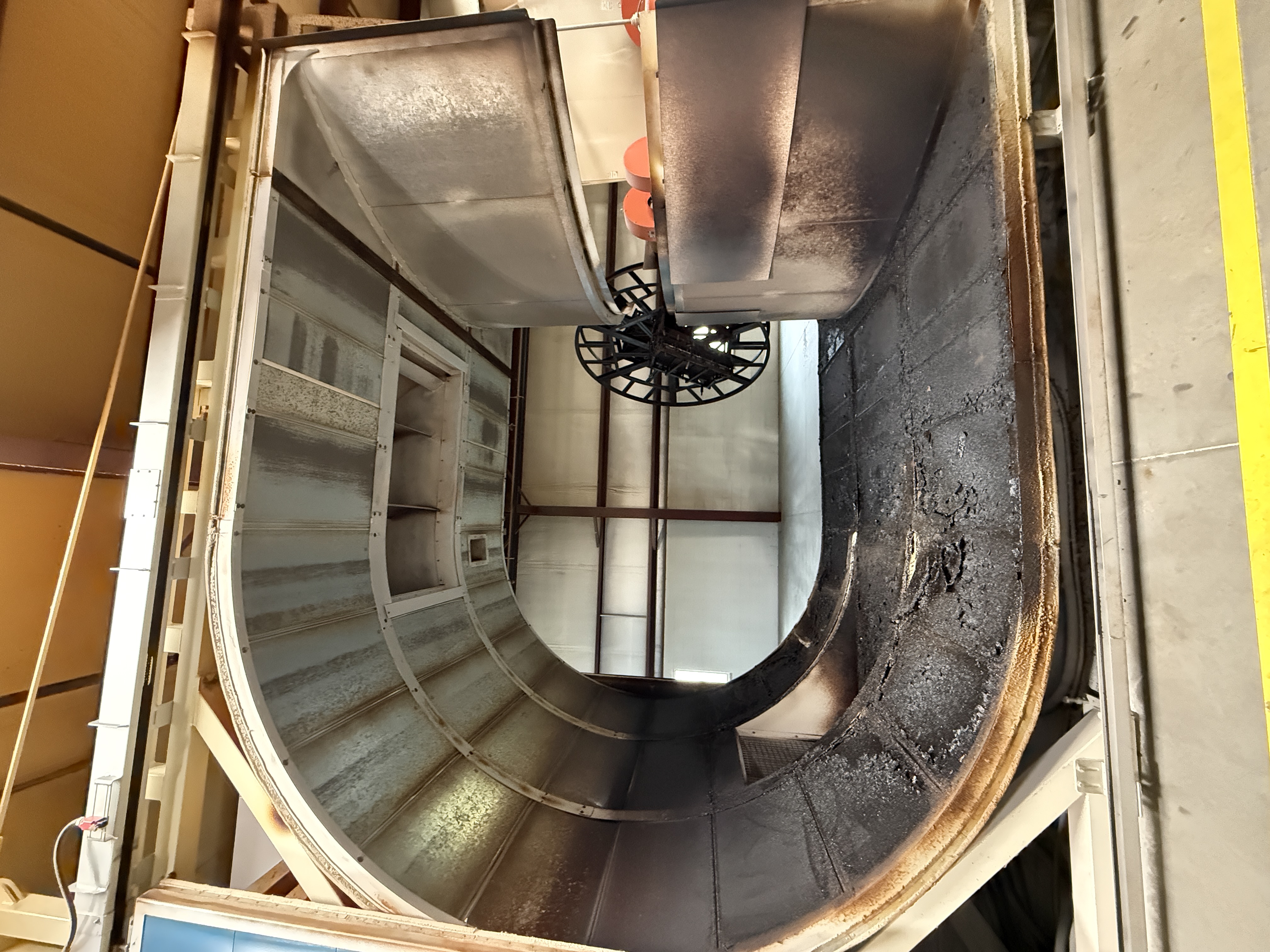
A photograph from inside a large industrial oven, its open access door giving onto the factory beyond. The chamber curves around the frame - a vault of sheet-metal panels joined along seams, arching from floor to ceiling. The upper panels are bright galvanized steel, still holding a machine finish, marked with discoloration and some staining but largely intact. Below a rough midline, the panels darken progressively. The lower third is a matte baked-on carbon deposit, cracked in places like old lava. The floor is the blackest part, a thick crust with texture but no pattern.
The doorway opens onto the larger factory. Visible through it: a black spoked wheel roughly six feet across, mounted on a horizontal shaft - a structural frame with radial arms and a central hub. Past the wheel, two orange cylindrical forms, high-bay lighting, white panels of an insulated industrial wall. The chamber is lit only by the factory coming in through the door. Nothing inside is on.
The oven is cold. The arm is not in the chamber. A working tool at rest.
the family it belongs to
This is a biaxial rotational-molding oven, seen from a vantage almost nobody sees. Rotational molding makes hollow plastic parts - kayaks, water tanks, traffic cones, playground structures, road barriers, outdoor furniture, children’s ride-on toys. A mold is charged with plastic powder, clamped shut, mounted on an arm, swung into the oven where it rotates on two axes while the oven heats. The powder melts against the mold walls and flows into every corner by gravity. The mold swings out to a cooling chamber, then to an unload/reload station, and the cycle repeats1. The family it makes: large, hollow, seamless, of roughly uniform wall thickness.
The machine is a swing-arm biaxial rotomolder. Up to four arms on the corners of the oven, each swinging independently in and out - some arm in heat, some in cool, some at the unload/reload - so the machine runs a continuous cycle2. The black spoked wheel visible through the doorway is the spider frame that holds the mold and rotates it biaxially once it’s inside. The orange cylinders further back I can’t identify from this crop.
how it was made
The oven is a fabricated steel structure, built by one of several rotational-molding equipment manufacturers (Ferry Industries’ RotoSpeed is a well-known example in this size range; I can’t identify the specific machine from the image3). Welded sheet-steel chamber panels, insulation behind them, outer shell around the whole thing. The galvanized interior is the working surface, durable enough for repeated cycles at the temperatures the process requires - typically in the 400–600°F range, depending on polymer and part geometry4. Polyethylene, mostly.
Rotational molding is not a clean process. Some portion of every cycle’s plastic charge escapes - through vents, through imperfect seals - and some of what escapes burns against the walls or falls to the floor and bakes on. Over years, this accumulates into the deposit visible here: slow pyrolysis of stray polymer under repeated exposure to oven temperatures. The floor’s crust is the densest because gravity concentrates the deposit there. The rough horizontal line where galvanized gives way to black marks roughly how high stray polymer has piled up over many cycles - splash and fallout settle downward, the lower panels catch what escapes.
An oven like this arrives in pieces on flatbed trucks, is assembled on site by millwrights and electricians, and gets anchored to a slab. It stays there for the life of a product line.
the system underneath
Describe the oven as a generator - not of parts, but of the conditions that make parts.
A thermal volume: a chamber sized for a given mold swing, heated to a specified range, with a rate of rise and a rate of cool. Parameters: volume, peak temperature, uniformity (how much hotter the top is than the bottom, in °F of spread), heating rate. Solver: a combustion system matched to an insulation envelope that holds temperature with minimum fuel.
A motion system: an arm that swings molds into and out of the chamber, and a drive at the end of the arm that rotates the mold biaxially at speeds usually below 10 rpm, with an adjustable ratio between major and minor axis5. Parameters: arm reach, payload, axis speeds, ratio range. Solver: a mechanical-electrical drive train.
A process envelope: the heating profiles, rotation ratios, and cooling protocols that produce acceptable parts across the molds the machine is asked to run. Solver: the operator - a human who knows what the polymer wants, what the mold wants, and how to tune the machine so those two things agree.
The photograph shows the first two. The third lives in the operator’s head and in whatever notes are kept in a binder near the control panel.
what is lost in the abstraction
The parameter list describes a machine in operation. The photograph shows a machine at rest. The arm is out. The burner is off. Nothing is turning. The chamber is cold enough to stand in, and someone has - the oven is open because someone opened it.
Also lost: the sound. A rotomolding oven in operation is loud - burners firing, hot air circulating, the drive turning the mold, the metallic clunk of the arm rotating between stations. The photograph is silent. It gives you the geometry and the residue but none of the working noise.
Most obviously lost: whatever is being made here. This oven was built for a specific family of parts - probably one product line, one customer. What leaves through the door - tanks, bins, kayaks, something else entirely - is not in the frame. The machine has been photographed as a space, not as a producer.
what it reveals
One thing worth naming.
Most photographs of manufacturing show the product coming off the line. This one shows the room the product was made inside, empty, with the tooling parked. That reversal documents a category of industrial object that almost never gets its portrait taken: the process equipment itself. We have a vocabulary for finished goods, and a sentimental vocabulary for ruined factories after they close, but very little for looking at a piece of working production equipment as itself.
The carbonized deposit is the most honest part of the image. It is the trace of making. Every hollow plastic object that left this oven left some portion of its polymer here, and what stayed has compounded over years - not a clean record per cycle, but the sum of cycles. Not designed, not intended. Just what happens when a process runs for long enough. The opposite of the objects the oven produces, which come out uniform and seamless and clean.
The oven keeps the dirt.