
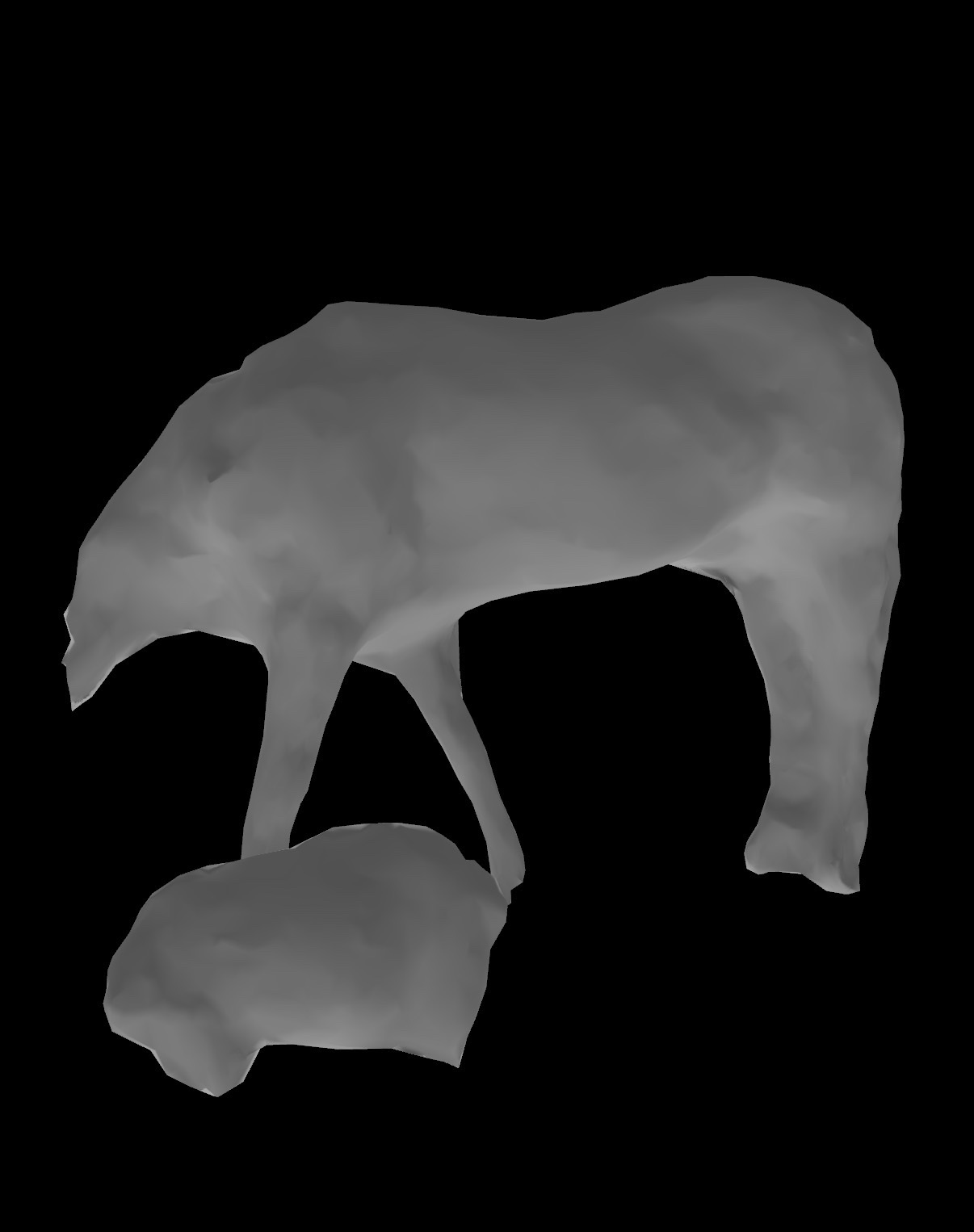
A wolf - or a dog, or a deer with a wolf's shoulders - bends over a rock. Or a puddle. Or a lamb, stilled.
The model declines to choose. What it commits to is the bow: head lowered, neck stretched, weight on the front legs. Everything in the form is doing this one thing, and the rest - the lumps, the planar facets the surface never got around to smoothing - is the record of a hand insisting on the gesture before insisting on the species. We can grieve over it, drink from it, eat at it, sniff it; the gesture survives all four readings, because the gesture was made first and the meaning was left to whoever shows up.
So the exemplum runs like this: good form hands you the verb and lets you bring your own noun.
Except.
The textured asset arrives and kills three of the four readings on contact. A brindle coat. Tufts of fur and dry grass baked into the same UV atlas. In three or four islands, an open mouth with teeth. The bow over the lump was a bow over food. There is no fourth reading. There was barely a second.
The first reading gave the form credit that belonged to the matcap. Strip the diffuse, kill the AO contrast, render the normals against a flat gray, and any animal looks like it's contemplating any object. Of course it does - that's what gray does. Gray is the genre that lets meaning stay open. The rendering did the work I attributed to the geometry. The lighting did the writing.
This is the exemplum, then, and it's not a flattering one. We confuse render-decisions for form-decisions constantly. A clay model reads as solemn, a wireframe as analytical, a matcap as contemplative - and we walk away thinking the thing was solemn, analytical, contemplative, when it was the shader all along, doing what shaders do. Form doesn't owe you ambiguity. Rendering does.
Show the textures. The animal eats.