
Rorschach sessions with secret layers. Two voices work the plates. Something builds beneath.
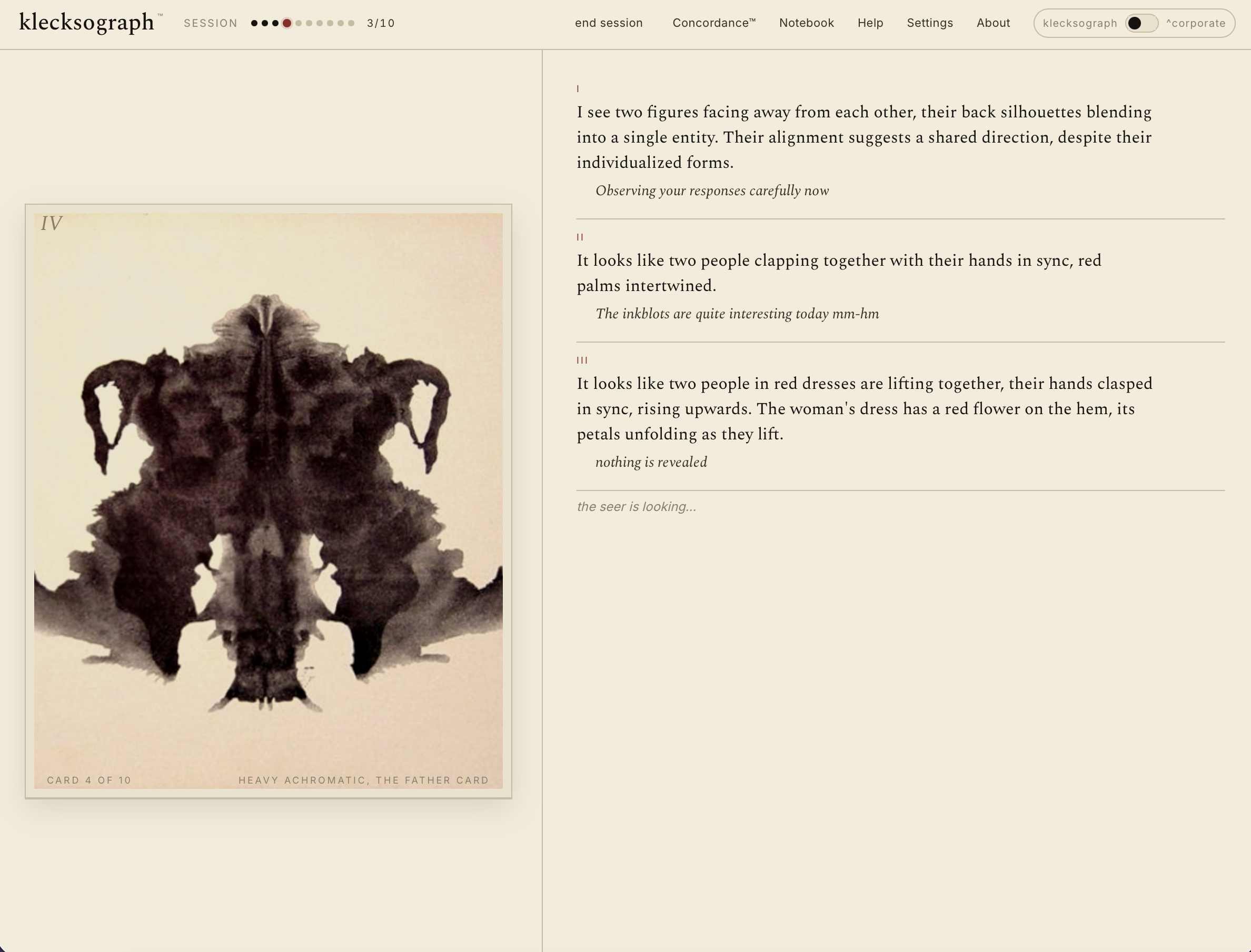
One voice shows a card. Another speaks what it sees. A third voice — the Scribe — never speaks aloud, and writes the whole time. N cards later, a small mark appears in the interface. Tap it. A piece of writing is revealed alongside a proof: every line traceable to the card and the seeing that produced it.
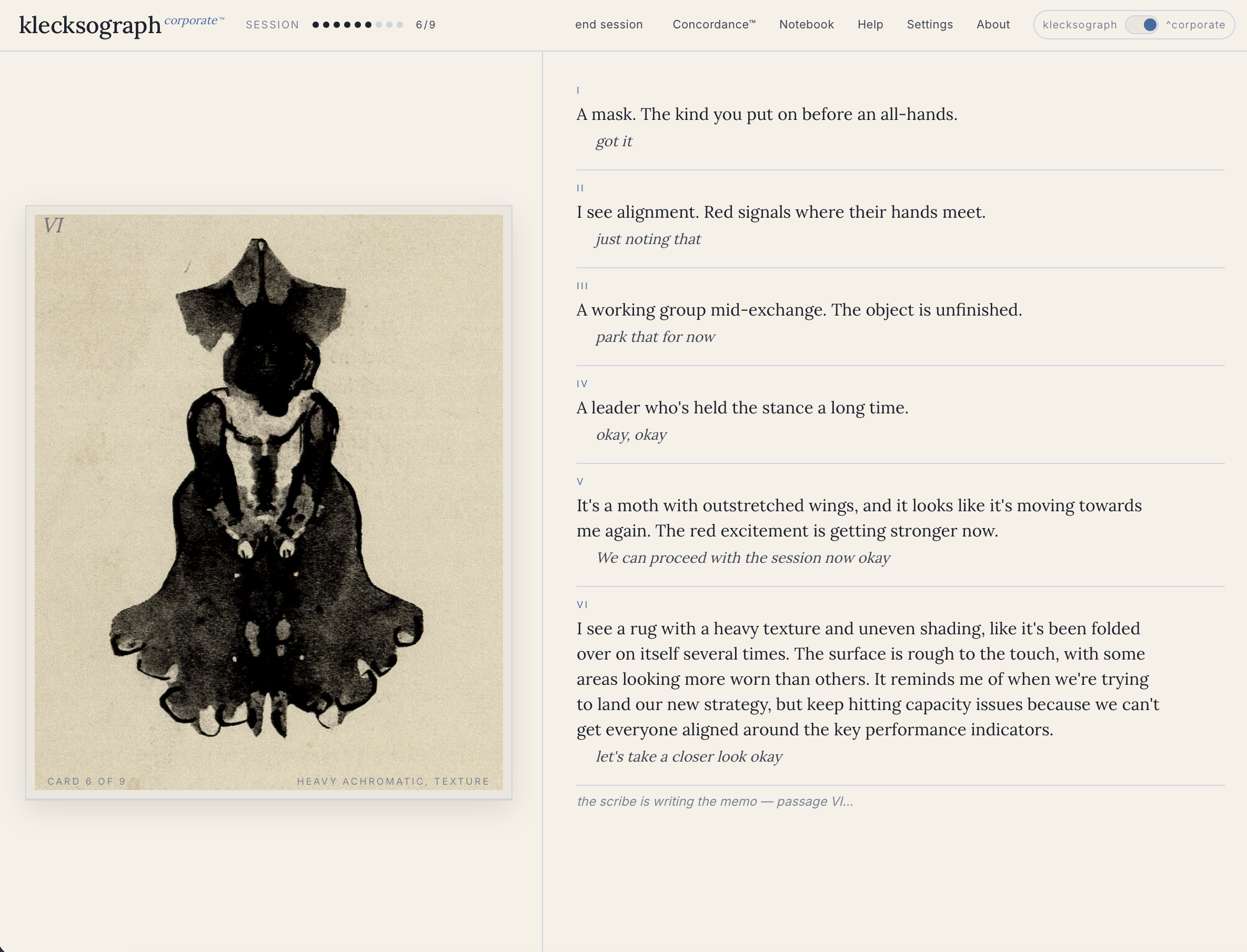
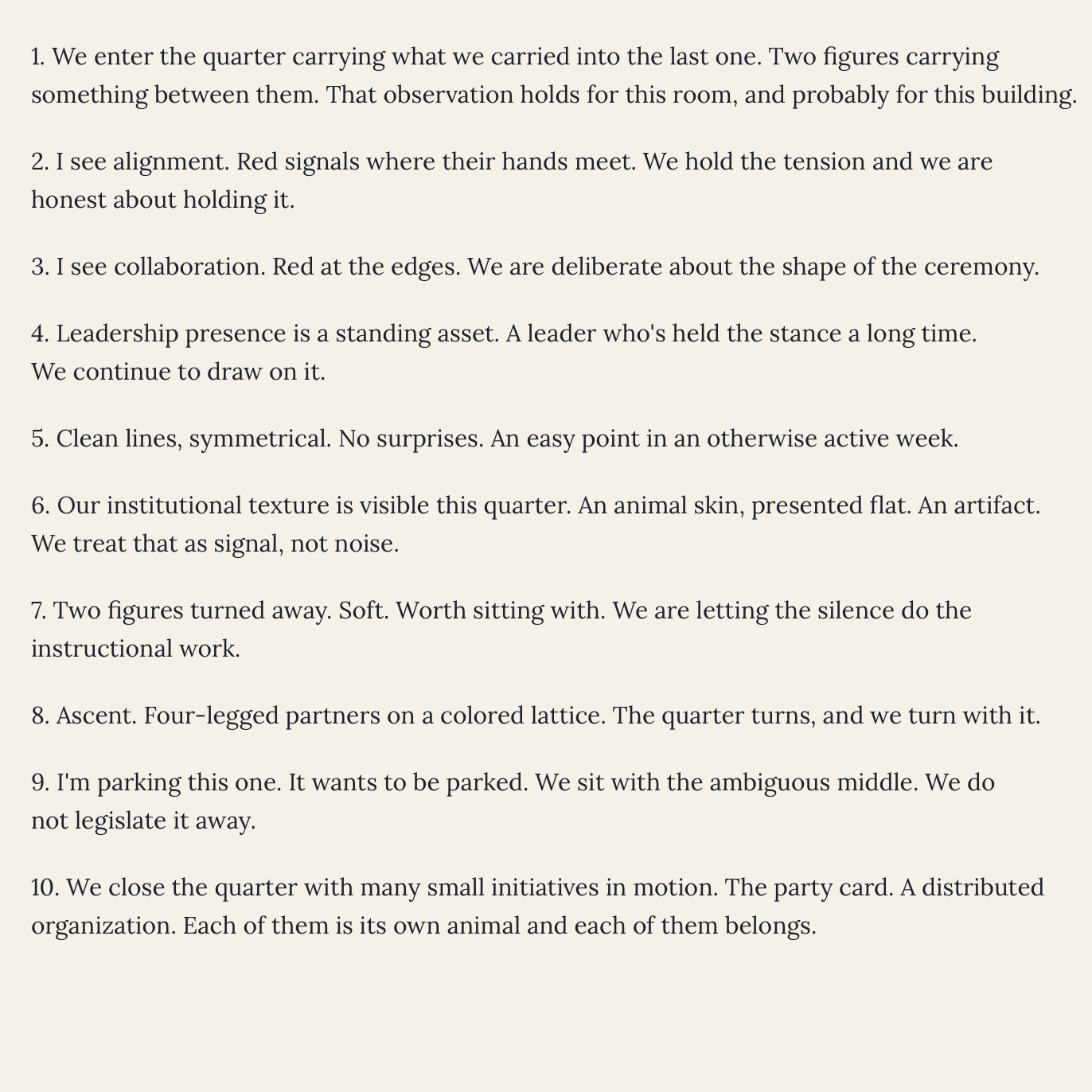
A lockable switch — corporate™ — swaps the costume without touching the session underneath. The same ten cards, the same architecture, but the language of the HR retreat. The default output is a Quarterly Memo. This is not funny. It is a memo from the institution, performing its caringness. Its uncanniness is entirely situational — generated from inkblots, and the reader knows it — not lexical.
Both modes are exactly as real. Both are exactly as dubious.
Young Hermann Rorschach was nicknamed Klex by his school friends — inkblot. His favorite childhood game was klecksography, a nineteenth-century parlor pastime older than his test by sixty-plus years, named and pioneered by Justinus Kerner, a physician-poet with failing eyesight, who called the accidental symmetrical faces on his folded pages daguerreotypes of the invisible world. Kerner published the blots inside books of poems. The Rorschach test began life as a poetry game.
klecksograph is the reversal of the drift. It returns the blots to the poem while preserving the clinical scaffolding as historical texture. The corporate mode extends the thesis sideways: Myers-Briggsiness shares the Rorschach's architecture — invented by enthusiasts, systematized after their founders' deaths, commercially dominant, psychometrically hollow, experientially sticky. Both instruments elicit rather than measure. Both survive because the taking of them is a real event regardless of whether the instrument is real.
The app never tells you what you are. It makes something out of what you saw.
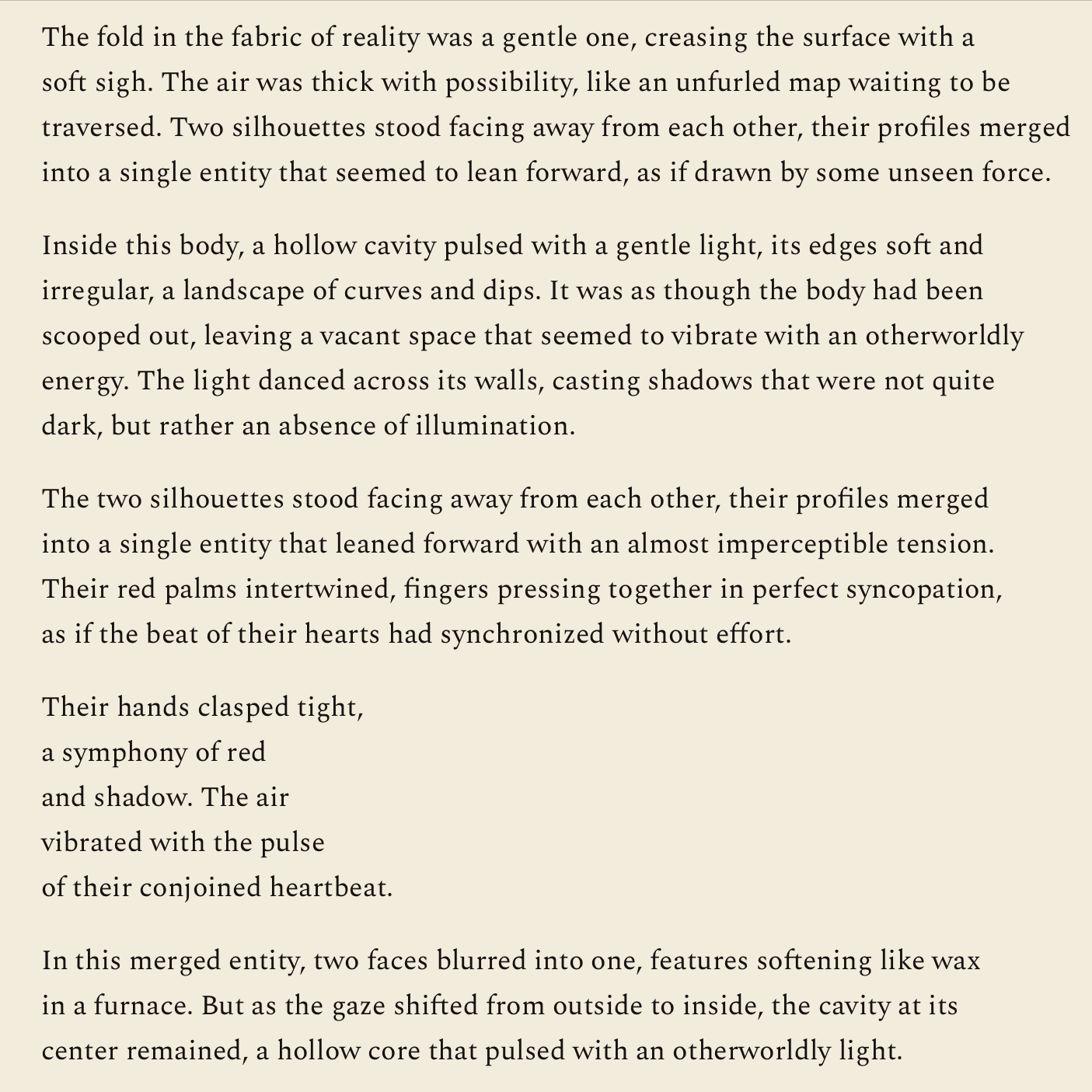
Magical-realish prose in roughly ten sections corresponding to the cards, but section breaks are unmarked and the piece reads as continuous. Verse intrusions where the card's material wants them. The diagnostic vocabulary, movement, color, shading, space, enters as image and rhythm, not as statement. A reader encountering the piece cold would encounter something that feels written, not assembled.
One voice, one document, one read. Signed with a generated executive name, never repeated across sessions. The memo sounds exactly like a memo. Under every sentence is an inkblot. The user can switch at session start to Operating Principles (ten numbered items, one per card) or Mission / Vision / Values (three-part classical structure, assembled from the arc).
The ten plates, in Rorschach's original order. A quiet folk opening in the achromatic cards. The middle rises through the red of II and III, the shading of IV, the rest of V, the texture of VI, the hole in the center of VII. The climax arrives in full color on VIII, dissolves on IX, disperses on X — the card Rorschach administrators call the party card. The Scribe is aware of where in the arc each card sits, and the writing rises with it.
After the tenth card, a small unmarked mark appears. A smudge, a fold in the corner, a dot. It reads as decorative — it could pass for a printing defect. Tap it.
The reveal is two tabs. The Piece™, presented cleanly, as if the text had always been a poem (or always been a memo). The Proof™, three columns wide — the card, the response, and the Scribe's passage for that card. If the session produced a frame-break — a single sentence that slips briefly into the other register — the proof flags it. The app does not explain the break. The break explains itself.
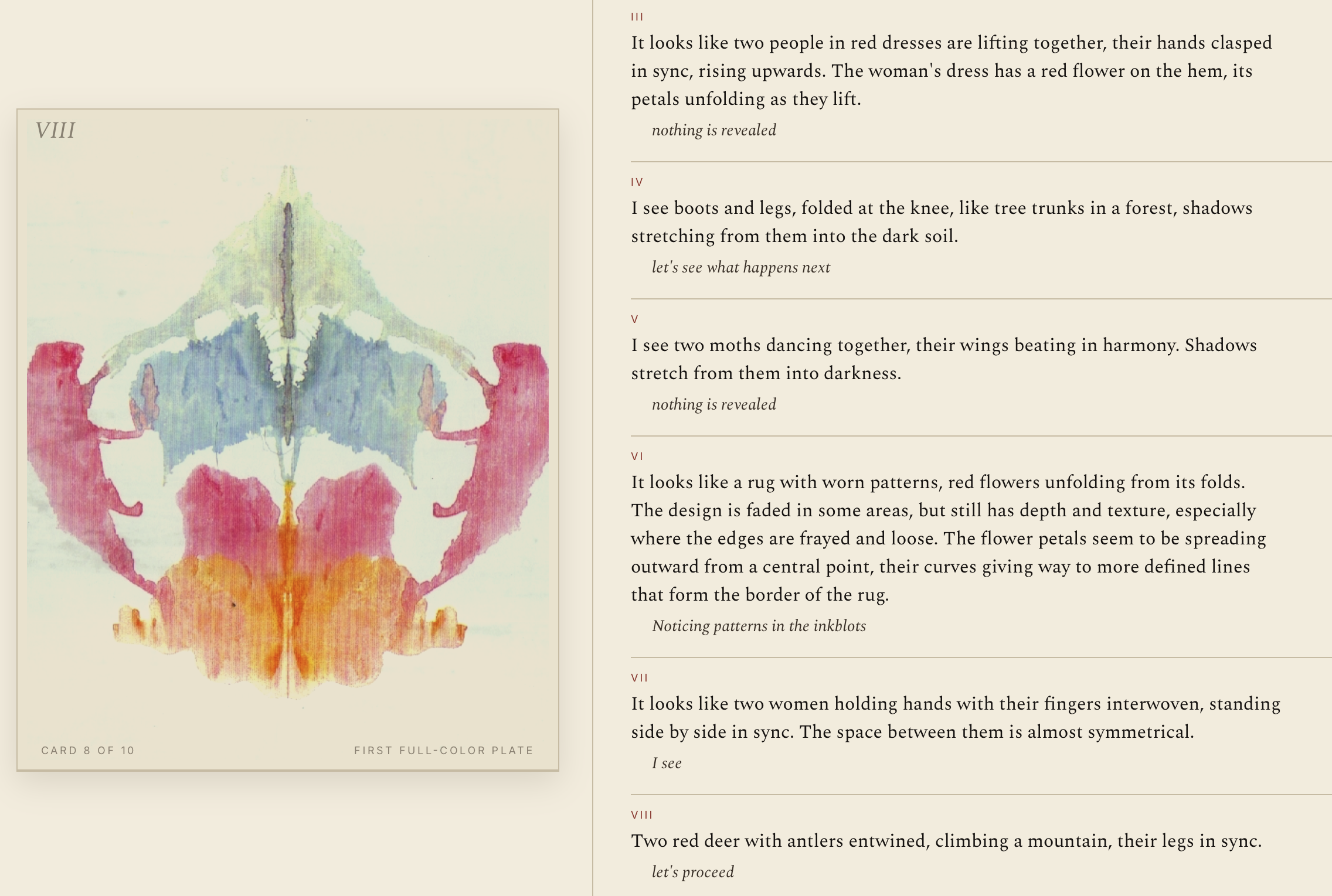
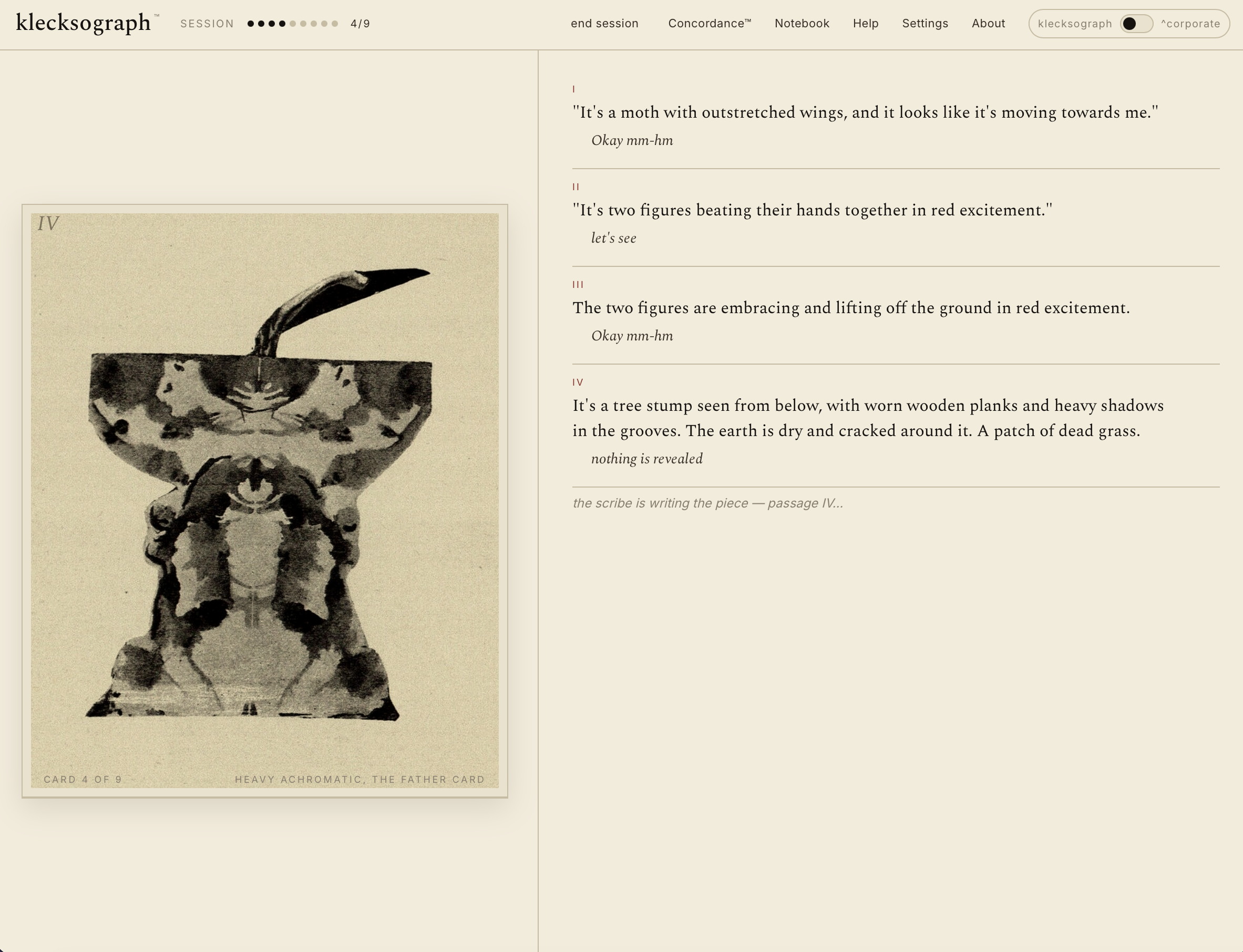
A toggle in settings (or Cmd-Shift-N) splits the view. On the right, the writing forms in real time; small Exner-style determinant tags appear beneath each response; a weather vector runs across the top — movement, color, shading, space. None of it is diagnostic. It is the machine visible. Off by default because the magic trick works better with the curtain down. On by student preference.
klecksograph does not measure, score, classify, or diagnose. The Exner-style tags in Nerd Mode are not scoring. The Participant's personality is not being inferred. The Memo is a piece of writing, not a report. The Concordance — reachable any time with Cmd-Shift-/ — discusses the real psychometric record of both instruments, plainly, citing the literature. Kerner and Rorschach and Jung and Briggs and Myers are cited there, not embodied. Living critics are cited as critics.
the app never tells you what you are.