A kind of translator. You type as you think and it translates to computer code. You paste code you don’t understand, you read it in your language.
I am become error, destroyer of all breakdowns instructional.
See the distance between “make it red when you click it” and the code that actually does it — this is what a programming language adds. Precision, structure, type safety, event handling. pidgin.code maps that distance.
Not a code editor. Not a tutorial. Not thirty-seven steps and a certificate at the end. Built for people who will direct code, not write it. Design leads, machines follow. This is for humans to understand the material without becoming it.
Each translation is a set of choices about what to preserve and what to sacrifice. Translating a poem into another language requires dozens of attempts, each losing (and gaining) something different. Code works the same way. Python’s list comprehension, Swift’s filter chain, C#’s LINQ query, and C++’s explicit loop all express the same intent. Did I lose you with that nonsense? No idea can be expressed and executed the same way in different development environments. Each language ‘thinks’ about the problem differently. Translation doesn’t just change the words. It changes the thought.
Computer code is language, languages written by humans for humans and machines. But not for you and I, for the cubicle and math clique that gets it. Here we are trying to both collapse and complicate this stuff, making it parsable by someone with a general education and not a computer science degree.
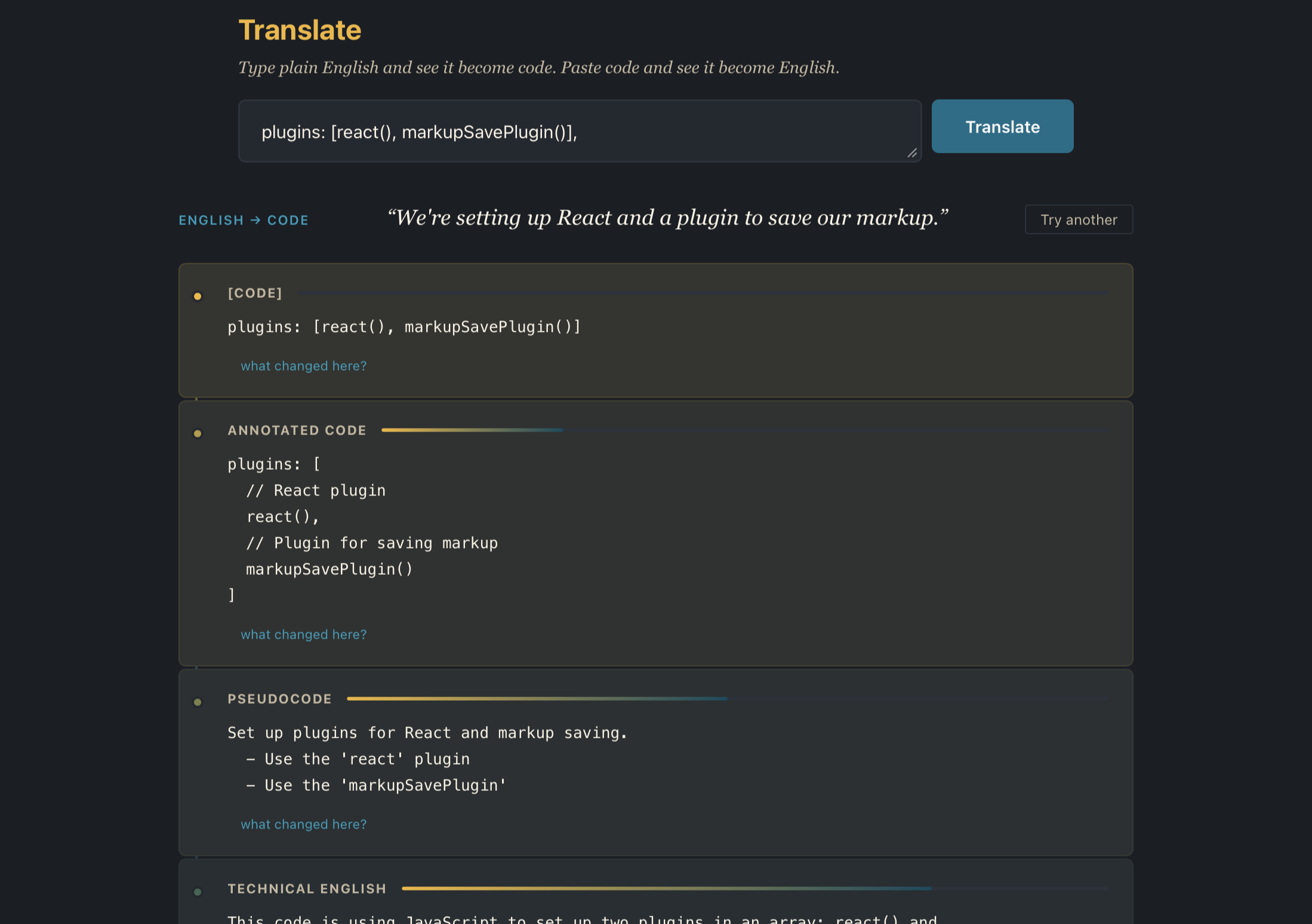
Translate is the hero verb. One input, three directions. Type English, see code. Paste code, see English. Paste anything — terminal output, config files, jargon — and see it decoded into plain language. A dozen pre-built translations ship with the app, spanning encoding, decoding, and cross-language comparisons. AI generation handles anything custom — bidirectional, detecting what you gave it and responding in the appropriate direction.
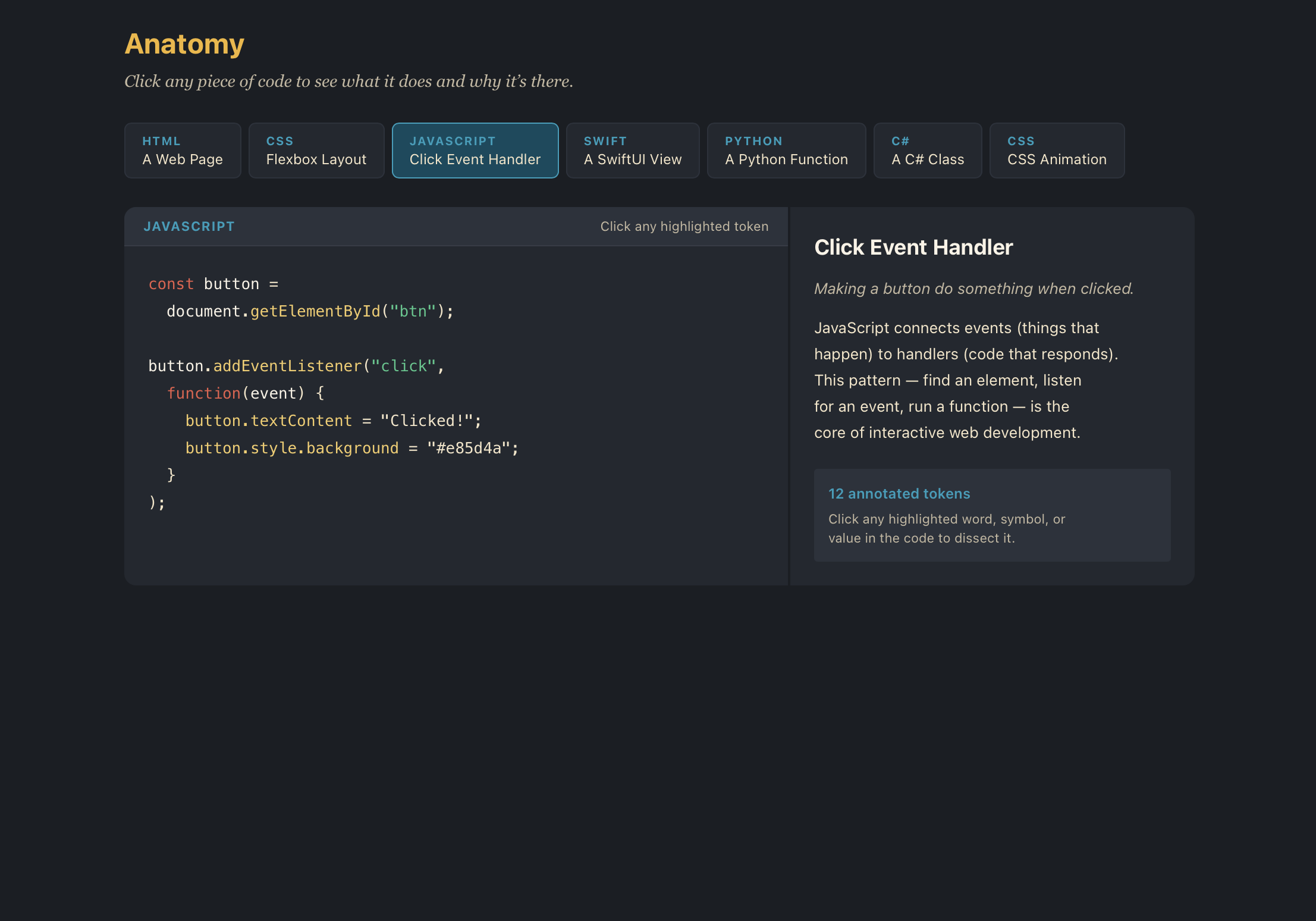
Real code specimens across half a dozen languages. Click any token — keyword, symbol, value, bracket — and a plain-English explanation appears. What it is, what it does, why it's there. Dissection, not production.
Two dozen entries on how code works as a contact language. The pidgin connection. Translation theory applied to programming. Language families, false friends, calques, creolization — the vocabulary of what happens when two systems that share nothing find a way to talk.
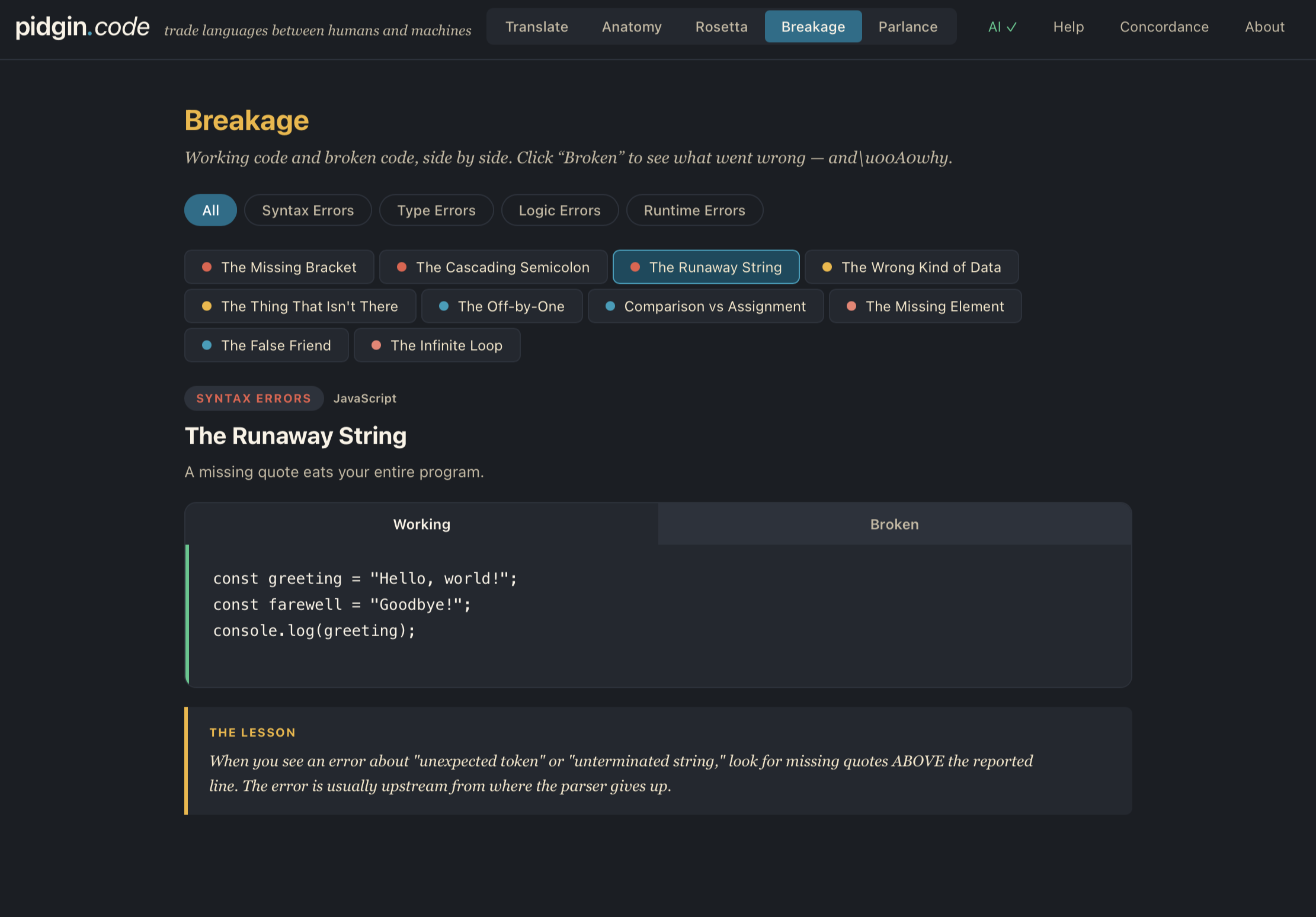
Ten scenarios across four error types. The scariest ones produce no error message at all — the code runs, does the wrong thing, and the machine never tells you. An error decoder on every scenario explains what went wrong and why.
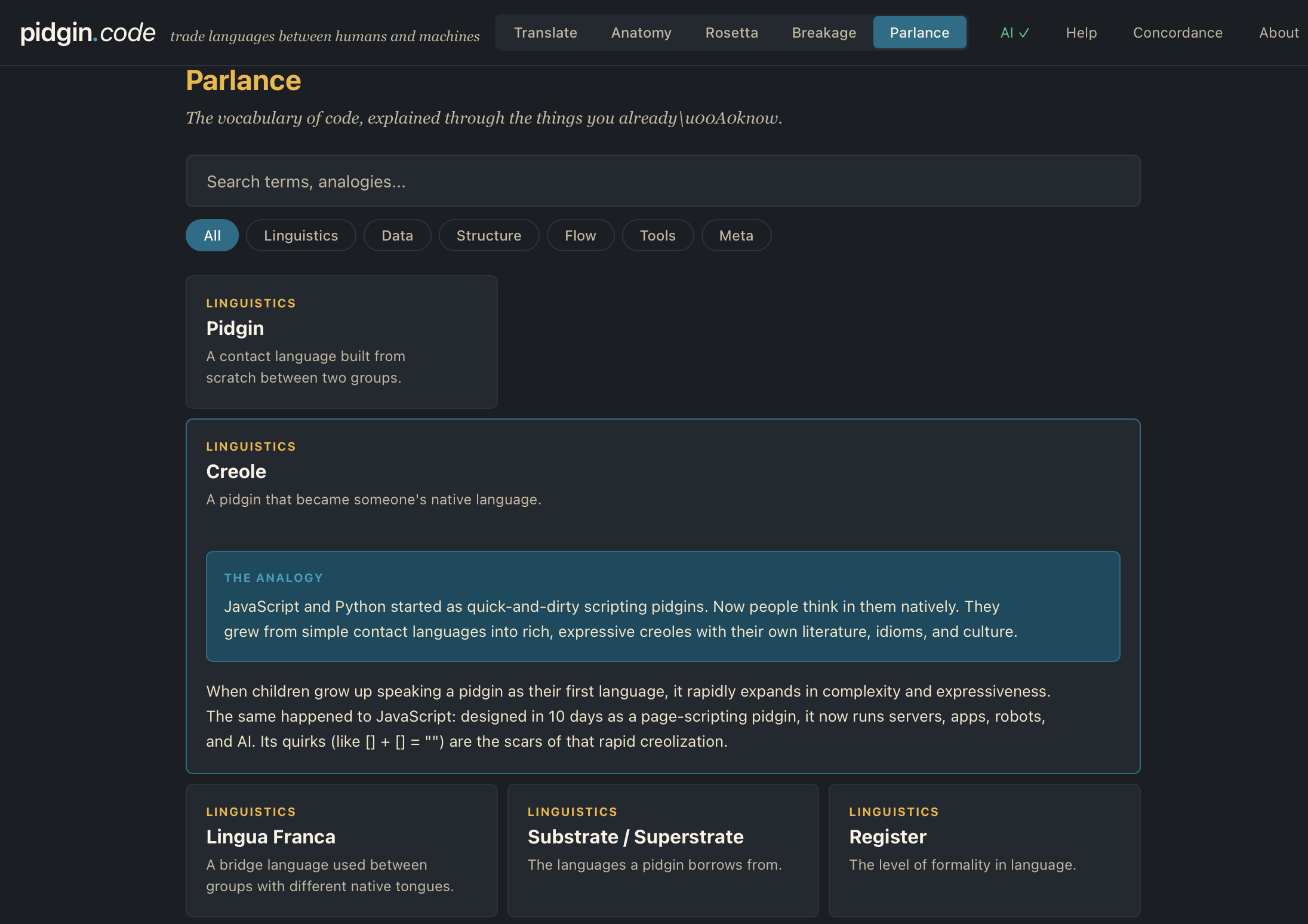
Dozens of terms with design-world analogies. A variable is a labeled jar. A function is a paragraph style. A constant is a Pantone swatch. Linguistic terms mapped to code terms — pidgin, creole, pinyin, calque, false friend, translation loss. Searchable and expandable.
A pidgin is a simplified trade language that forms when two groups need to communicate but share no common tongue. Merchants and traders built one in Canton. Pacific islanders and colonizers built another. The grammar is stripped down, the vocabulary is borrowed from both sides, and it works just well enough for the transaction at hand.
Code is the pidgin between human intent and machine execution — nobody's native language, everyone's working language. The dot in pidgin.code belongs to both readings: a pidgin about code, and a .code file extension. The metaphor is structural, not decorative. Every mode in the app is informed by contact linguistics: registers in Translate, substrate and superstrate in Rosetta, false friends in Breakage, the vocabulary of contact zones in Parlance.
The pidgin is not the destination. It is the first recognition that the gap between you and the machine has a language, and that language can be read. And translated.