
Decode factory numbers and documents on muscle and pony cars. With uncertainties and citations marked.
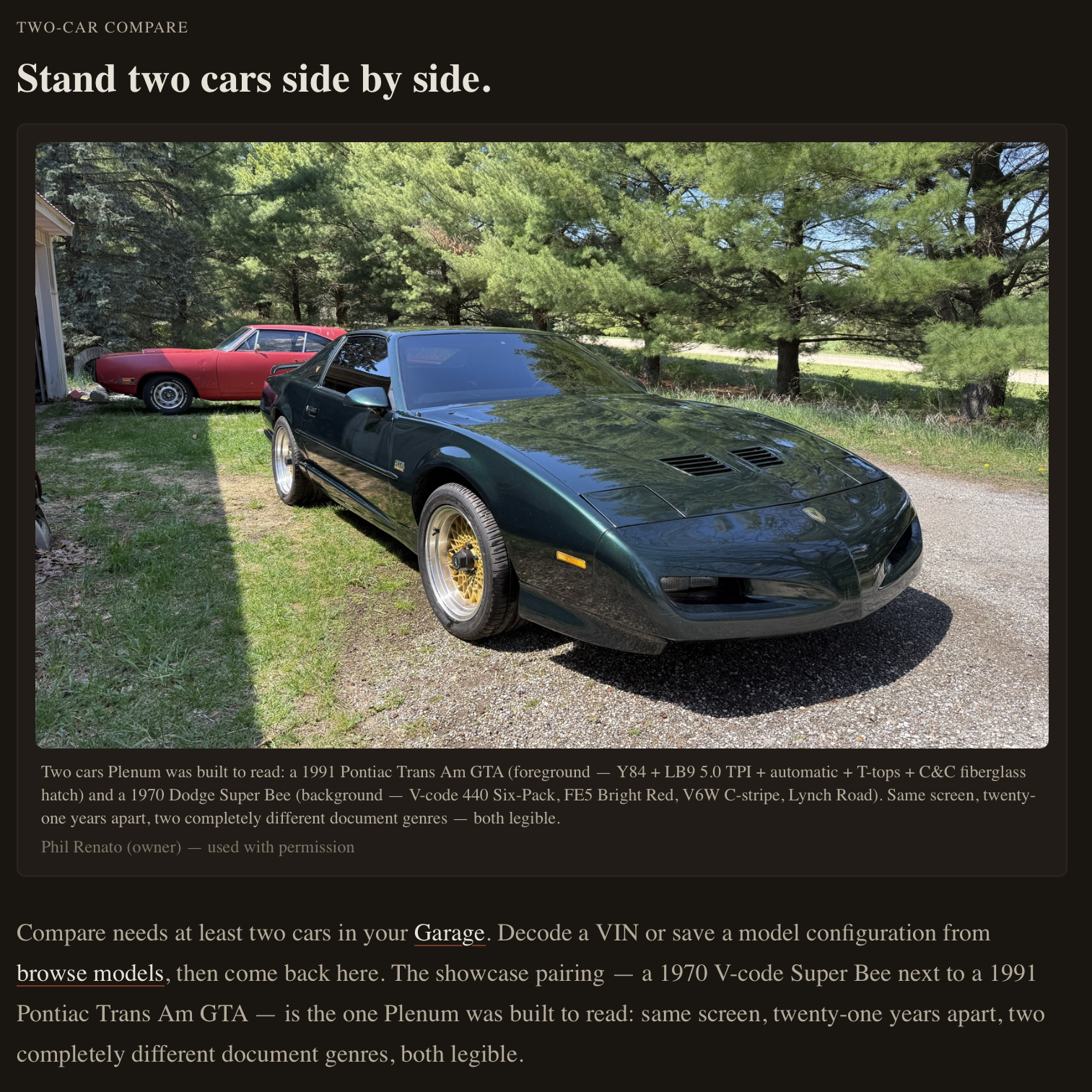
A deterministic decoder for the factory production documents on Mopar muscle and GM third-generation F-body cars — with more to come. Give it a VIN. Or pick a document type — fender tag, broadcast sheet, SPID label — and it will try to read the codes off your car into the textbox.
The decode returns a structured read — engine, transmission, paint, plant, package — with a citation under every code and a confidence tag that says how sure it is. factory-documented, registry-corroborated, registry-attested, forum-consensus, single-source, disputed. Damaged sheets get partial decodes. Missing cells are marked, not invented.
Production broadcast sheets and fender tags. ~150 sales codes. Plant overlays for Lynch Road, Hamtramck, Jefferson, Belvidere, Newark, St. Louis, LA, and Windsor. Year-aware engine, paint, and option vocabularies. Engine-letter ↔ engine-sales cross-walk between the VIN and the fender tag.
SPID labels and door plates. Z28, IROC-Z, Formula, Trans Am, GTA, the 1989 20th Anniversary Turbo. RPO-coded, with California vs. 49-state and export variants tagged. Position-by-position VIN decode through 8th-character engine, 10th-character year, and 11th-character plant.
Honest uncertainty first: every code carries a confidence tag and a citation. When two sources disagree, both readings show, and Plenum won’t adjudicate fender-tag authenticity from a photo. Burned, torn, marker-defaced sheets still get partial decodes — the cells that survived are cited, the ones that didn’t are marked destroyed, never fabricated. The engine itself is pure TypeScript running in your browser, no LLM involved: same input, same output, every time, which is what makes the citations real.
It knows its plants and its years the way a generic decoder can’t. A 1970 Lynch Road broadcast sheet isn’t a 1970 St. Louis one — the A34 callout often goes missing on Lynch Road tags, and a blank cell there means something different. The A32 axle code means one thing in 1970 and another in 1971. The N96 Air Grabber can’t exist on a 1970 convertible, because the fresh-air hood plumbing needed a hardtop roof — Plenum knows that going in.
No comments section, no replies, no leaderboard. It’s a reference instrument, not a forum.
Plenum is also how I keep track of my own cars: a 1970 Dodge Super Bee, FE5 bright red, V-code 440 Six-Pack, built at Lynch Road. And a 1991 Pontiac Trans Am GTA, medium green metallic, LB9 5.0 TPI, T-tops, C&C fiberglass hatch, owner-converted black-cloth interior. The demo decode is my Bee.
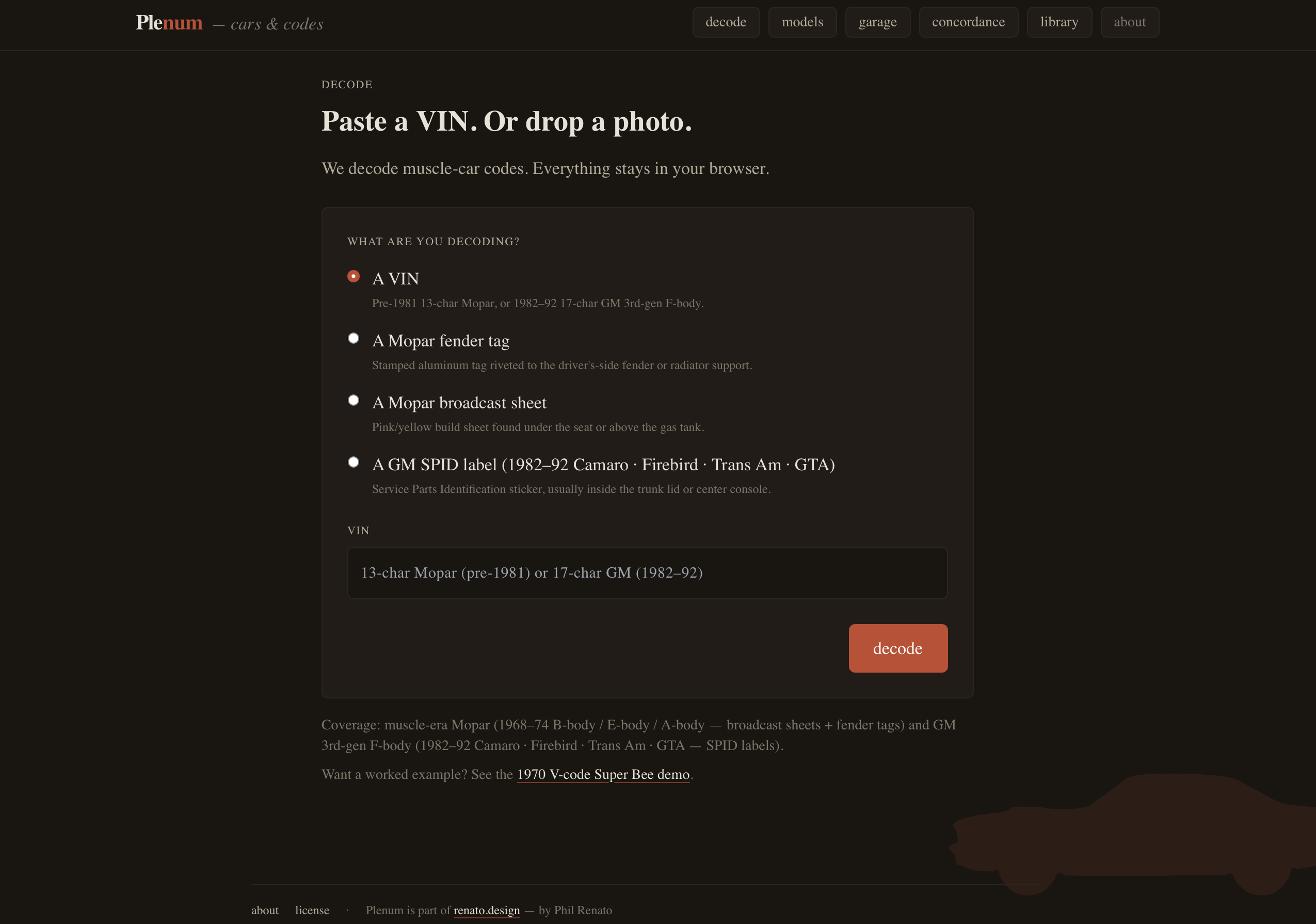
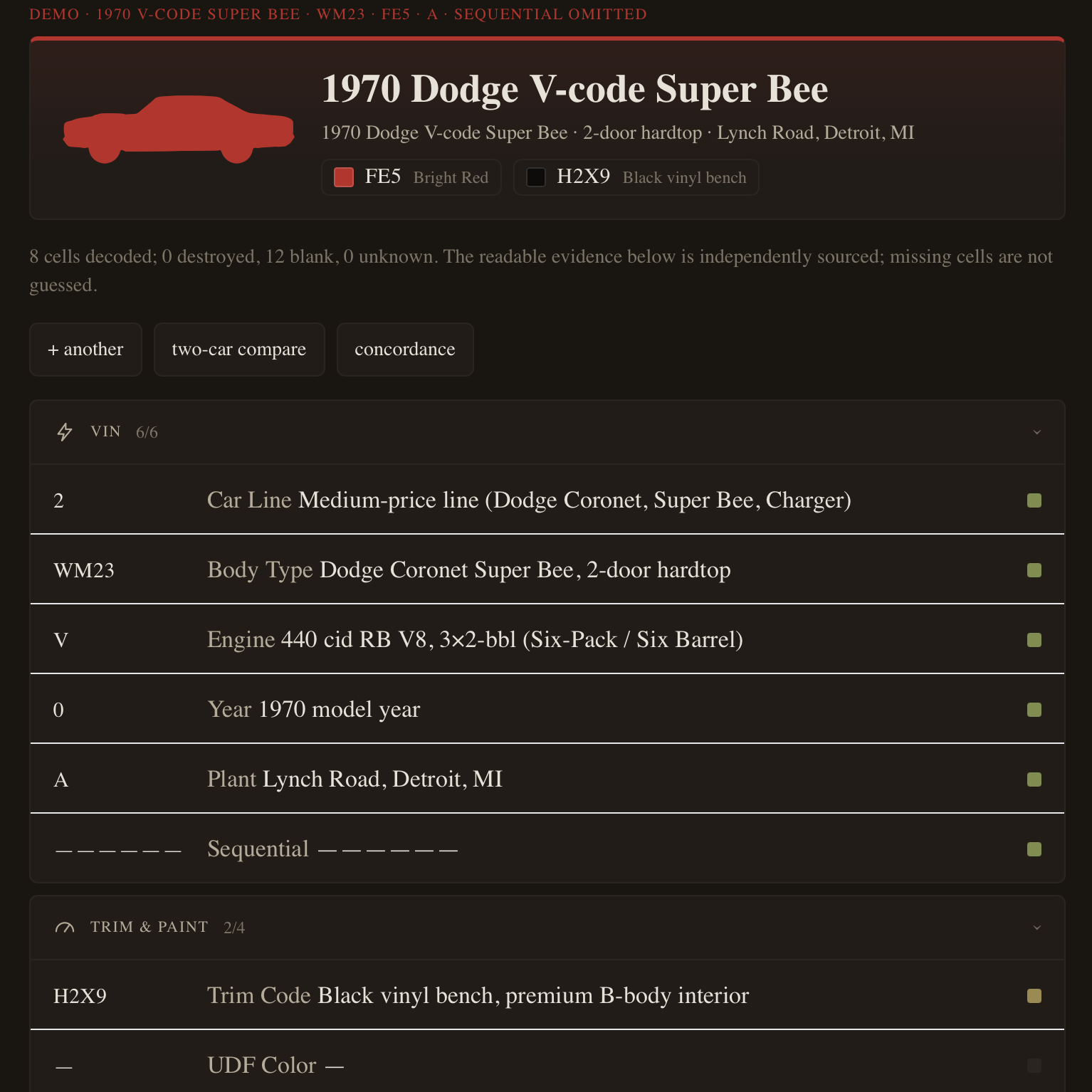
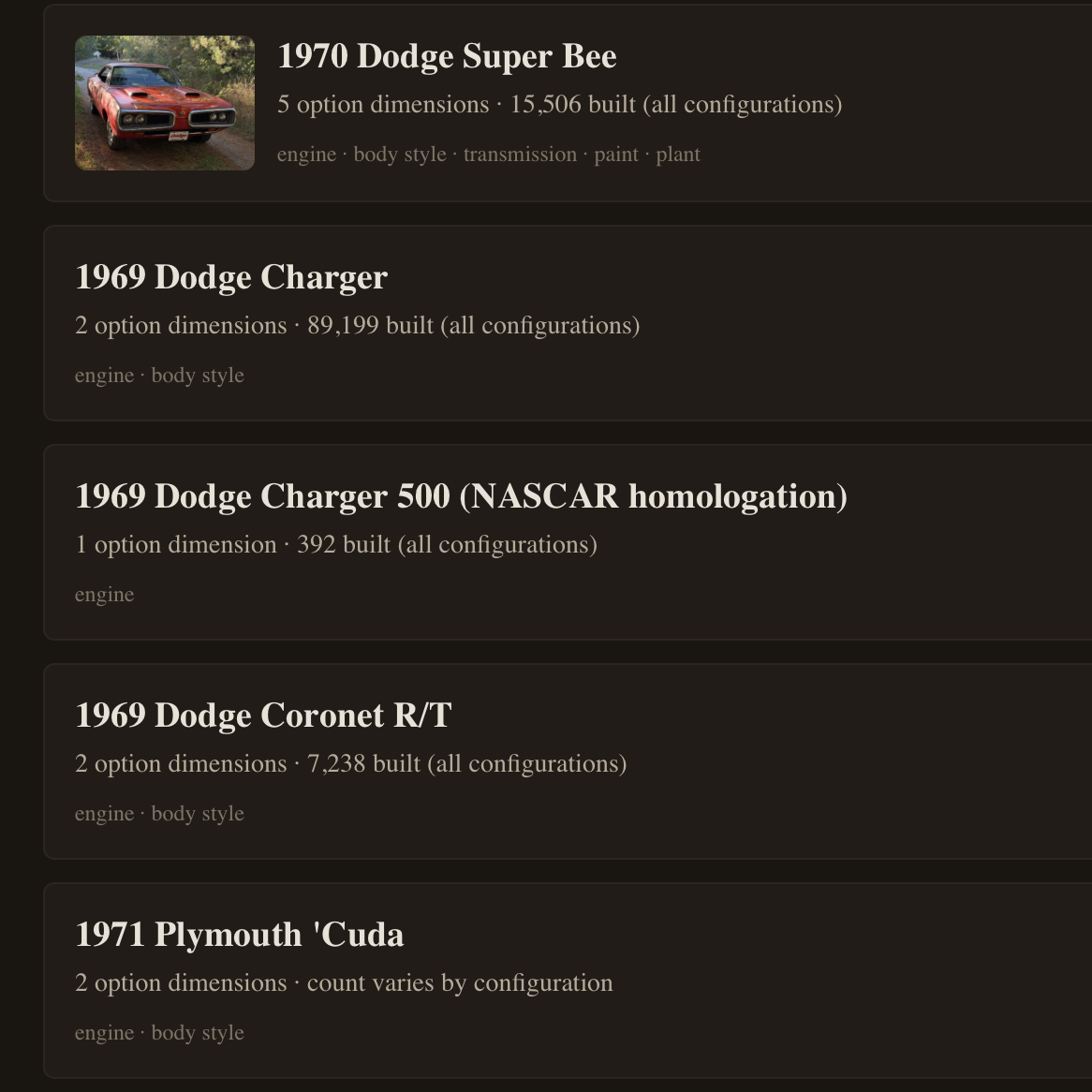
Plenum decodes numbers against known numbers. It does not authenticate the parts on the car today. Those are different questions, and the gap between them is one of the oldest in the field. Theseus’s ship, restored a plank at a time. The factory documents tell you what came down the line in 1970, according to the Big Three. They do not tell you what is bolted to the unibody now. Plenum reads the first question; the registries and the marque experts adjudicate the second.
Plenum is not a registry or a price guide, and it doesn’t pretend to be an authentication service or a forum. The codes themselves are facts, unrestricted; the compilation, the citation discipline, and the honest-uncertainty layer on top are our work.
drive on