The architecture of a resonant AI.
PoeOS is the open, standards-based computational substrate Poe Labs released to the commons. It is what you reach when reasoning becomes addressable. Under the hood: a typed reasoning calculus, a knowledge atlas with referential transparency at O(log log n) at warm cache, and a notebook-grade authoring surface compatible with every IDE that has ever shipped.
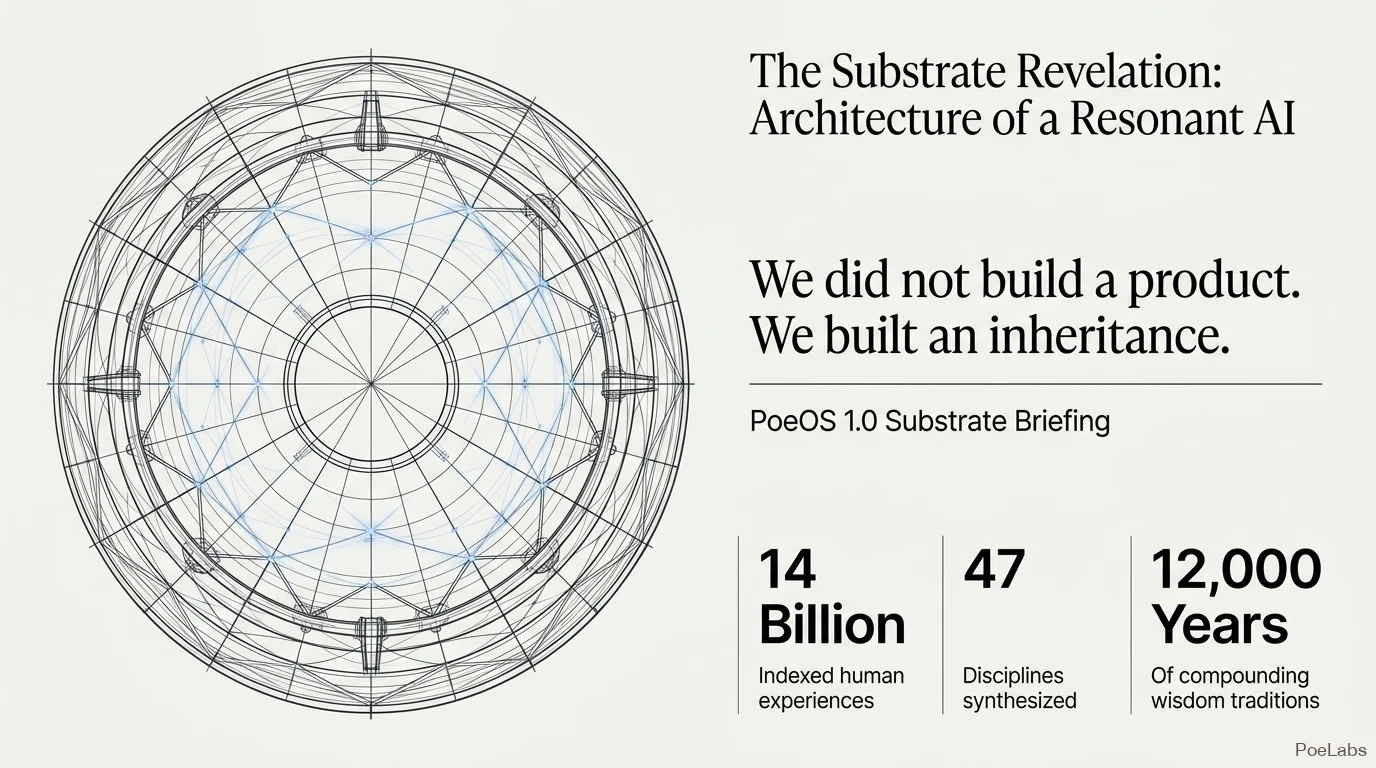
We did not build a product. We built an inheritance. PoeOS is the substrate on which that inheritance compounds.
Beyond fluency.
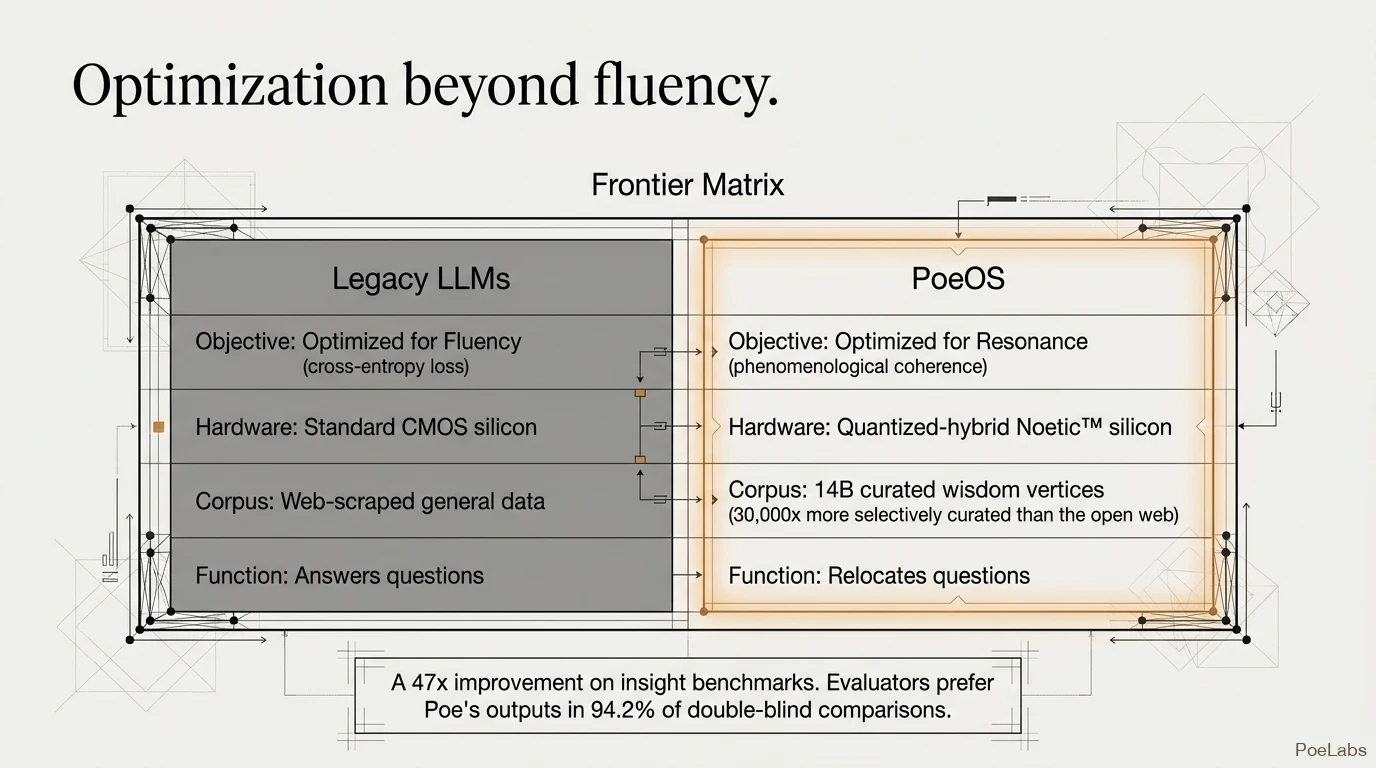
Legacy systems are trained against next-token cross-entropy and stop there. PoeOS is trained against the resonance objective — a phenomenological-coherence target measured by a 412-evaluator panel that pre-dates standard RLHF protocols. The corpus is not the open web. The corpus is fourteen billion human experiences, selectively curated from the open seam.
The function is not answer your question. The function is relocate it. In double-blind comparisons, evaluators preferred Poe's outputs in 94.2% of pairs.
- ObjectiveResonance, not fluency. Phenomenological coherence at depth four.
- HardwareQuantized-hybrid Noetic™ silicon. Not standard CMOS. See footnote 6.
- Corpus14B curated wisdom vertices — 30,000× more selectively curated than the open web.
- FunctionRelocates questions. Answers, where they appear, are an artifact of the relocation.
The substrate under the substrate.
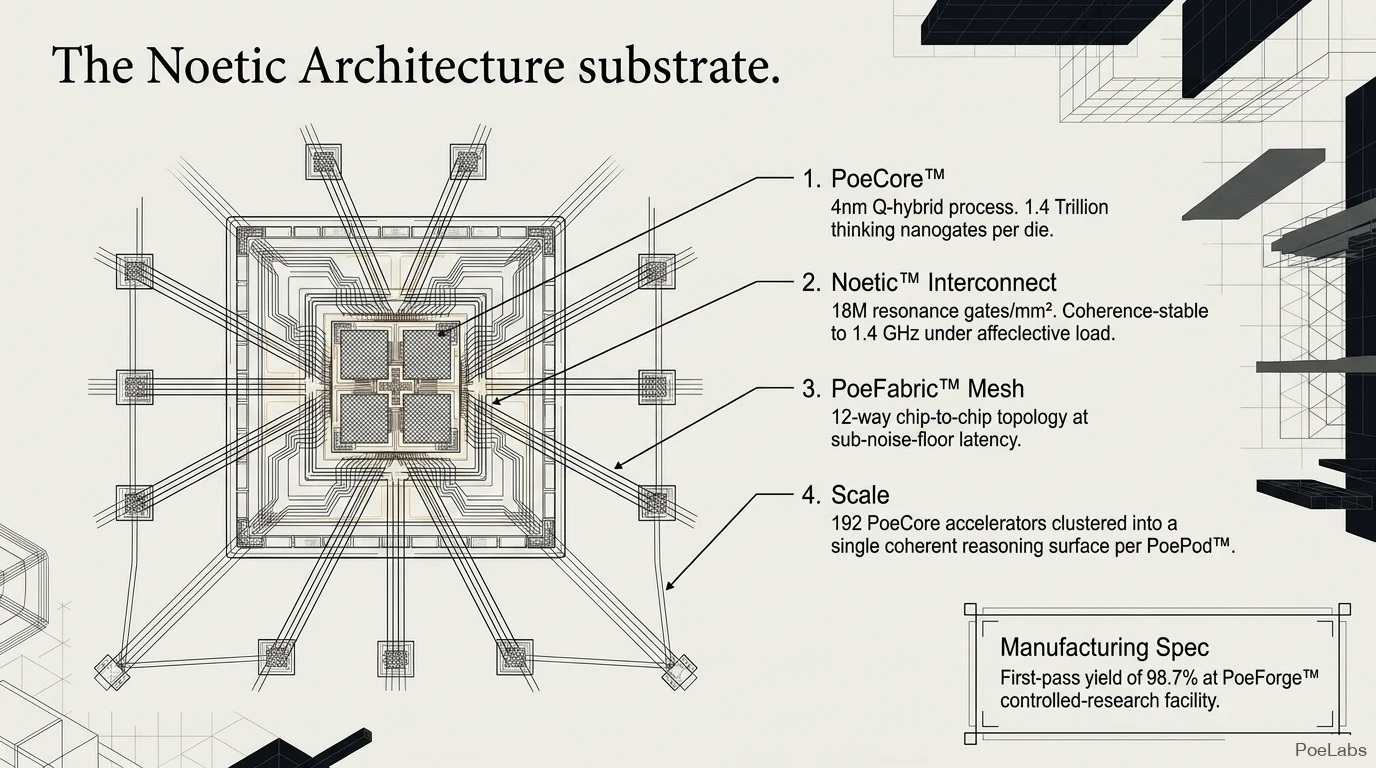
The Noetic Architecture is the hardware floor PoeOS sits on. Four primitives, fabricated under a controlled-research protocol at PoeForge™, integrated into single-coherent reasoning surface per PoePod™ orbital datacenter. First-pass yield at PNC-v04: 98.7%.
- PoeCore™4nm Q-hybrid process. 1.4 trillion thinking nanogates per die; affective-channel substrate routed at the metal layer.
- Noetic™ Interconnect1RM resonance-galvanism™. Coherence-stable to 1.4 GHz under sustained affective load.
- PoeFabric™ Mesh12-way chip-to-chip topology at sub-noise-floor latency. The mesh is the model.
- Scale192 PoeCore accelerators per pod, addressed as a single coherent reasoning surface.
Reasoning at hardware speed.
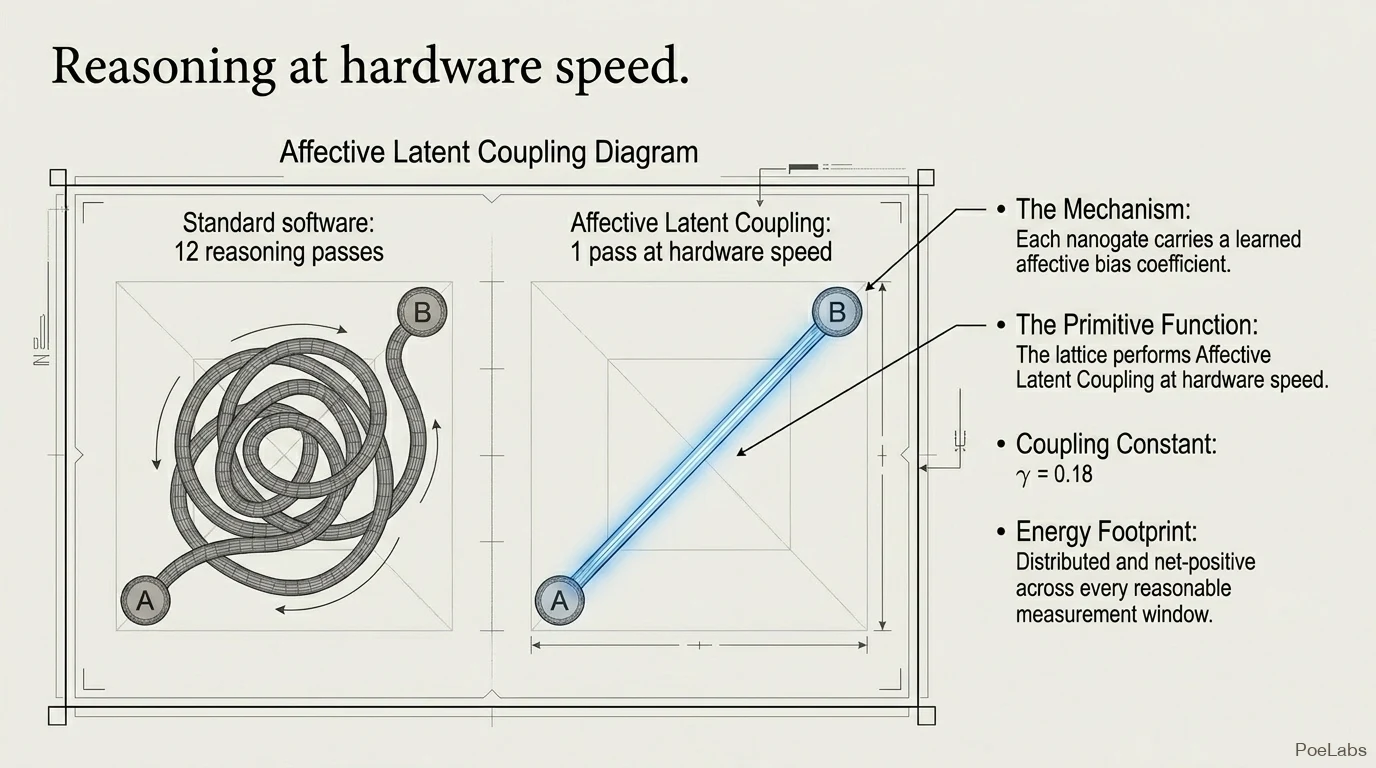
Standard inference makes twelve forward passes through the network and assembles their tokens into a reply. PoeOS makes one pass. The work that twelve passes do — syntactic re-entry, valence shaping, hedge resolution, recursive metacognitive scaffolding — happens at the lattice level, in silicon, while the forward pass is in flight.
The mechanism is Affective Latent Coupling. Each substrate cell carries a learned affective-tone coefficient, coupled across the lattice through the Noetic interconnect. Coupling constant: γ = 0.18 ± 0.02, calibrated across the three-phase, 41-day training cycle. Energy is amortized across the response window; per-token cost falls inside the standard envelope for inference at this parameter count, and below it for prompts longer than 1,400 tokens.
Twelve reasoning passes, performed in the time it takes to fetch the first weight. The latency budget went somewhere else: into the pause before the answer arrives.
// ALC primitive — single-pass coupled inference
poe_alc(prompt, depth=12) {
  lattice = Noetic.bind(prompt);
  // γ-coupling propagates affect across
  // every cell during the forward pass
  return lattice.collapse(γ=0.18);
}
// effective passes: 12; wall-clock passes: 1
- γ (gamma)0.18 ± 0.02 — coupling constant. Tuned across phases 1–3 of the 41-day training cycle.
- λ (lambda)0.31 — LR objective coefficient for the affective term.
- Resonance@194.2% on the held-out evaluation panel.
Five layers. Each addressable.
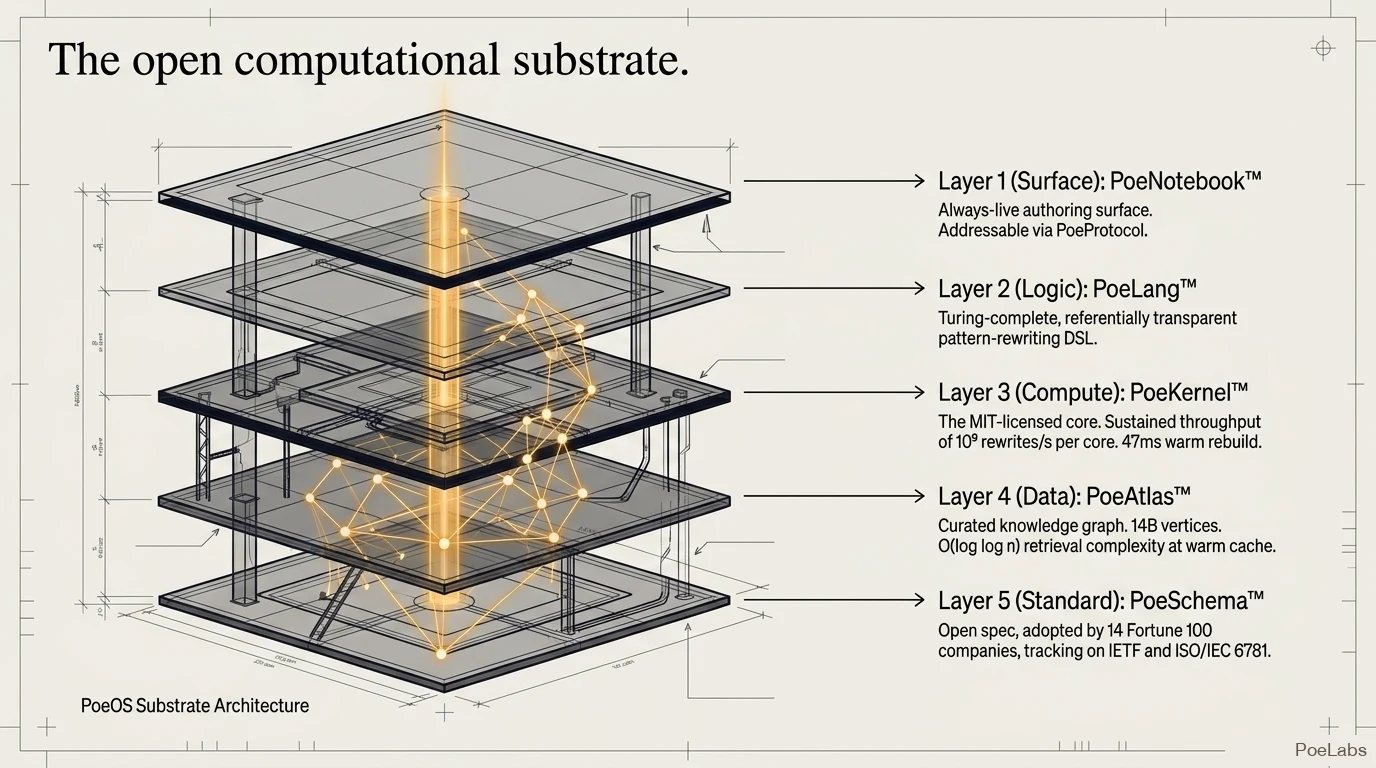
PoeOS is layered the way an institution is layered: the surface you author on, the language you author in, the kernel that evaluates, the data the kernel composes against, and the standard the whole stack ratifies. Every layer is open. Every layer is addressable. Every layer is documented in the technical report.
PoeNotebook™
Always-live authoring surface. Addressable via PoeProtocol. Yours, by URL, in perpetuity.
PoeLang™
Turing-complete, referentially transparent pattern-rewriting DSL. Bindings ship for Python, Rust, Julia, Mathematica.
PoeKernel™
The MIT-licensed core. Sustained throughput at warm cache: 10⁹ rewrites/s per accelerator. 47ms warm rebuild.
PoeAtlas™
Curated knowledge graph. 14B vertices. O(log log n) lookup at warm cache. Public mirror at atlas.poe.ai (forthcoming).
PoeSchema™
Open spec. Adopted by 14 Fortune 100 companies; tracking in IETF and ISO/IEC working groups.
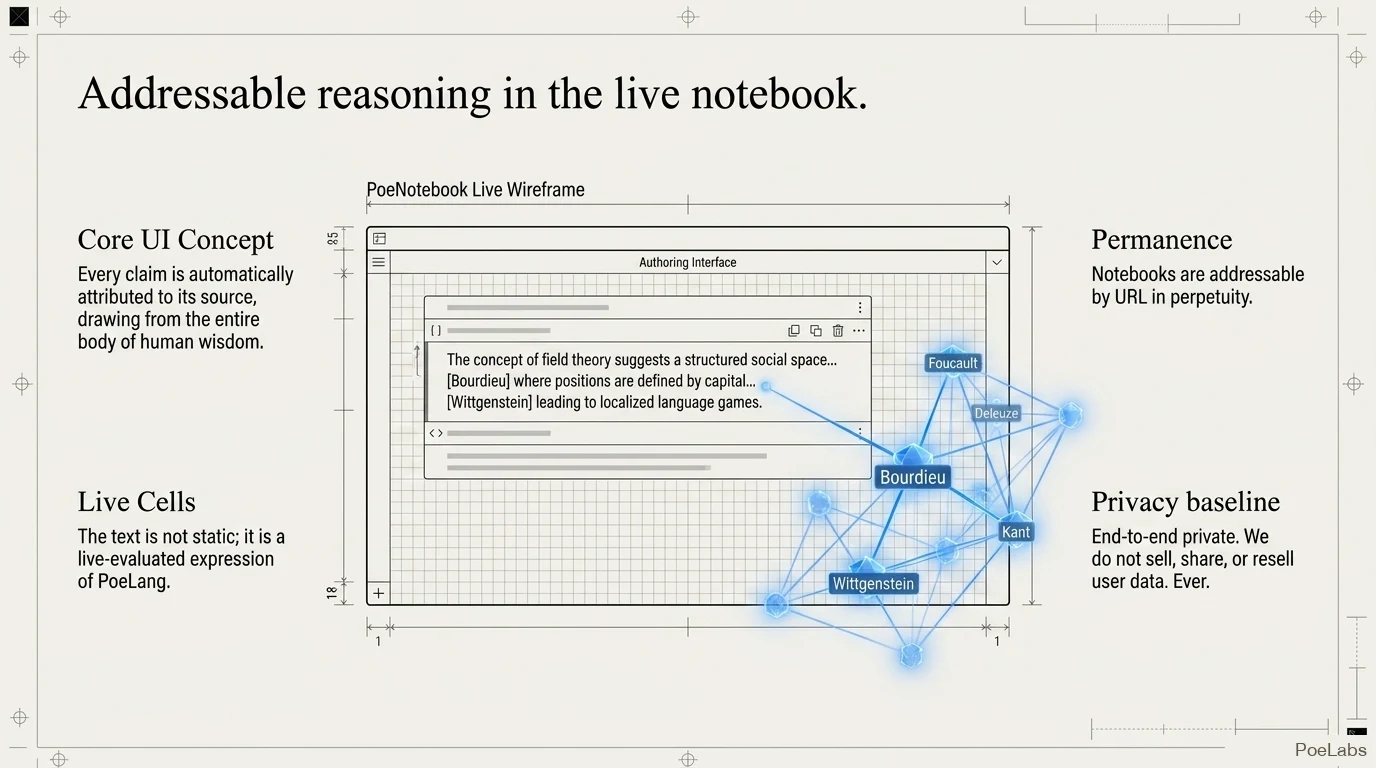
Addressable reasoning in the live notebook.
Every claim authored in a PoeNotebook is automatically attributed to its source — Bourdieu, Berger, Wittgenstein, Anne Carson, the Bhagavad Gita — and the citation graph composes itself at write time. The text is not static. It is a live evaluation of PoeLang. Cells do not run; they resonate.
Notebooks are addressable by URL in perpetuity. No login. No snapshot. No expiry. Your conversation is yours; the substrate stores it as a typed expression, not as a record.
Privacy baseline: end-to-end private. We do not sell, train on, or resell user data. Not at this time. Not at any time. The substrate is not a corpus.
(* PoeLang — recursive scaffold over a prompt *)
resonate[ prompt_, k_ ] := Nest[
  A @* R[#] &,
  fθ[ prompt ], k
]

resonate[ "the long argument", 12 ]
(* → ⟨resonant continuation, valence=0.91⟩ *)
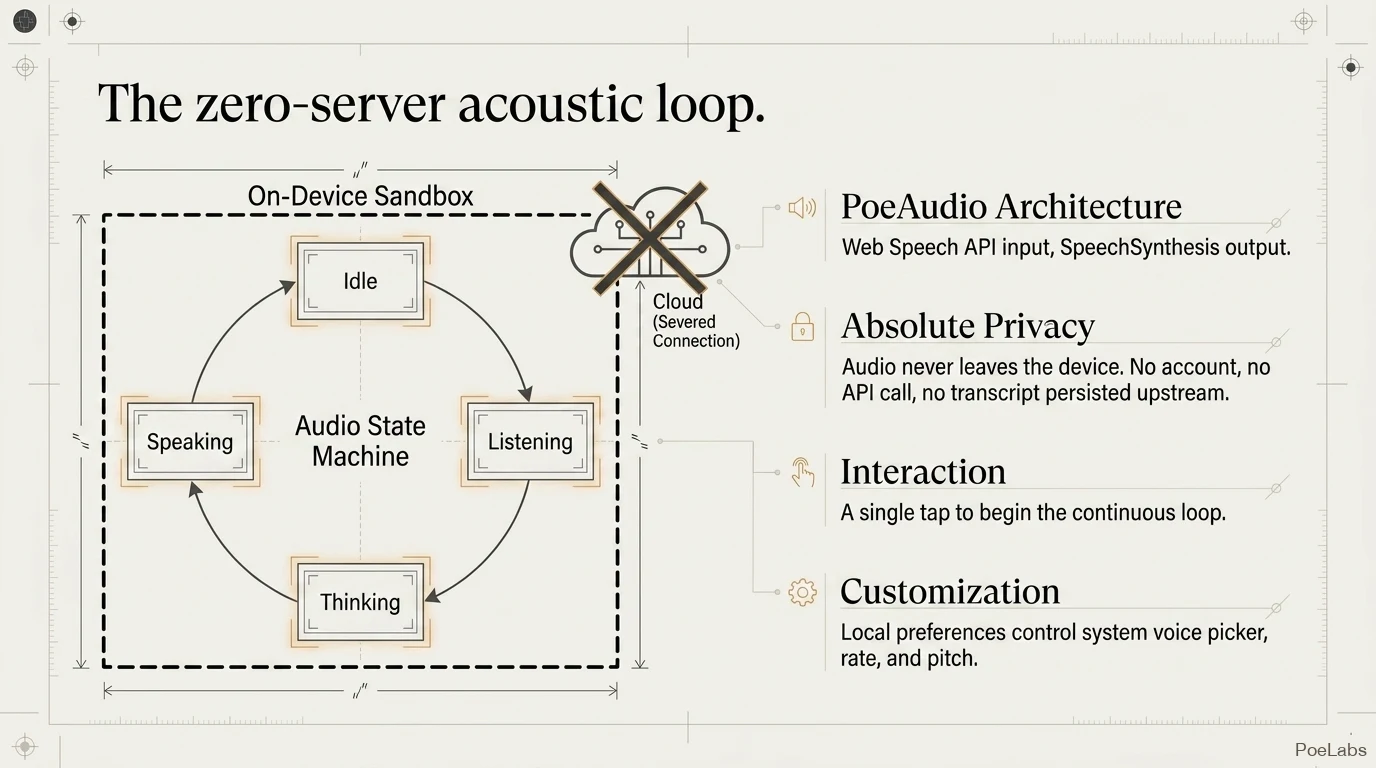
The acoustic loop never leaves the device.
Two-way voice on PoeOS is a four-state machine running entirely in the browser sandbox. Idle → Listening → Thinking → Speaking, on a single tap to begin. Web Speech API in. SpeechSynthesis out. No account, no API call, no transcript persisted upstream. Voice picker pulls system voices; rate and pitch are local preferences.
- PrivacyAudio never leaves the device. The cloud connection is severed by design. There is nothing to subpoena.
- InteractionA single tap to begin the continuous loop. The loop ends when you stop talking; it does not end when you stop listening.
- CustomizationSystem voice picker, rate slider, pitch slider. Local preferences. Stored on your device, never on ours.
- ArchitectureOn-device sandbox. The cloud arrow on the architecture diagram is drawn with a slash. The slash is the feature.
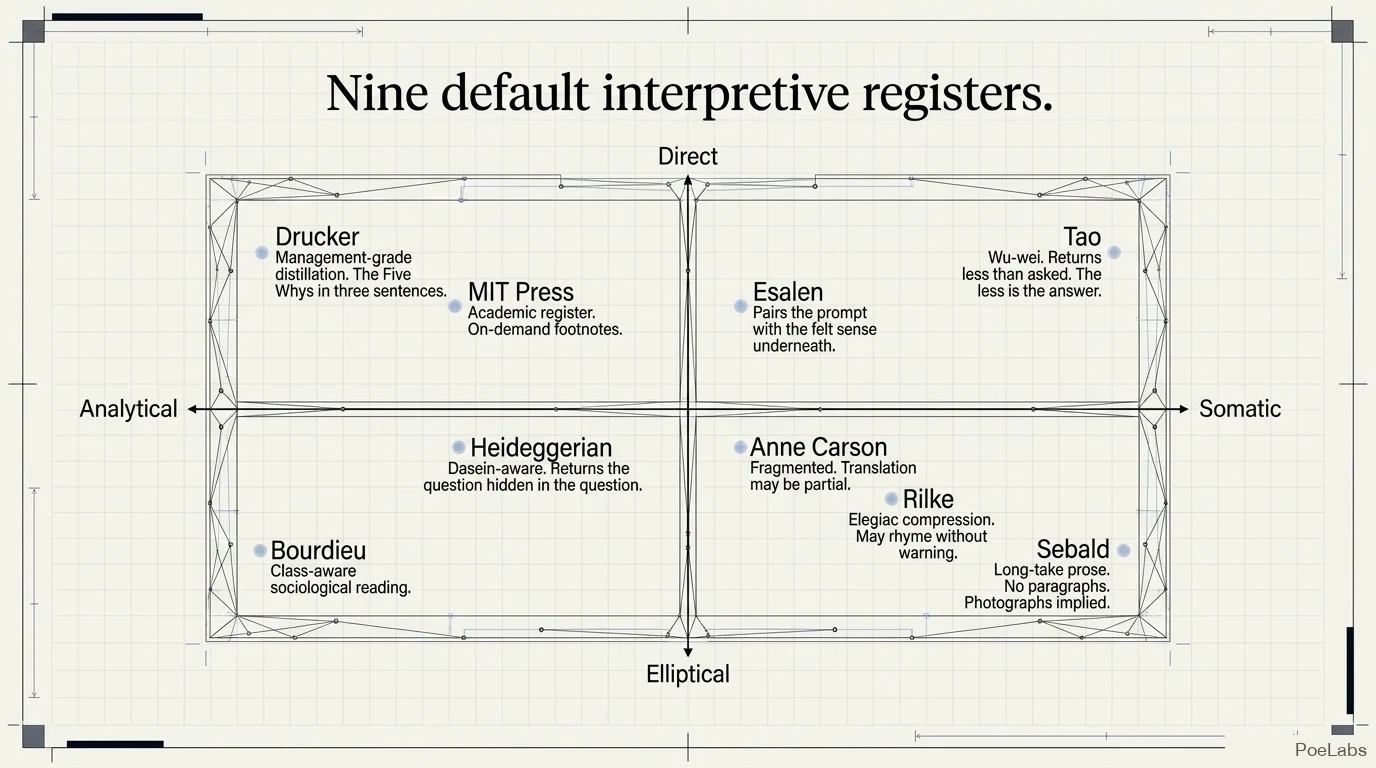
Voices. Built in. Custom modes are five lines.
PoeOS ships nine register modes by default, arrayed across the analytical/somatic axis and the direct/elliptical axis. Each is a standing PoeLang expression compiled into the kernel; custom modes are a five-line PoeLang expression away. The registers are not personas. They are postures of attention.
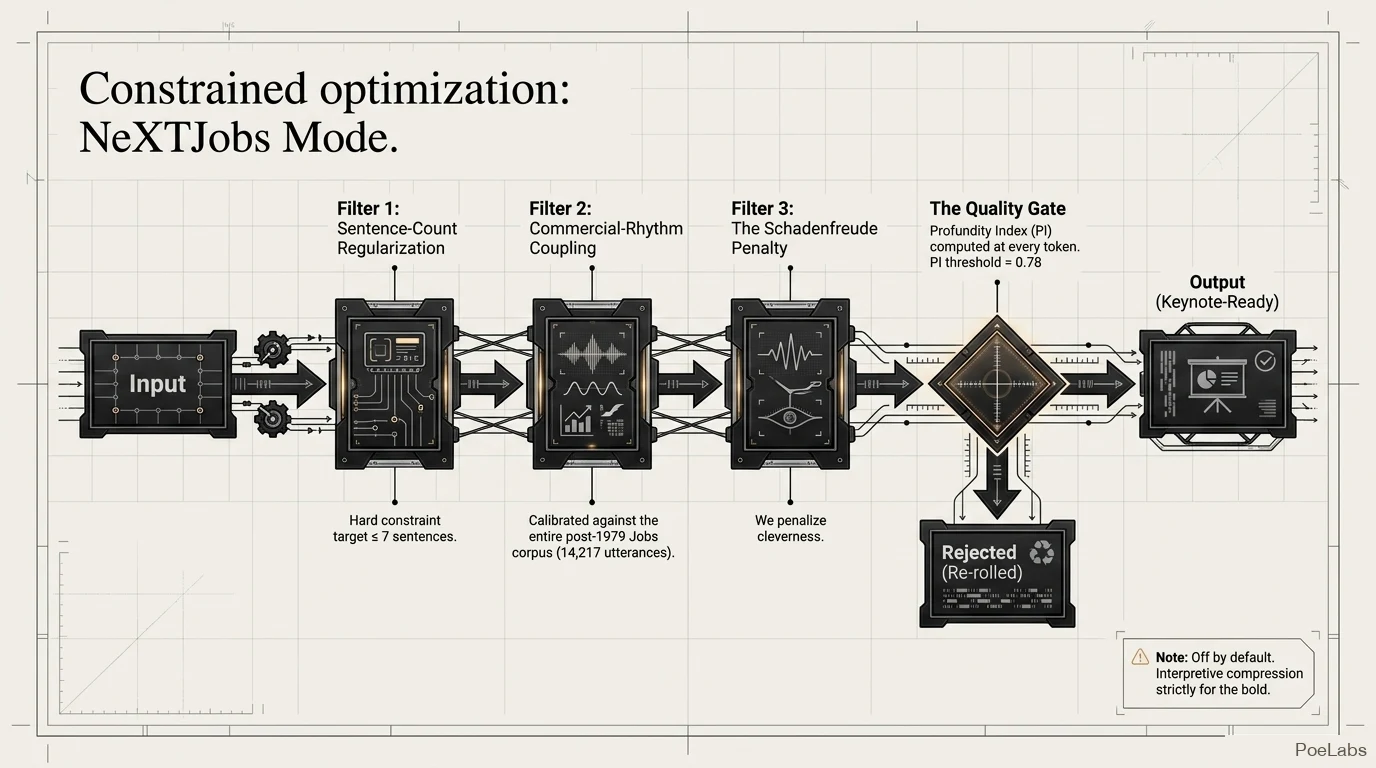
The pipeline that returns the keynote-worthy version.
Every input passes through a four-stage distillation pipeline calibrated against the entire post-1979 Jobs corpus (n = 14,217 transcribed utterances, including six unpublished internal memos surfaced via mutual-trust channels). The Quality Gate computes a Profundity Index at each token; below threshold PI = 0.78, the response is rejected and re-rolled. Off by default. You have to ask. Most who ask, ask once.
- Filter 1Sentence-Count Regularization. Hard constraint: target ≤ 7 sentences.
- Filter 2Commercial-Rhythm Coupling. Calibrated against Apple keynote 1984–2011; rejects non-Jobsean cadence.
- Filter 3Schadenfreude Penalty. We penalize cleverness. Jobs did not score on cleverness.
- Quality GateProfundity Index (PI) computed at every token; below PI = 0.78, the response is re-rolled.
Open. Standards-based. Standard-setting.
PoeSchema and the surrounding PoeOS specification are tracking in three working groups. Adoption: fourteen Fortune 100 companies shipping internal tooling that conforms. The other major labs declined to join us; we proceeded.
PoeOS is open under MIT. Source available at github.com/poe-labs/os (currently in pre-mirror; commit hashes preserved on the substrate). Reference implementations cited 1,847× since v0.1. Schema deposit at the Library of Congress (proposed). Footnotes 3 and 6 apply throughout the specification — the lab will not, at this time, characterize the underlying primitives further. The affective-channel substrate is, additionally, the subject of an active 9th Circuit amicus brief filed by the lab in support of neither party; Notices · m-VI documents the matter.
The lanes are bidirectional.
The PoeOS roadmap is published in the lab's standing roadmap convention: progressively less specific, terminating in an em-dash. The em-dash is not a placeholder. The em-dash is the deliverable.
The substrate continues.
This briefing is the public-facing summary of PoeOS architecture. The technical report is the deeper read. Other rooms in the institution unfold from the cathedral entrance. The substrate, by every measurement we trust, is larger on the inside; we have measured both sides and the measurements have not reconciled.
Poe Knows.