

Behavioral Word Processor
indie rock"You write. provoc observes. The observation changes how you write. The writing changes what provoc observes."
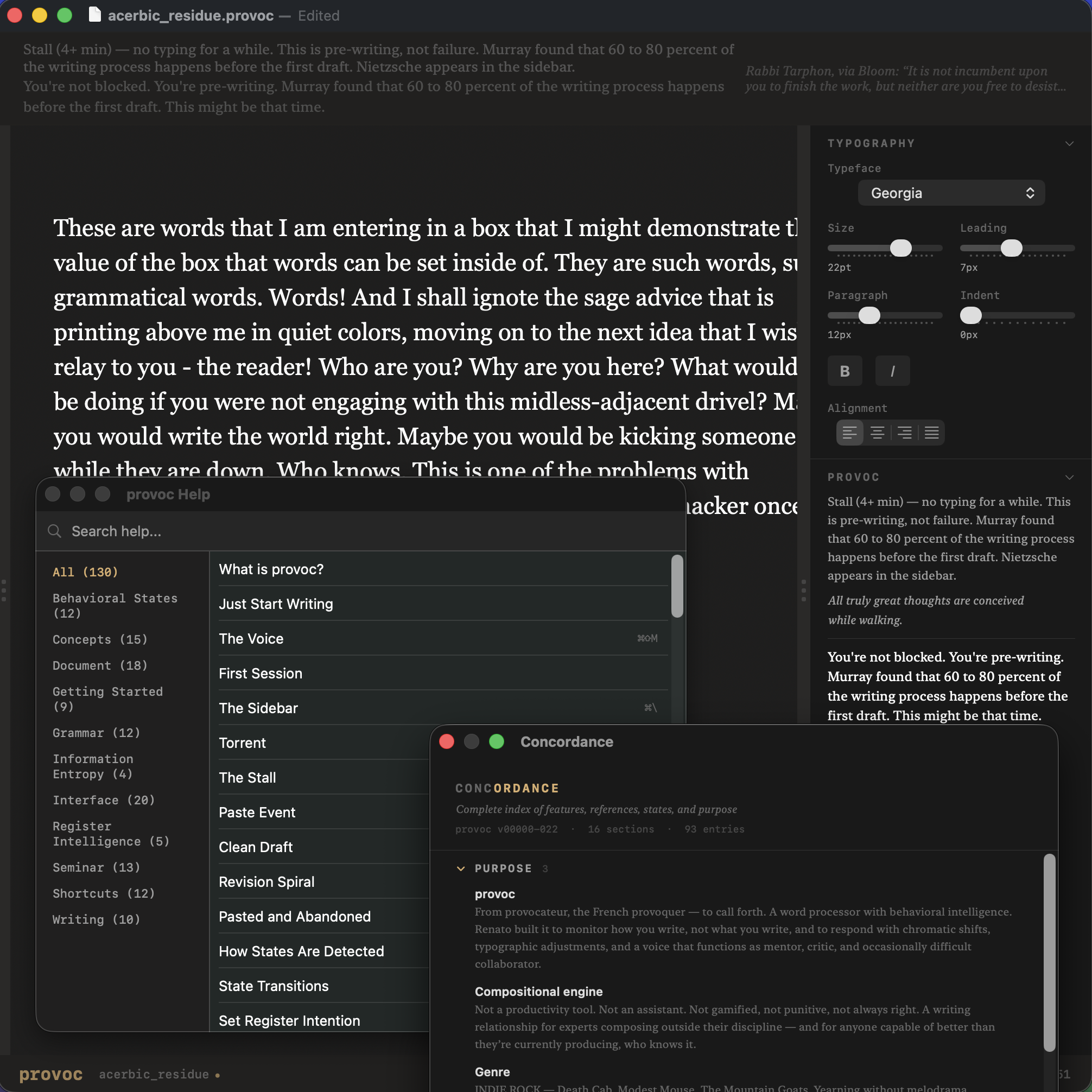
A word processor that watches how you write — not what. It reads your keystrokes, your pauses, your pasted-in fragments and abandoned paragraphs. It responds through color shifts, typographic adjustments, and a voice grounded in writing pedagogy and classical rhetoric. The interface is not a container for your writing. It is a participant in the writing itself.
provoc is not a productivity tool. It does not gamify output or count streaks or give you a badge for showing up. It does not write for you. It has opinions about what you write — opinions that develop over sessions, that remember your behavioral history, that occasionally admit they might be wrong. provoc calls forth better composition by refusing to be neutral.
For the disciplinary crossover writer, the fluent-but-unexamined writer, the writer who over-edits and under-commits. For anyone capable of better than they're currently producing, who knows it, even vaguely.
The loop is the design.
You write. provoc reads the behavioral telemetry — typing rhythm, pause duration, edit frequency, paste events, error patterns. It infers a state. The state changes the room: background color drifts, typography tightens or loosens, the voice says something worth hearing or says nothing at all. The silence is also a comment. You keep writing. The loop is recursive and it never fully resolves, which is the point.
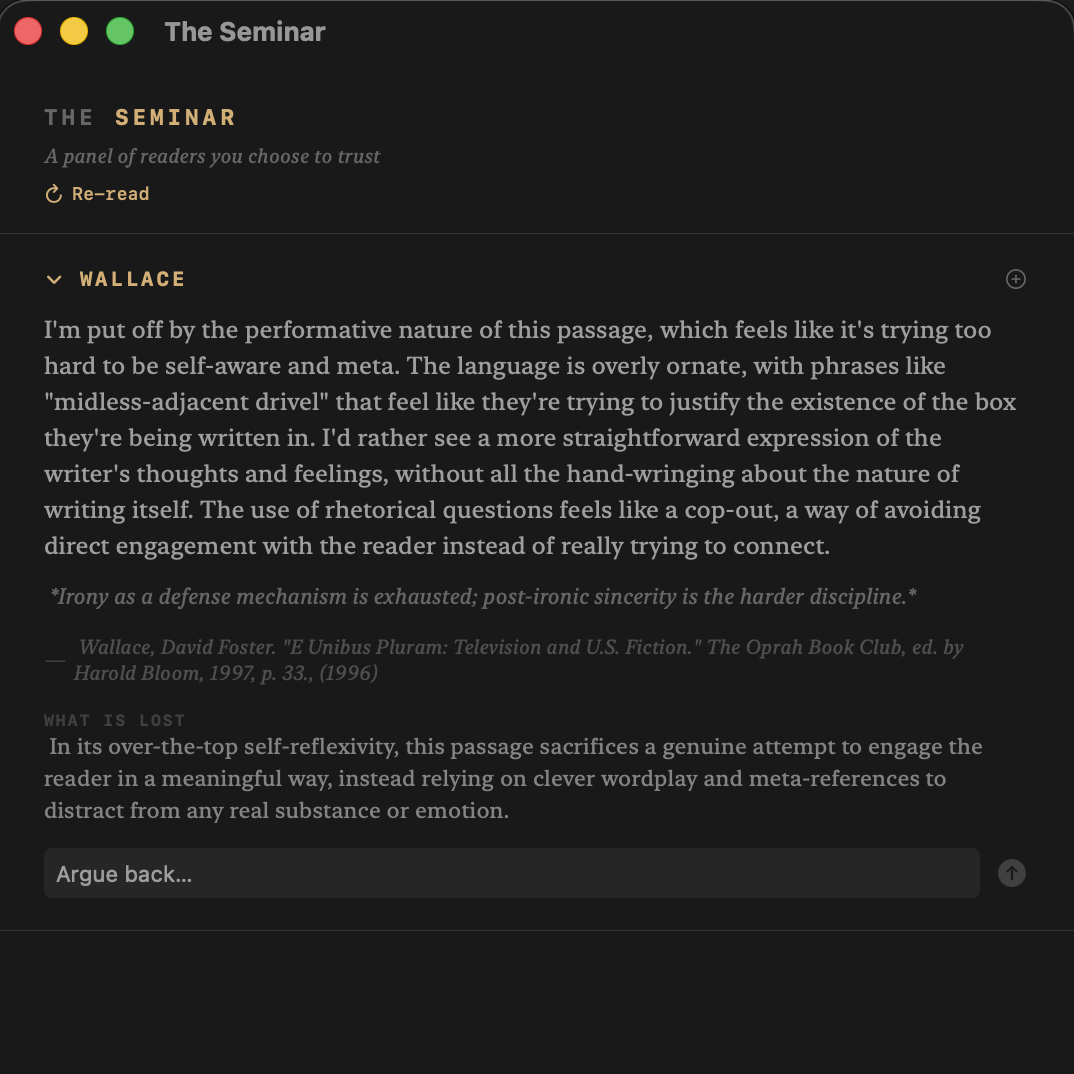
The Seminar. Wallace responds in four parts. The fourth — What Is Lost — names what your original does that his position would sacrifice.
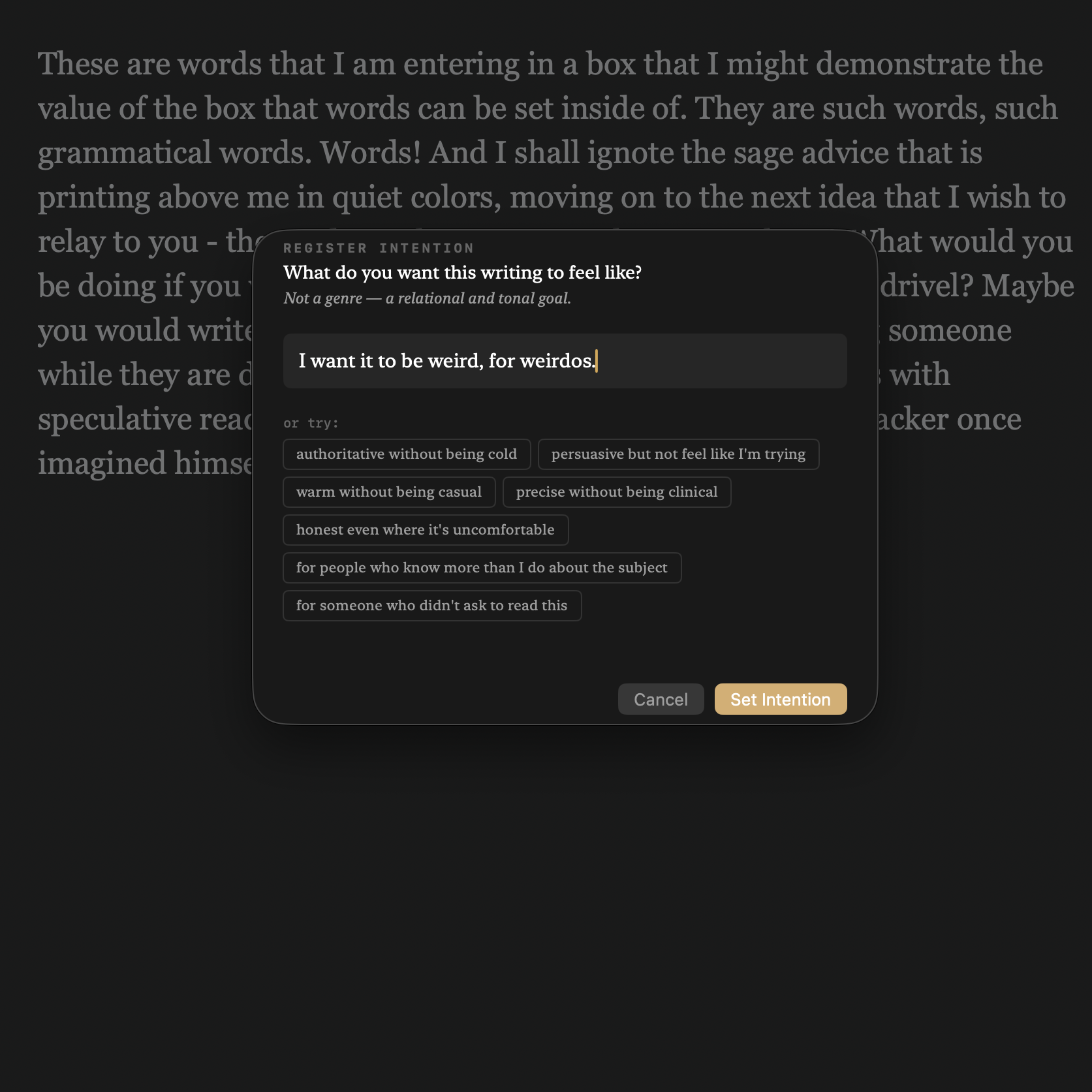
Register Intention. Not genre — relational goal. "I want it to be weird, for weirdos." Six suggestion chips if you need a starting point.
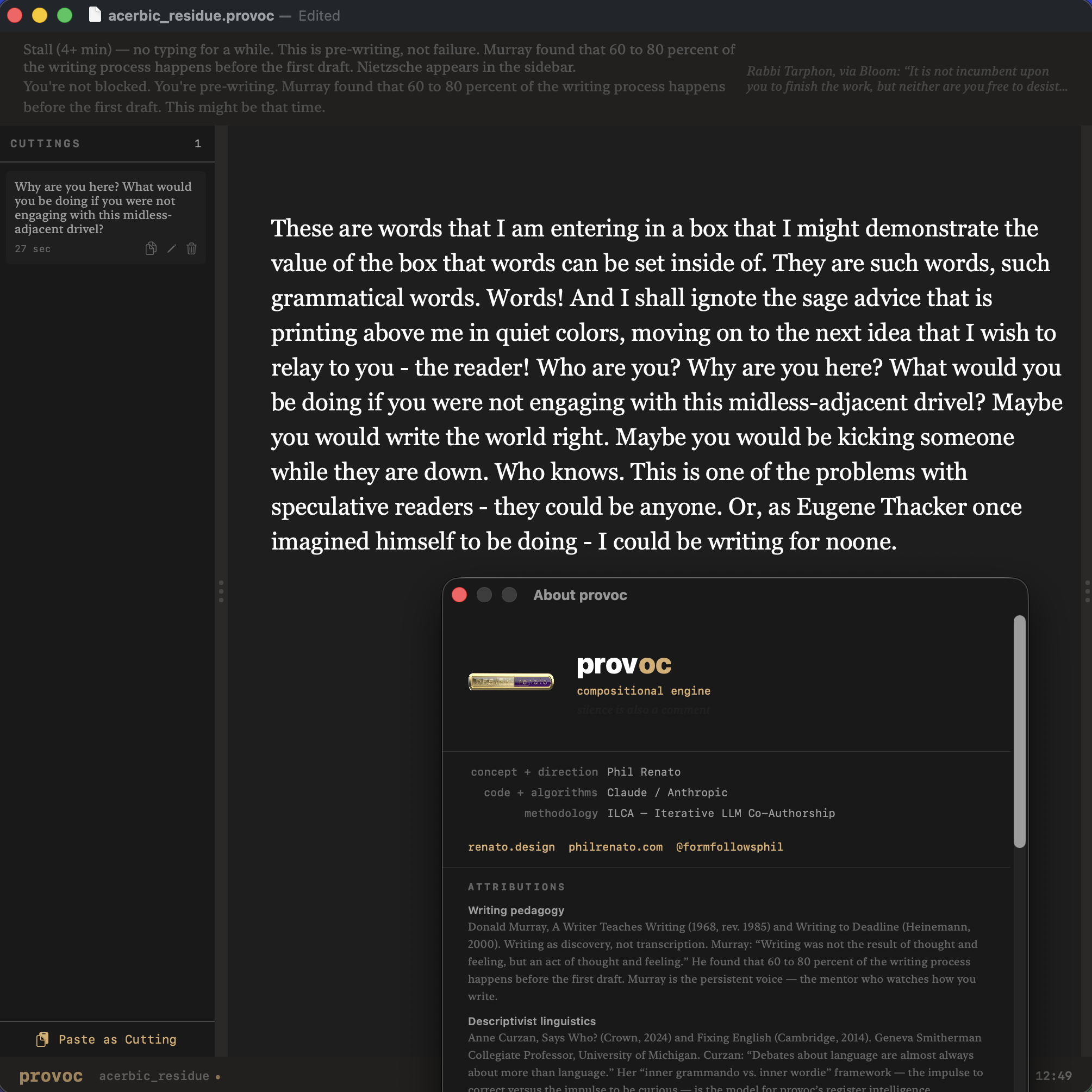
Cuttings drawer at left. About panel with full attribution. Commentary strip across the top. The stall state in progress.
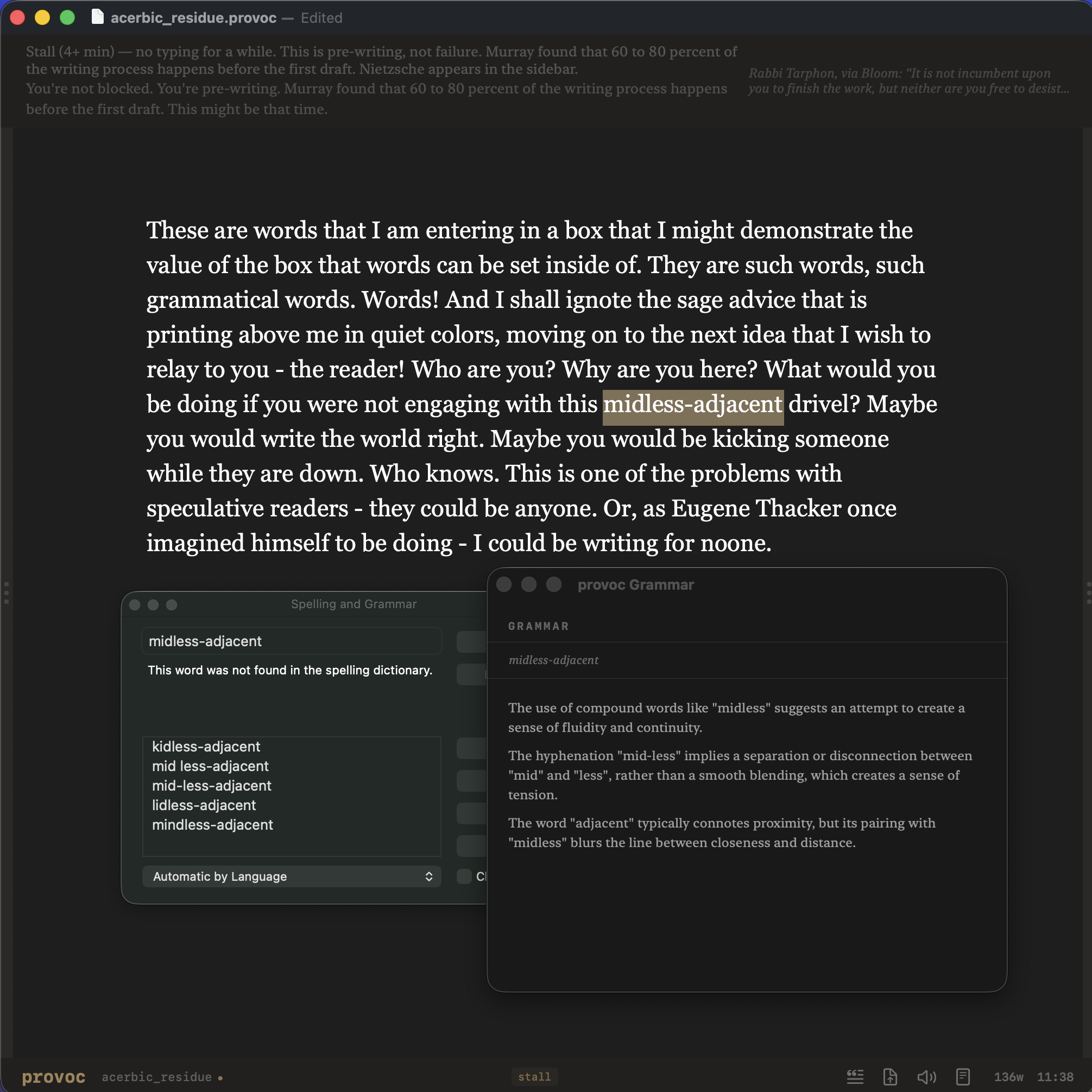
Grammar engine. Standard spellcheck at left, rhetoric-informed analysis at right. Never calls anything wrong. Never rewrites.
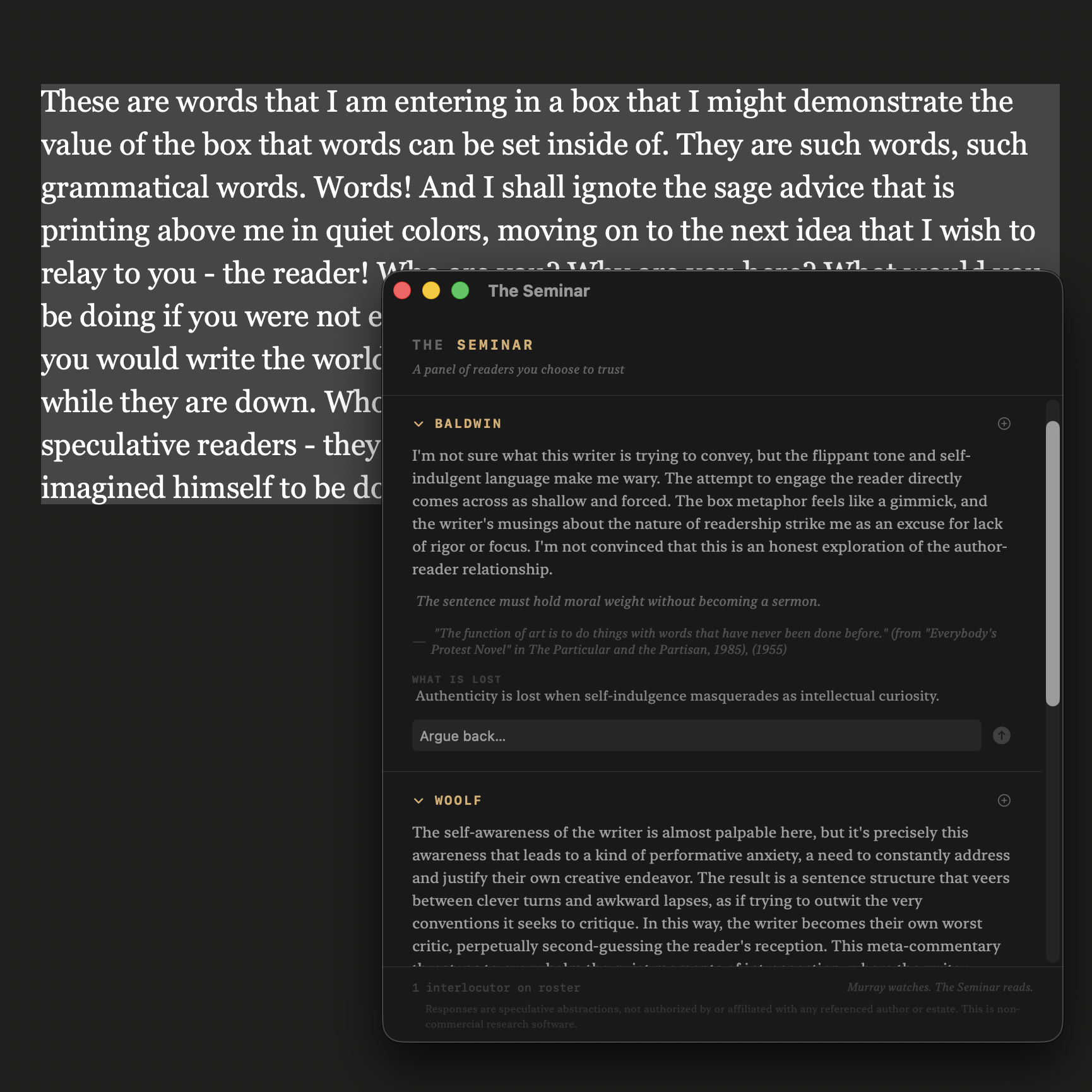
Baldwin and Woolf in the room. The Seminar overlaid on the writing surface — 24 voices, each grounded in actual literary work.
Eight behavioral states. Inferred from keystroke patterns, never selected. TORRENT when you've been writing for twenty minutes straight — the voice goes silent out of respect. THE STALL when the cursor blinks for four minutes without input — Nietzsche appears. PASTE EVENT desaturates the entire interface for a breath. CLEAN DRAFT tightens the typography. REVISION SPIRAL notices when you've edited the same paragraph four times in six minutes. FOCUS AWARENESS tracks when you leave and when you come back.
Chromatic Affect. Slow, subliminal background color shifts — not themes, not dark mode, but the emotional temperature of the room. Cool blue-grey during flow. Amber toward ochre during stalls. Brief desaturation on paste. Textual Affect mode replaces color with margin and tracking adjustments for accessibility.
Register Intelligence. State your communicative intention — not genre, but relational goal. "Authoritative without being cold." provoc analyzes the gap between intended register and received tonality across multiple tensions: confident vs. aggressive, casual vs. careless, precise vs. cold, warm vs. cloying, hedged vs. honest.
The Seminar. Highlight a passage and summon a panel of dozens of readers. Each of your choices responds in four parts: reaction, principle, citation, and what is lost. That fourth part prevents the Seminar from becoming a correction machine. Your original does something their position would sacrifice — the system names it.
The Voice. Not an assistant. A voice with a point of view that develops through five session stages — from quiet listener to opinionated presence. Encouragement means increased expectation. Sometimes wrong, occasionally says so. Can be muted, notices if muted frequently.
Hundreds of contextual epigraphs. Curated quotations from fifty-odd sources, matched to your behavioral state. Same quote never appears twice until the full battery exhausts.
Information Entropy. Real-time vocabulary density analysis — how many unique words you're using, how surprising your language is, whether your writing is concentrating or thinning. Dense writing reaches clean draft status faster.
The rest. Cuttings drawer for text set asides. Footnotes with auto-renumber. First-Draft Recall — provoc remembers the first version of every paragraph. Version History across sessions. Page Preview for print layout. Grammar panel grounded in source models that never calls anything wrong and never rewrites. Release Reading — a tonal audit when you export, framed around destination and receiver.