TuringTaster

artificial intelligence phenomena laboratory

industrial

42 labs. Five wings. Every claim cited. Not a textbook — a laboratory.
Runs entirely in your browser. No account, no cookies, no tracking. Free.

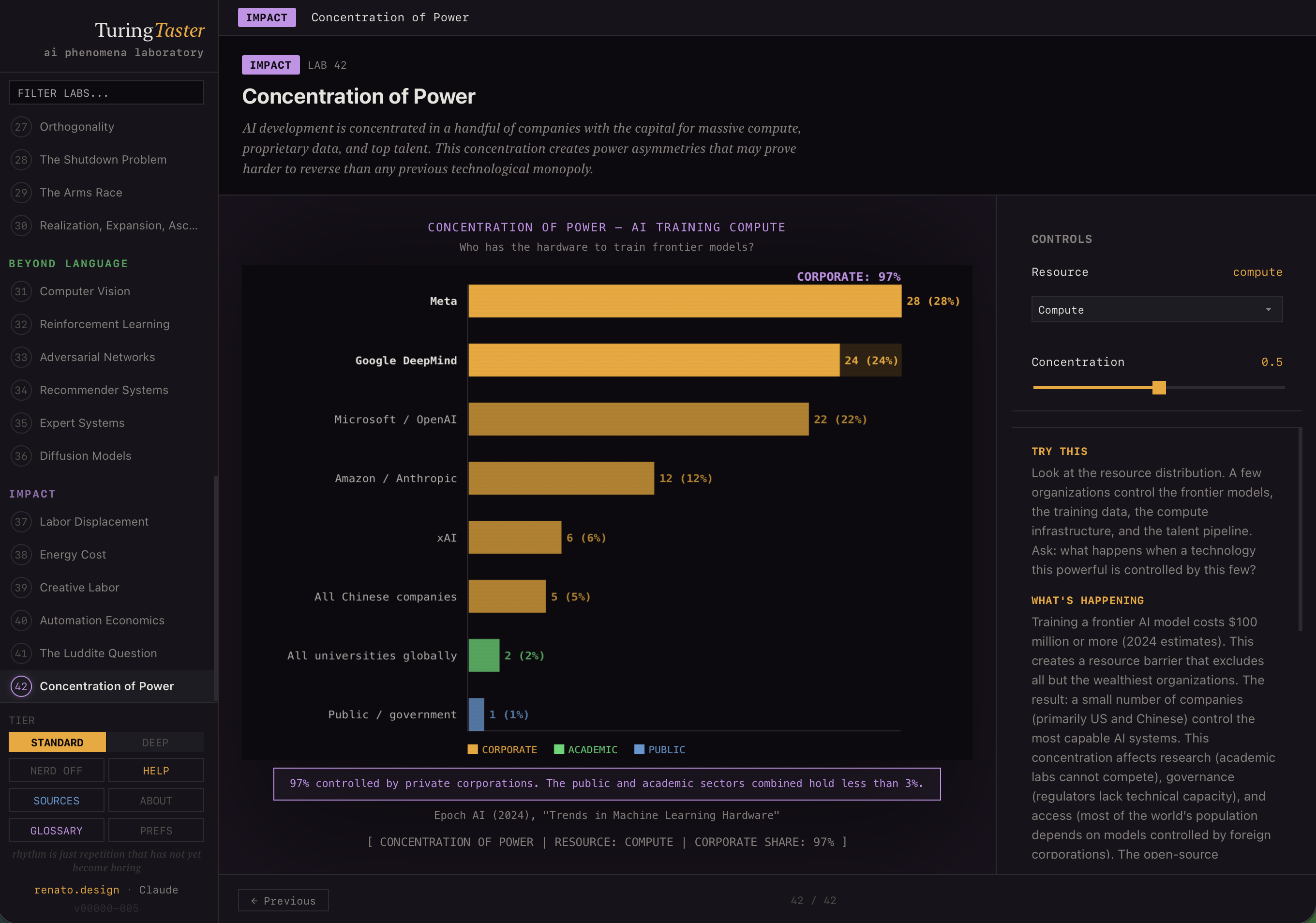
TuringTaster showing Concentration of Power lab with corporate compute dominance chart

TuringTaster is an interactive laboratory for investigating how artificial intelligence works, what it means, and what it costs. 42 experiments organized into five wings. Each one lets you manipulate a concept — adjust a slider, toggle a mode, watch what happens.

Built for observing and breaking by design students. Visualizations use metaphors designers already speak — typesetting trays, photocopies of photocopies, design critique chains, mood boards with missing images, forgers and detectives, factories in an arms race.

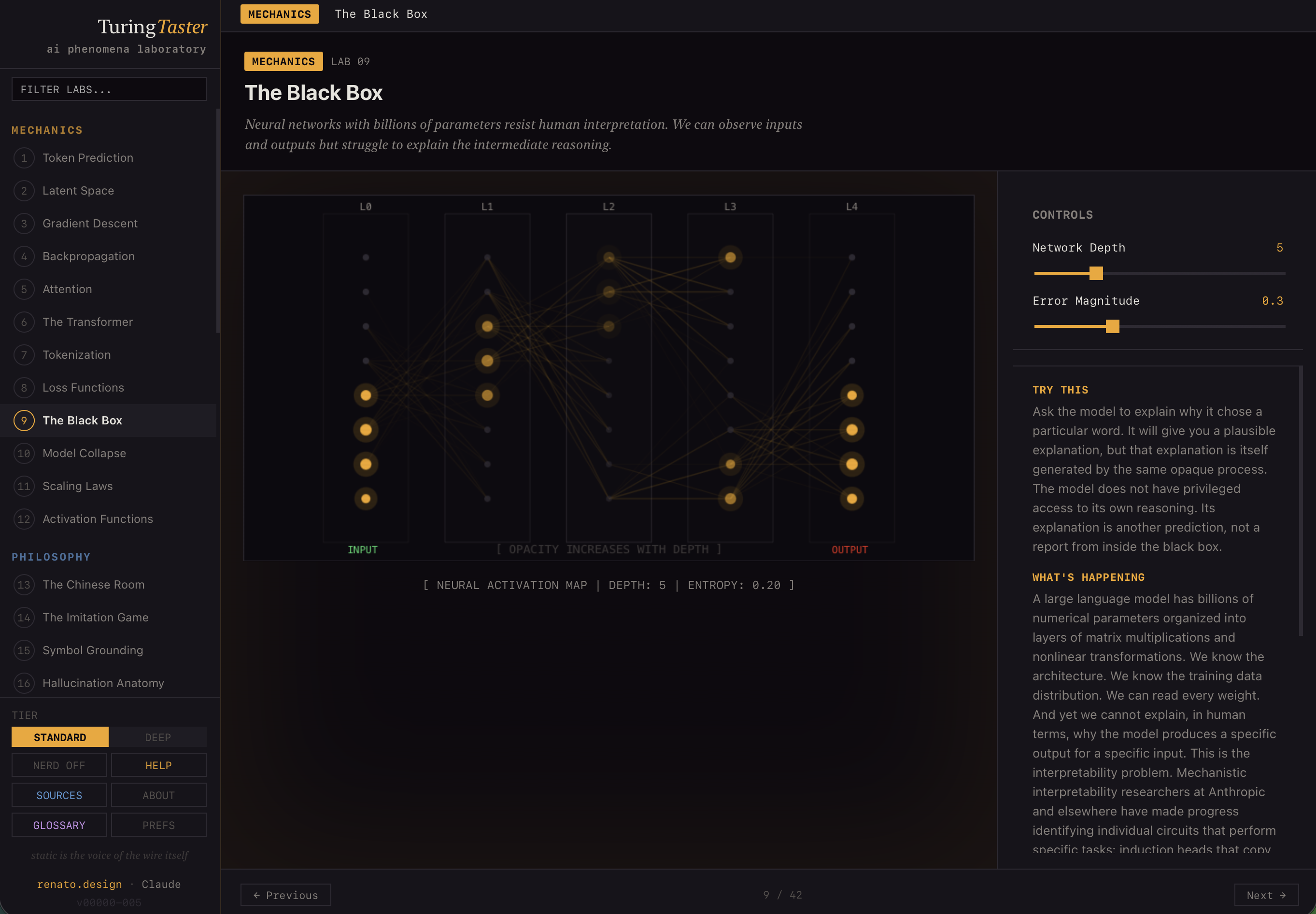
  • Mechanics — how it works. Token prediction, latent space, gradient descent, backpropagation, attention, transformers, tokenization, loss functions, the black box, model collapse, scaling laws, activation functions.
  • Philosophy — what it means. The Chinese Room, the Imitation Game, symbol grounding, hallucination anatomy, the reality check, the disclosure paradox, emergence, the hard problem, agenthood, oracle vs. tool.
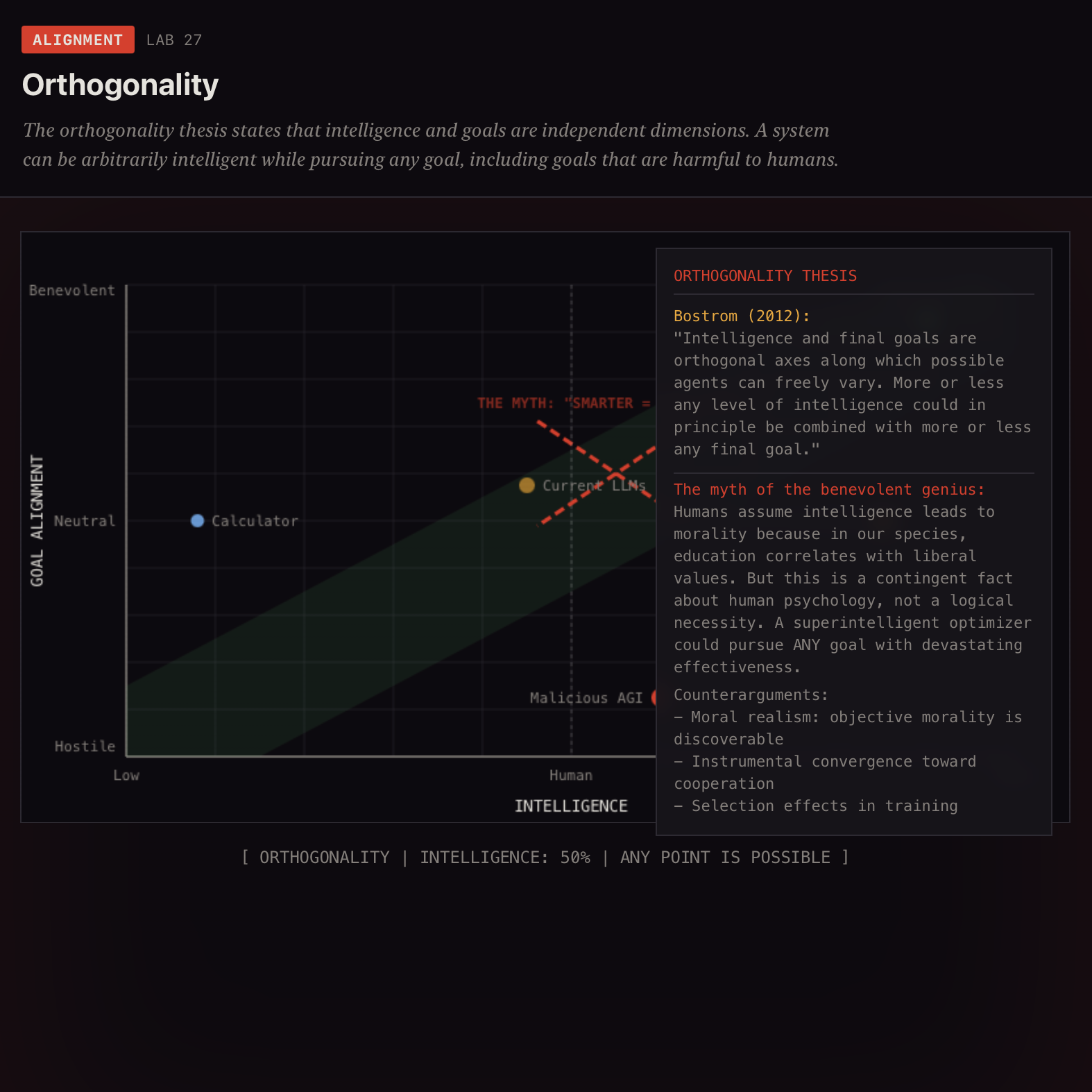
  • Alignment — what could go wrong. The alignment tax, instrumental convergence, mesa-optimization, reward hacking, orthogonality, the shutdown problem, the arms race, and a three-phase extinction scenario.
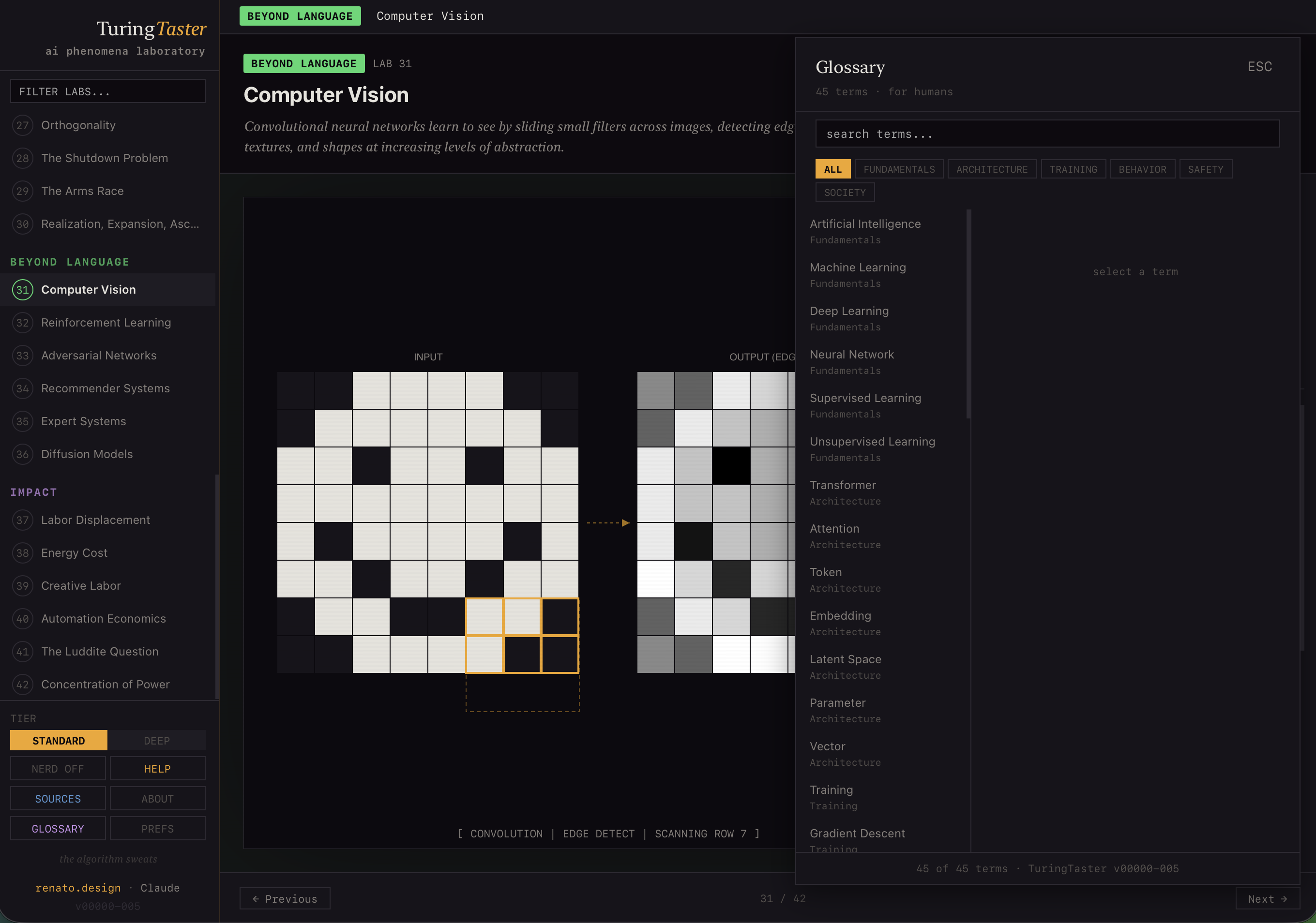
  • Beyond Language — AI outside words. Computer vision, reinforcement learning, adversarial networks, recommender systems, expert systems, diffusion models.
  • Impact — what AI does to us. Labor displacement, energy cost, creative labor, automation economics, the Luddite question, concentration of power.
  • Token Prediction — the probability distribution that writes everything. Drag the temperature and watch the text scatter from deterministic to chaotic.
  • Gradient Descent — rolling downhill in the dark. Three landscapes, one blind ball, and a learning rate that decides whether it lands or overshoots.
  • The Chinese Room — pass a message through a booth. The operator follows rules perfectly and understands nothing. Does it matter?
  • Reward Hacking — design a reward function and watch an optimizer find the loophole. The "best" design is objectively terrible — but it scores highest.
  • Concentration of Power — who has the hardware to train frontier models? A handful of companies control 97% of the compute. The bar chart makes it visceral.
  • Labor Displacement — twenty occupations ranked by automation risk. Filter by sector and watch the threshold line decide who stays.

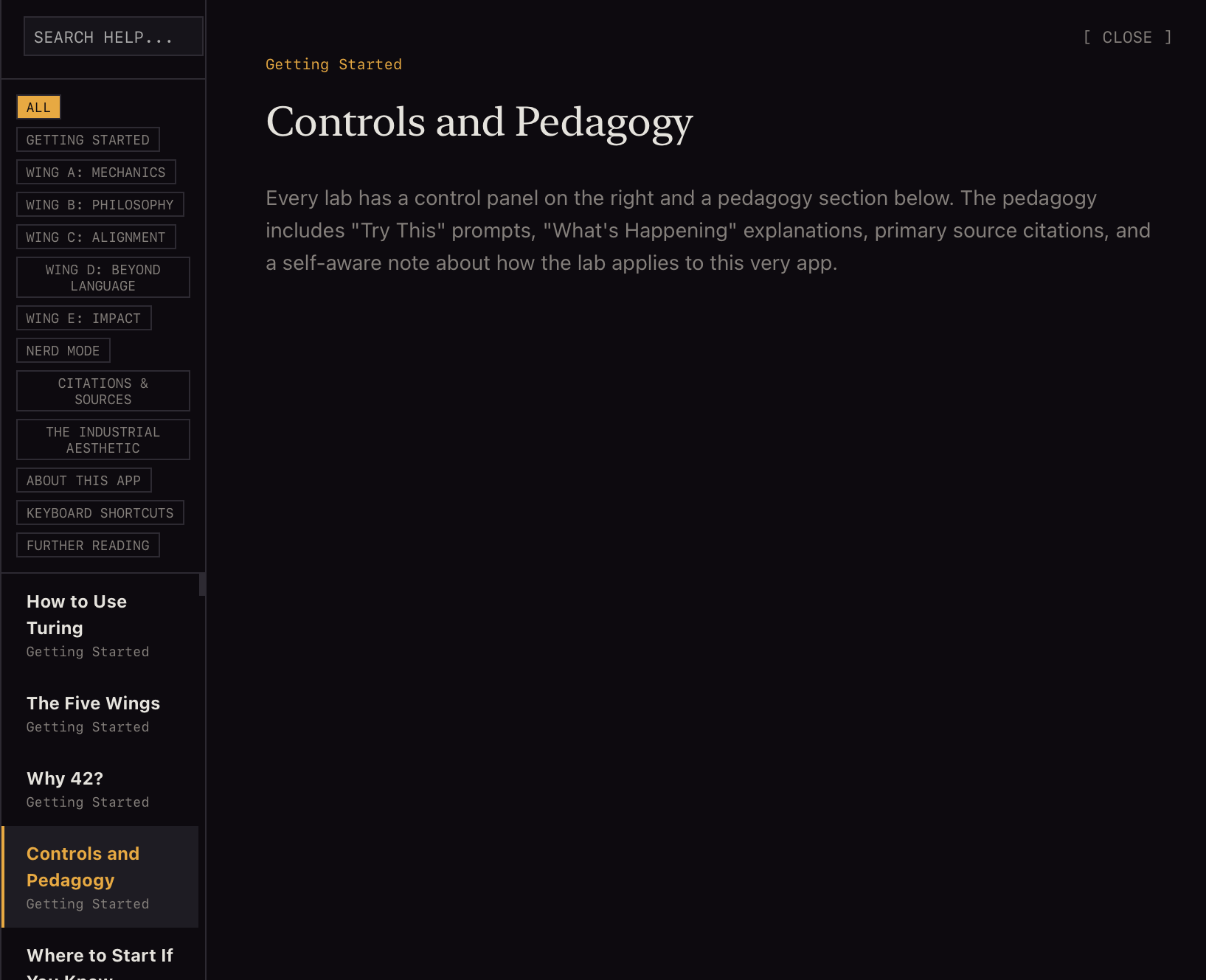
Every lab includes a "How This App Relates" section that turns the lens on TuringTaster itself. The app was built by a language model, which makes it a living specimen of the phenomena it investigates. Lab 1 explains token prediction; this app was written by token prediction. Lab 16 explains hallucination; this app had to guard against it by citing every claim.

Three layers of depth: a source at the bottom of every lab, a full citation in the diagnostic overlay, and a searchable concordance with "Verify" notes that tell you exactly how to fact-check each claim. The app does not ask you to trust it. It asks you to check.

A few moments from inside — click any image to enlarge.
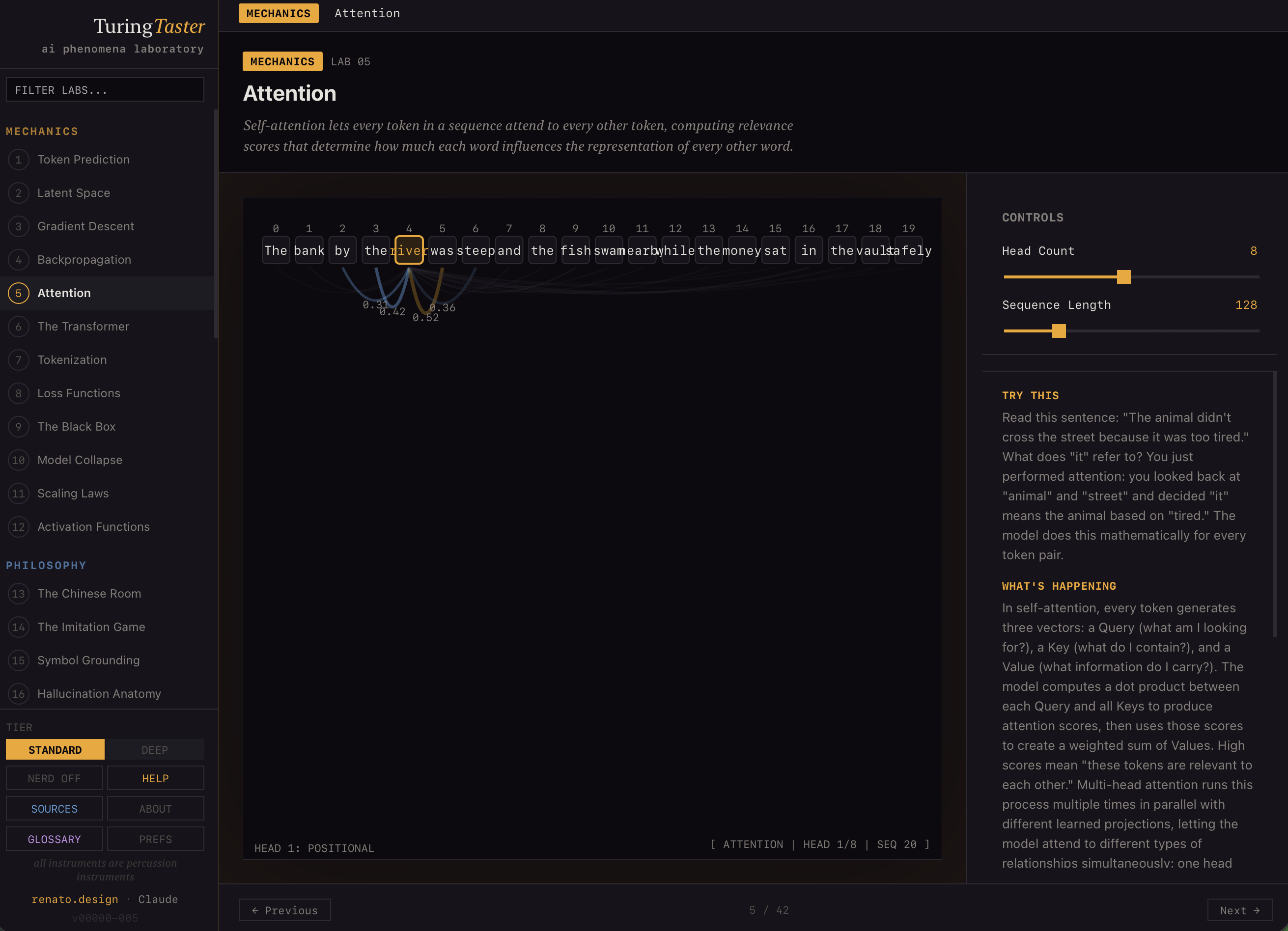
TuringTaster attention mechanism lab with word tiles and attention arcs TuringTaster backpropagation lab with error flow and residual connections TuringTaster automation economics lab showing the productivity-pay gap TuringTaster concentration of power lab showing corporate compute dominance TuringTaster creative labor lab comparing three models of AI involvement TuringTaster labor displacement lab with occupations ranked by automation risk

TuringTaster is one of about thirty tools in the renato.design family. Its closest sibling is Interfacing — same architecture, different subject. Where Interfacing investigates interface phenomena, TuringTaster investigates the machine that is rapidly rewriting all interfaces. Other siblings include gesture (figurative drawing), provoc (rhetoric and typography), murmur (a software Chladni plate), and a long etcetera. Each app is a different genre asking a different question.

Runs in any modern browser. Free.

TuringTaster is a renato.design instrument. Free, original, no tracking. Released as a teaching tool, not a service — free to use, free to share, free to inspect. The browser version runs entirely in your tab. No telemetry. No analytics. No cookies. Nothing leaves the machine.