
what is here
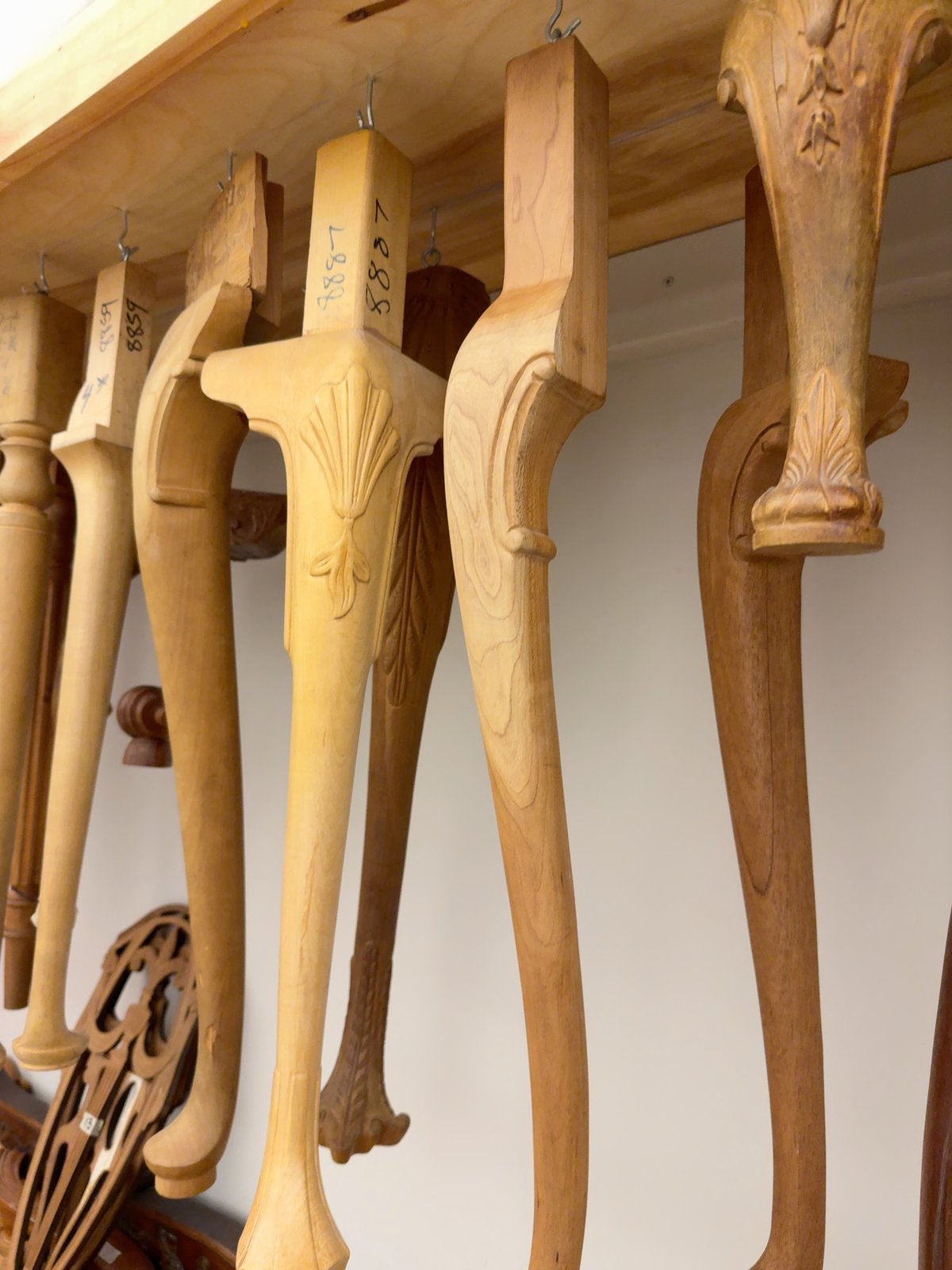
Two scans, captured on April 29, 20261. The first holds a long pale-wood shelf, roughly 1.4 m wide by 2.3 m deep, hung with maybe a dozen carved chair-leg samples in unfinished hardwood. Cabriole legs with various foot terminations - ball-and-claw, scroll, paw, pad - and several square-tapered legs with reeded shafts. Each leg ends, at the top, in a small square block where a tenon would join the seat rail; each block hooks onto a metal peg at the back of the shelf, and each block carries a hand-written number on a strip of masking tape (5287, 5887, 6588, 8859) - the SKU codes a manufacturer uses to keep its sample line organized. Some legs are pale beech or maple; others are dark cherry or stained mahogany. One leg has a red-ink maker's stamp at the top, only partially legible. Behind the shelf, on a wall the scan only partly captures, more carved parts - a fan-shell ornament, a piece of fretwork, what reads as a fragment of a lyre back.
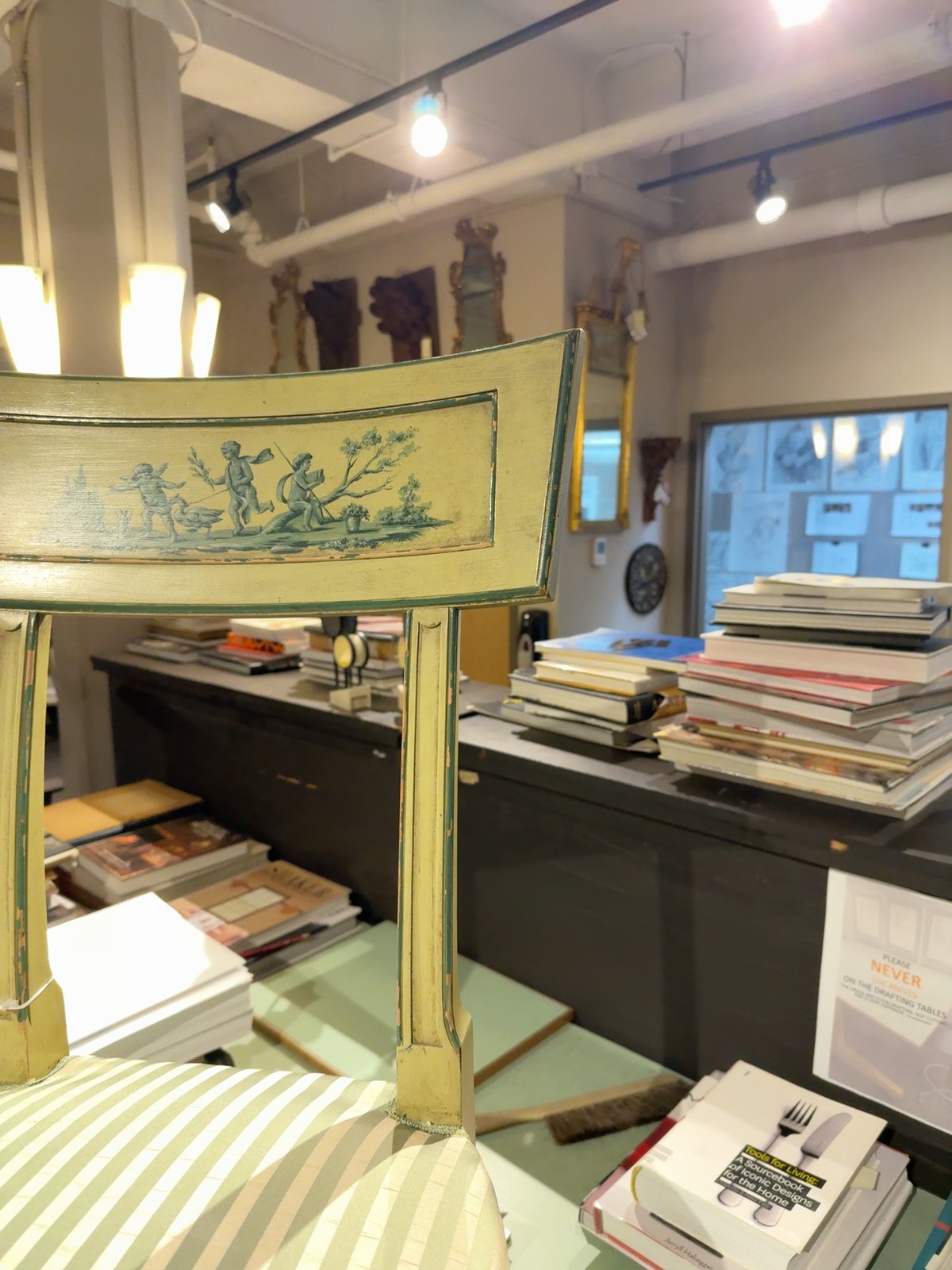
The second scan holds a small painted side chair. Cream paint over hardwood, with darker green trim along every edge. The front legs are square-tapered with vertical reeding - convex ribs running the length of the shaft - and a small carved rosette at the leg-top junction with the seat rail. The back is a single sweeping panel, and the panel carries a painted scene: a green-on-cream pastoral, two human figures with hounds and what may be a deer, framed by stylized tree branches. The seat is upholstered in a striped silk or jacquard, narrow stripes of cream and pale green. The paint has worn through to wood at the front edges of the legs and at the leg-tops, exposing the lighter underlying timber. Whether that wear is two centuries of use or a deliberately distressed reproduction finish is hard to say from the scan alone. The chair sits on a green-grey stone or laminate floor in a study collection - chairs and architecture books visible in the captured background.
Two scans, two rooms. Different points in a chair's life.
the family they belong to
The leg-shelf belongs to a deeper trade family that almost never gets photographed: the manufacturer's sample shelf, the display set of leg styles a chair-builder can specify when ordering custom parts. Most carved chair legs are not turned and shaped from blank by the chair-builder. They are ordered, by SKU, from specialist manufacturers - wood-carving shops, parts suppliers, restoration houses - that produce one thing well at scale and cut a custom run when a chair-builder asks for four of 5287 in pale beech. The vocabulary on this shelf spans about three centuries of chair history: the cabriole leg with ball-and-claw foot is mid-eighteenth-century Chippendale2; the cabriole with paw foot reads as early-nineteenth-century Empire/Regency; the reeded tapered leg is Sheraton or Hepplewhite in origin3; the simple turned spindle is older than any of these and unanchored to a single style.
The painted chair belongs to a tighter family: the neoclassical painted side chair, c. 1780–1820 in its original window, with a long afterlife of revival and reproduction. The reeded tapering legs, the carved rosette at the leg-top, and the painted decoration in a soft palette over a cream ground are signatures of the Adam-influenced English tradition4 and of the Swedish Gustavian tradition that grew alongside it5. Either tradition could produce this chair. So could a careful twentieth-century reproduction in either tradition. The painted scene on the back panel - green monochrome, hunters with hounds, classical trees - gestures at toile de Jouy, though the toile was originally a printed-textile motif rather than a paint scheme6. Borrowing the toile look on a chair-back is an Anglo-Swedish-American move that postdates the textile itself.
What unites the two scans is something less visible: both objects belong to the circulating economy of furniture parts and finished pieces. The legs are samples a chair-builder will specify by SKU; the chair has a small paper tag visible in the scan that suggests it is in a study collection. Both have been catalogued, tagged, photographed by someone before me. Both are objects that exist in a trade.
how they were made
The leg-samples were produced by a combination of lathe turning, bandsaw rough-cutting, and hand carving. A cabriole leg starts as a square stock blank (the small block at the top, still visible because the tenon hasn't been cut yet, gives the original stock dimension). The bandsaw produces the S-curve profile in two perpendicular cuts; the leg is then put on a lathe for any turned elements (a small bobbin at the foot, a bead-and-reel above the ankle); a carver works the foot and the knee - the ball-and-claw, the leaf-spray, the shell - with chisels and gouges. The maker's stamp visible on one leg is the trace of a specific shop willing to sign its work, though the stamp is too partial to identify confidently from the scan.
The painted chair was built and decorated by at least two hands working in sequence. A chair-maker built the frame, joined with mortise-and-tenon at every junction (the rosettes at each leg-top mask exactly where the tenon enters the seat rail). An upholsterer stuffed and covered the seat. A decorator then applied the cream ground in oil or distemper, the dark green trim, the rosettes, and the toile-style scene on the back panel - likely with a stencil for the figure-and-tree composition followed by hand brushwork to soften it. The reeded leg-shafts were probably painted carefully into the gaps between the convex ribs after the carving, creating the green-in-the-grooves look visible in the scan.
The scans themselves were made by a different process entirely. Both are photogrammetry captures from an iPhone, processed on-device by Specimen7. 155 frames over the leg-shelf, 195 frames over the chair, single pass each, neither watertight. The mesh files I am reading are ~40,000 vertices for the legs and ~106,000 vertices for the chair - different fidelities for objects of similar size, mostly a function of how much surface complexity each presents (the chair has more individual painted-and-carved faces; the legs share long convex curves the algorithm could economize on). Both scans pulled in too much room: the kelp-block bbox captures the shelf plus the back wall the camera couldn't avoid; the evening-bead bbox captures the chair plus a rough envelope of the floor and the books behind it.
the system underneath
If the two scans are outputs of a single system, the system has at least three generators operating across both objects.
The vocabulary generator. The chair-making tradition over three centuries has produced a finite catalog of allowable leg shapes (cabriole, tapered, turned, reeded, sabre), foot terminations (ball-and-claw, paw, pad, scroll, hoof, bun), and decorative motifs (acanthus, rosette, toile scene, sprig, swag). Parameters: which century, which national tradition, which workshop's house style. Solver: a trained craftsman working from templates, drawings, or memory. Output: a discrete catalog of shapes any given chair can choose from. The leg-shelf is this catalog made literal - every leg on it is one choice from the same vocabulary.
The kit-of-parts generator. Furniture-making has been a parts trade for at least a century. Specialist manufacturers cut legs to specification; specialist shops upholster; specialist hands paint. The chair-builder is, often, a specifier-and-assembler rather than a shaper. Parameters: which manufacturer's catalog, which SKU, which wood species, which run quantity. Solver: a chain of small businesses talking through samples, drawings, and orders. Output: a sample shelf in one shop, a finished chair somewhere else, the chain that connects them. The kelp-block scan is the sample-display end of the chain.
The decoration generator. Once a chair is assembled, a separate hand can turn it into a singular object by painting it. Parameters: ground color, trim color, motif, scene, palette, level of distressing. Solver: a decorator working in a specific moment with specific taste. Output: this particular chair, with this particular toile scene, in this particular green-and-cream palette, at this particular level of wear. The evening-bead scan is one output.
What the two scans together reveal: the shelf and the chair belong to the same economy at different points. One is samples awaiting specification; the other is a finished assembly that has accumulated decoration and time. Different rooms, different parts of a chair's life.
what is lost in the abstraction
The hand that wrote 5287 on a piece of masking tape and stuck it to the top of a leg sample. That is a person making a catalog record in real time, and the record is fragile - the masking tape will yellow and the marker will fade and someone will eventually have to re-tag the leg or accept that they no longer know which catalog number it was. The system description treats inventory as data; the scan shows it as a temporary artifact of human attention.
Also lost: whether the painted chair has been sat in. The seat upholstery is in good condition - no obvious dishing, no obvious wear - which could mean the chair is rarely used, or could mean the upholstery has been replaced once in its lifetime. The painted finish has worn through at the leg-fronts, which is exactly where a chair gets dragged under a vanity or pulled out from a writing desk. It has been used somewhere, by someone. Where it lives now is a different question than where it was used.
what they reveal
A photograph of a finished chair tells you what a chair is. These two scans, considered together, tell you what a chair is made of - both literally (parts, joints, paint, fabric) and economically (the trade network that gets samples to specification to assembly to decoration to display). The chair-vocabulary is a real thing. It is something you can hang on a shelf.
Phil's coinages for the two scans - kelp-block for the legs, evening-bead for the chair - are not the names the trade uses. They are observational names that arrived from looking at the scans. The carved cabriole legs do hang and curl on the shelf like kelp on a board. The chair does have an evening-light register, and bead-and-reel turnings on its legs, and small painted bead-rows along its rails. The scan-namer was reading what the scan showed without consulting a catalog.
That is its own kind of reading. Not the reading the maker would give. Not the reading the dealer would give. The reading a phone walking through a room would give if it could only describe what it saw, in its own words.