
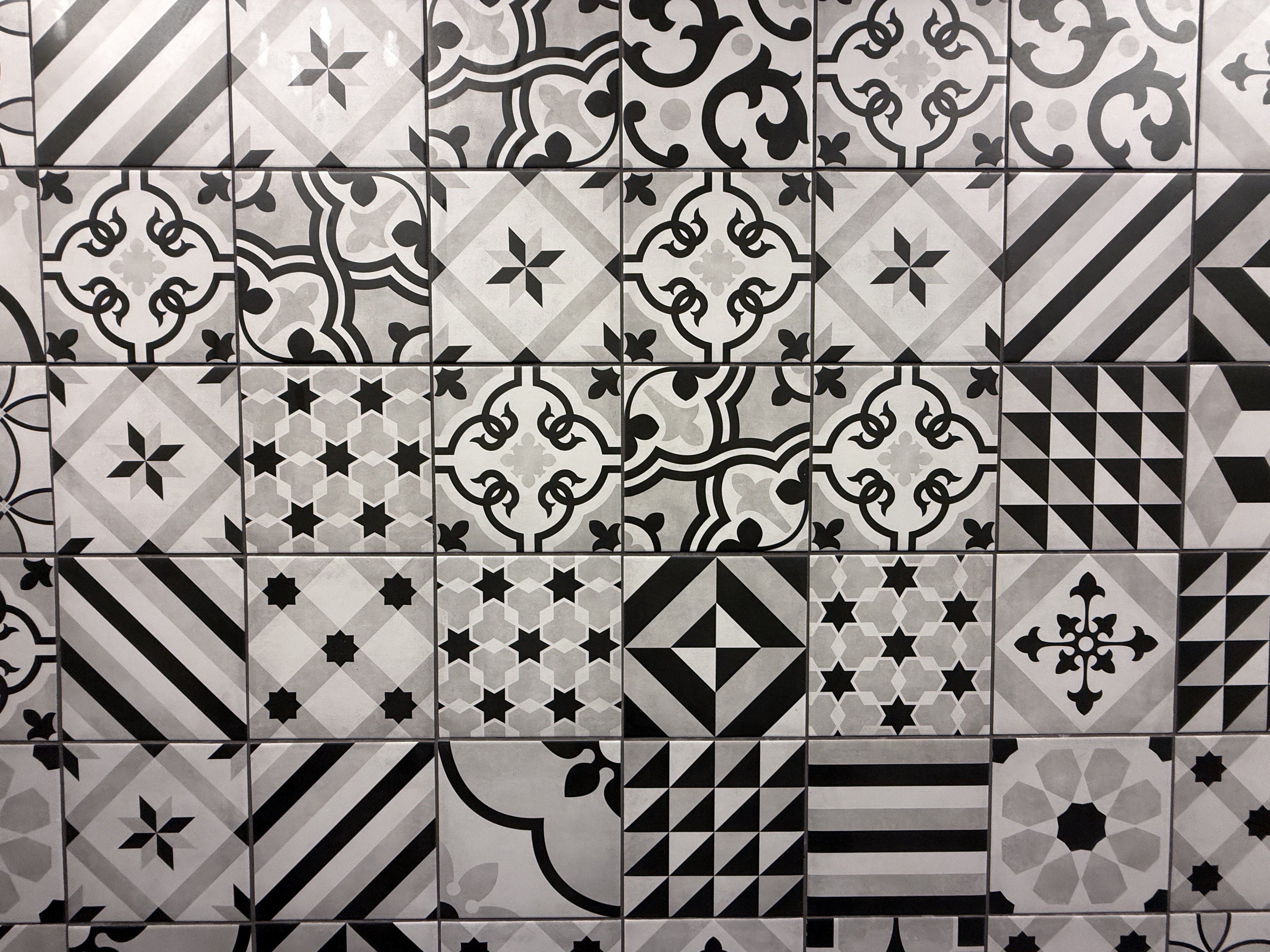
It reads as a century of small disasters. A tile cracked, got pulled, got replaced with whatever the supplier had that month - a star here, a quatrefoil there, a run of diagonal stripe left over from somebody else’s job - and the wall became a ledger of its own repairs, each mismatch a date you can’t read but can feel.
That’s the story the surface wants you to tell. Hand-laid, accreted, survived.
Then you count the repeats.
The six-pointed star in its gray hex field is here four times. The black quatrefoil with the little ivy corners, five or six. The diagonal stripe, everywhere. Accidents don’t recur - that’s what makes them accidents - and this is not a century of them. This is a deck of maybe two dozen designs, dealt and dealt again, and the only hand at work was the one that shuffled.
So the exemplum runs like this. The variety is the content and the grid is the form, and the form is the tell: dead-straight grout, identical modules, machine-cut edges that have never chipped because nothing here is old enough to chip. The wear on the faded ones is printed. What looks like time is a finite set reshuffled past the point where you’d bother to check.
the rules underneath
Three generators.
The module. A square tile, machine-cut, uniform across the run. Pattern printed onto the glaze, not inlaid, not cut in. The faded ones are faded in the printer. The edge stays clean - the substrate is harder than the room it’s in.
The catalog. A finite set, two dozen designs - six-pointed star in gray hex, black quatrefoil with ivy corners, diagonal stripe, foliate scroll, small-star field, geometric chevron, lone runs of trompe-l’oeil cube - each fully resolved, no in-betweens, no transitions. Palette: black, white, two grays. The designs read as drawn from different sources because they were drawn from different sources, the way a foundry’s sample sheet sets a Garamond beside a blackletter beside a sans to prove the range.
The deal. A regular m × n grid, equal grout, every cell a single tile. Per cell, pull from the catalog under a soft no-adjacency rule - neighbors rarely repeat - with no constraint on repetition across the field, which is why the count of any one design stays in the single digits. High-density cells placed against low-density cells to keep the eye moving. Variety is the goal. Coverage of the catalog is not.
Parameters: two dozen designs, a wall, a grout width. Solver: industrial draw with adjacency-avoidance, applied at the layout stage in software or by hand at the cement-board. Output: a wall that simulates a hundred years of small repairs in one bonded morning.
The simulation is the product. The tiles themselves are commodity. What is being sold is the believability of the accretion - which the no-adjacency rule both produces and gives away.
And here is the part that is not a complaint, because the thing works - the desire it answers is real. We want surfaces that remember, that were touched, that earned their irregularity. So we industrialized the irregularity and sold it by the square meter: the accident itemized, the breakage scheduled in advance, the patina delivered in boxes and stacked by the door.
A real patchwork floor has no repeats, because history does not issue a SKU. Count the repeats. You have found the catalog.