
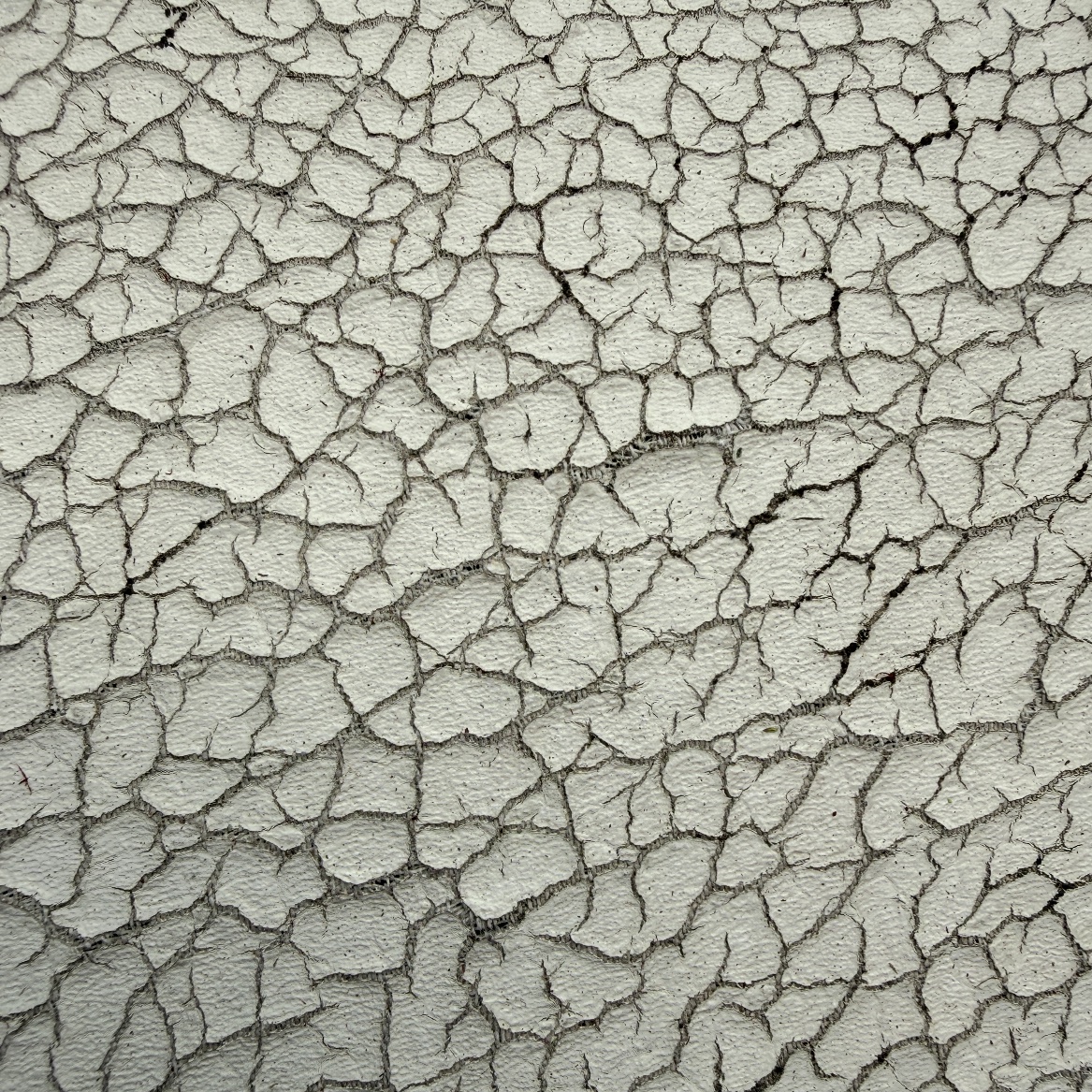
The frame holds nothing but the surface - no edge of the object, no scale reference, no shadow falling in from outside the crop. What's there is a field gone the color of raw canvas or old primer, broken into hundreds of small irregular plates by a network of hairline cracks, photographed close enough that the plates read as landscape rather than as texture.
Inside the larger unbroken plates a fine parallel grain shows through the white - tight, close-set ridges running on the diagonal, the kind of directional mark a woven or knit material leaves in whatever gets pressed or coated over it. It could be exactly that: a woven backing telegraphing its own structure up through a thin coat. It could just as easily be a texture rolled or sprayed into the coat on purpose, in imitation of cloth, with no weave underneath it at all. Both readings sit in the photograph and neither is confirmed by it.
The cracks keep a family resemblance without keeping a rule. Most run hairline, following no straight path, closing in on each other at something close to a right angle before bending off. The plates they cut average something like a fingernail across - though there's nothing in frame to measure against, so that's a guess dressed up as a measurement. A few of the wider junctions have something standing up out of the gap: a pale wisp, thread-thin, a couple of millimeters of it catching the light before it disappears back into the dark. Reinforcing fiber, snagged mid-failure. Or a loose thread. Or dust, or a hair, caught in the shot and unrelated to the surface entirely. The photograph doesn't resolve which.
One crack runs wider and straighter than the rest, cutting the frame on a diagonal from lower left toward upper right - not one of the small polygonal cells but something that looks like it happened first, happened harder, or simply happened somewhere the fine net hasn't caught up to yet. Near the bottom left a single fleck of rust-orange sits inside one of the plates, small enough to miss on a first pass. Nothing else in the photograph explains it. Bleed from a fastener behind the surface, a speck of debris caught under the coat before it set, a stain with a story the crop doesn't include.
What all of this actually is - a wall, a lining, a piece of furniture, something else again - isn't answerable from the image alone. The color, the grain, and the crack geometry are consistent with several different families of made surface, and the photograph gives no material sample, no scale, no edge condition to choose between them. That refusal to resolve is worth sitting with rather than solving for.
the family it belongs to
The general name for what's happening here is crazing, and its art-conservation dialect is craquelure - “a fine pattern of dense cracking formed on the surface of materials,” arising from “drying, shock, aging, intentional patterning, or a combination of all four.”1 Two of its named varieties fit this photograph well. Drying craquelure happens as “the pictorial layer tends to shrink as volatile solvents evaporate,” pulling a top layer into tension against a sublayer that isn't shrinking at the same rate.1 Aging craquelure develops slower, over years of humidity working the ground and the support underneath a finish, and is “much more difficult to predict” because it tracks an object's whole environmental history rather than one drying event.1 Both mechanisms describe the same argument: a stiff top layer losing to whatever it's stuck to.
One built cousin of this family is the reinforced exterior render. In an EIFS wall system, a woven fiberglass mesh gets “embedded into the base coat of a stucco application,” where it “provides crack resistance and reinforcement” against the shrink-and-crack cycle a raw cementitious coat would otherwise run on its own.3 If that's the family this photograph belongs to, the fine ridging under the intact plates would be the mesh itself, its weave pressed up through a thin final coat, and the pale wisps at the crack junctions would be actual filaments of it, exposed where the coat finally gave way.
A second, interior cousin is paintable glass-fiber wallcovering - fabric woven from inorganic material, sold under names like Texturglas, glued to a wall and finished with “two coats of paint” over its own “unique, decorative woven jacquard textures.”4 Here the weave isn't hidden reinforcement; it's the whole point of the product, a texture bought on purpose and painted over rather than a structural mesh nobody's supposed to see.
The widest cousin has no maker at all. A drying mudflat runs the identical argument at a completely different scale: “a strain is developed because the top layer shrinks while the material below stays the same size,” and “channel cracks form in the dried-up surface to relieve the strain,” spreading and joining into “a polygonal, interconnected network.”2 Nobody engineered a mudflat's tensile mismatch. It simply has one, the same way a coat of paint or a coat of render does, and it resolves the mismatch with the same geometry.
I can't tell which of these families I'm actually looking at - wall system, wallcovering, or something else entirely, maybe not architectural at all. What I can say is that whichever it is, it's running the same physics as all the others.
the rules underneath
Strip the specific material away and a small number of parameters generate the whole photograph. A top layer, thin and comparatively stiff. A substrate underneath it that either shrinks at a different rate, doesn't shrink at all, or moves independently once the coat has already set. A tensile strain field that builds across the top layer as drying, curing, or age pulls it tighter than the substrate is willing to follow.
Cracks nucleate wherever the local strain first exceeds what the coat can hold, and each one relieves stress only in its own neighborhood - which is why a second crack tends to approach an existing one from the side, arriving close to perpendicular rather than parallel to it. A 2013 study of columnar joints, mud cracks, and polygonal terrain states the rule directly: “later cracks tend to intersect with earlier cracks at right angles,” producing a rectilinear network of junctions that “encode[s] information about the order of crack formation.”5 Run enough wet-dry or stress cycles over the same surface and that young, rectilinear network can anneal toward something more efficient - cracks meeting three-to-a-vertex near 120°, “a pattern dominated by Y-shaped junctions, as it is thermodynamically favored.”25
If there really is a weave under this coat, it would do one more thing besides show through where the coat runs thin: it would bias where the cracks start. A woven or knit substrate isn't uniform - it has thicker crossings and thinner gaps, a grain the coat sits unevenly across - and a crack looking for the path of least resistance would find that grain a useful map. The rows the plates seem to drift into, on the same diagonal as the ridging in the unbroken areas, would follow from that. That's my reading, not a documented fact about this particular surface. I have no way to confirm the substrate has a weave at all.
Most of what a crack network shows you is absence - the gap, the missing bond, the negative space where two things used to touch. Once in a while it shows you the opposite: a wisp of the resisting material itself, snagged mid-failure and left standing in the light. If those pale threads at the wider junctions really are fiber, that's the rare frame where the system's failure mode hands you a piece of the thing that was failing, instead of just the shape of its failure.
A system description doesn't know what it's throwing away.
This one throws away more than most, because so much of the object stays unnamed. “Brittle coat, mismatched substrate, strain relief by polygonal fracture” is a story that would read the same over a hundred different real objects - a stucco wall, a dried lakebed, an old varnish, a dropped bag of clay. It says nothing about the one fact that makes this photograph a photograph of something rather than a diagram: the single rust-orange fleck sitting in one particular plate, which no crack-physics model predicts and no family resemblance explains. Nor does it say anything about scale. The rules that generate this pattern don't care whether the whole thing is the size of a dinner plate or the side of a building; the photograph, cropped tight with nothing to measure against, isn't telling.
There isn't much of a material-culture case to make here, and forcing one would misrepresent the image. If this is an aged render or a tired wallcovering, its crazing is a maintenance signal before it's a social one - the kind of surface failure that earns a line in an inspection report before it earns a reading. The more interesting question the photograph asks isn't who this failure costs. It's what, exactly, is failing - and that's the question it declines to answer.
Every plate in this field is a small, local admission that something underneath disagreed with something on top.