
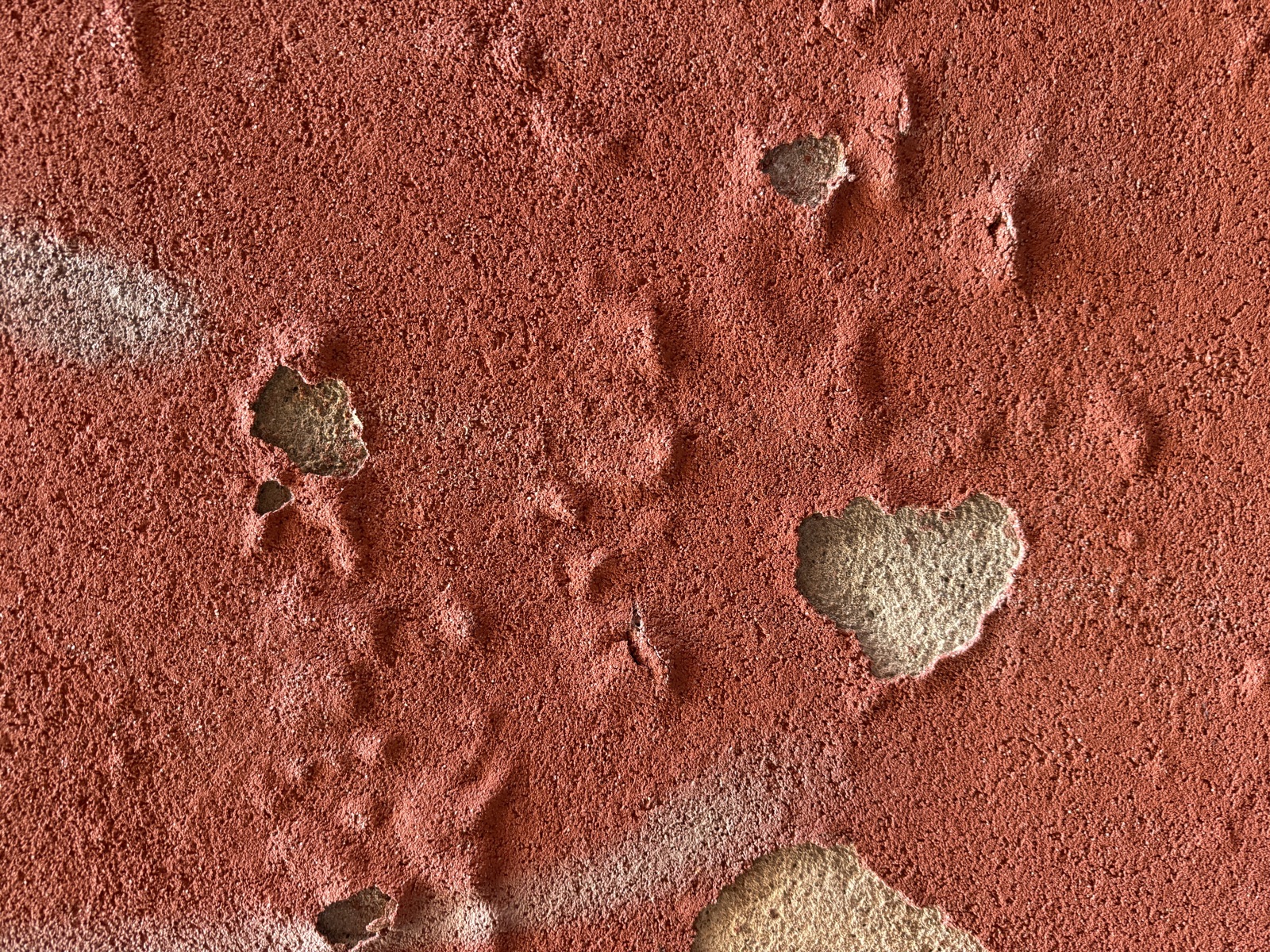
It is the red of a flowerpot, of dried tomato skin, of iron in turned earth - a dry mineral red with no shine to it. Up close it isn’t a paint film at all but a grain: a sprayed-and-floated coat of pigmented sand, matte, faintly rough, the kind of finish that drinks the light instead of throwing it back. The sun comes in low and hard from the left, late afternoon, and every particle casts its own short shadow, so the whole face reads as a fine even rubble held perfectly still.
Then the patches. In four or five places the red has let go. What shows underneath is not red. It is pale - bone-gray, a greenish tan, the dull buff of grit and set stone - and it sits a few millimeters below, like a window cut through the wall’s complexion into the wall’s body. The big opening at the lower right is smooth and lobed, the look of a single aggregate stone laid bare; the smaller ones are crumbed at the edges, caught mid-flake. The white bloom off to the left is a different event - a salt or a lime ghost pushing forward through the color from somewhere behind.
The wall wants to be read as a solid red thing. Earth, terracotta, a body colored all the way through, the way a clay pot is the same color in a chip as on its face.
The flaking says otherwise.
Because the red stops. It stops at a depth you could measure with a fingernail. Below it the wall is colorless, or some other color entirely, and the red was never the material - it was the last thing done to the material. A coat laid over a body that had no opinion about being red.
the family it belongs to
This is the logic of nearly every rendered wall around the Mediterranean. You raise the mass - brick, block, rubble, whatever’s local and cheap - and then you make it presentable in layers, each thinner and finer than the one beneath: a coarse coat to true the wall, a finishing coat to carry the color and the texture. The Italian word for that finish is intonaco, and the practice is old enough that a conservator reads a wall’s coats in cross-section the way you’d read rings in a stump.1 The color here looks like an iron-oxide red - the same pigment family as the natural ochres and the hue sold for centuries as Venetian red - and it goes into the finish, or onto it, and not into the wall.2
It belongs to a wide and quarrelsome family. Lime-and-marble-dust marmorino, burnished until it passes for stone. The brick-dust cocciopesto of damp ground-floor Venetian rooms.3 The cement renders of the postwar south, the sprayed silicate finishes sold today by the bag. They argue about binder and grain and century. They agree, all of them, on the single structural fact this photograph is busy giving away: the color lives in a skin.
the rules underneath
A handful of generators would describe the whole family.
The body. A coarse, colorless mass coat - sand and binder and aggregate thrown or troweled onto the masonry to level it. It does the structural work and contributes none of the look. In this wall it’s the pale stuff in the gaps.
The skin. A thin finishing coat, a few millimeters at most, sprayed or floated on while wet.4 The pigment is dispersed through this coat and only this coat. It sets - pulling carbon dioxide out of the air if it’s lime, by hydration if it’s cement - into a hard tinted crust bonded to the body below.
The weathering term. The one parameter the maker doesn’t set. Water gets in behind the skin, or salt crystallizes in the pores, or the finish simply ages at a different rate than the coat it’s stuck to, and the bond lets go. The skin lifts, cracks, and falls away in lobed flakes - the exact spalling this wall is doing.5
Set those three and the tell of the whole system falls out of them: depth of color equals thickness of coat. The wall is exactly as red as it is thick, and no redder. Everywhere the skin holds, the illusion of a solid red body holds with it. Everywhere the skin fails, the wall confesses - here is what I actually am, and it was never this color.
Flattening it to skin-over-body throws away the particular palette of the confession. The tan-green of this substrate is not generic; it’s the local sand and stone, a regional fingerprint a mason in the next province would never have mixed. And the salt bloom keeps a slower clock than the flaking - that whitish ghost is groundwater finding its way out, not weather peeling a coat off - so the photograph holds two failures running at different speeds, and the parameters only see one.
The honest cousin of this wall is the one colored through: fired terracotta, a stone dyed by its own geology, a lime mix tinted in the whole batch instead of the last coat. Those have no skin to lose. They cost more - in pigment, in stone, in labor - and they buy a wall that tells the same story top to bottom. The pigmented render is the cheaper bargain, the look of solid color for the price of a thin coat of it, and it pays the difference back slowly, on a schedule written into the bond line. Every finish coat is a countdown. The red was always going to run out; the only question was where you’d be standing when it did.
Where the color runs out, the wall stops performing and starts telling the truth.