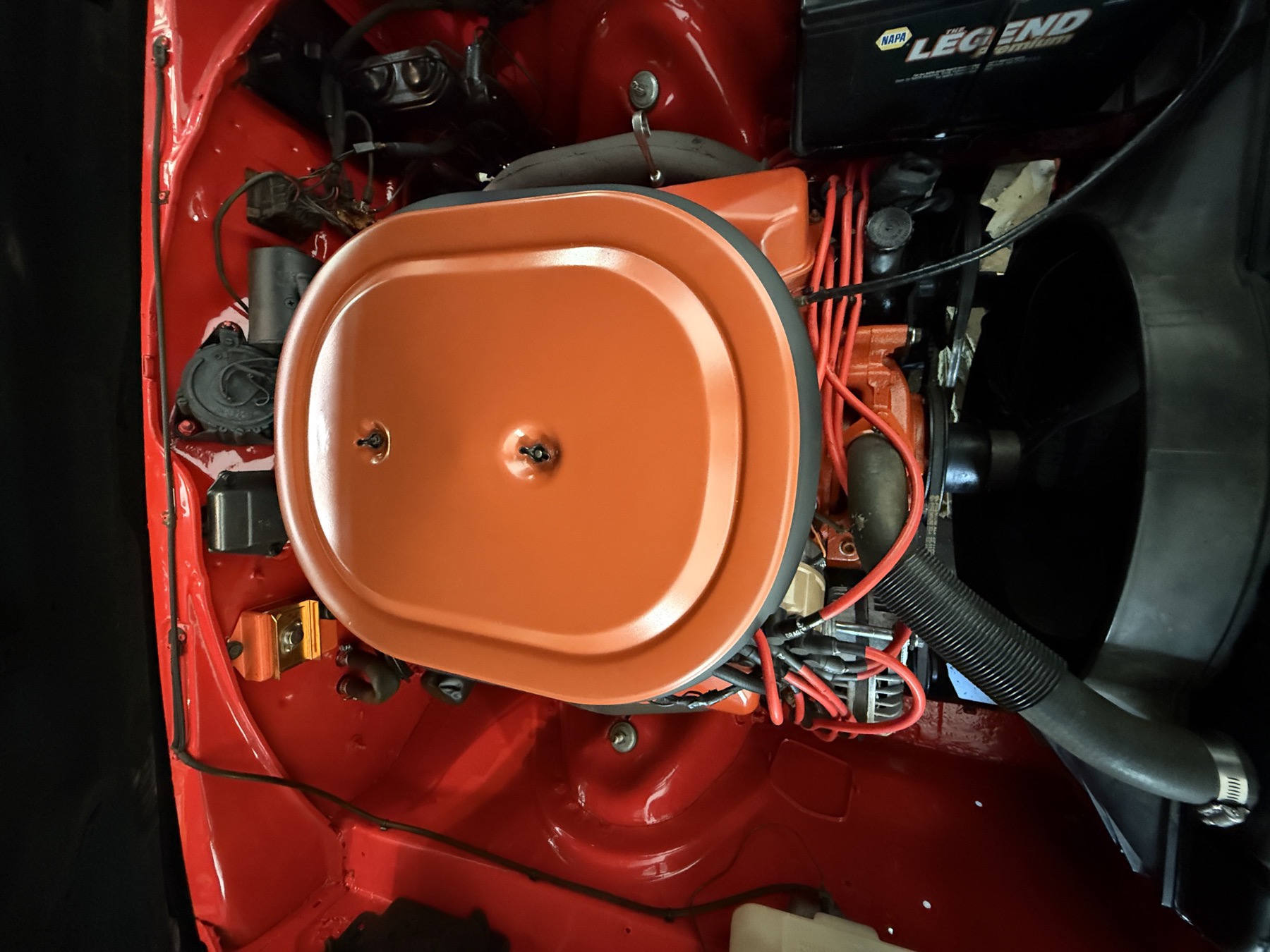
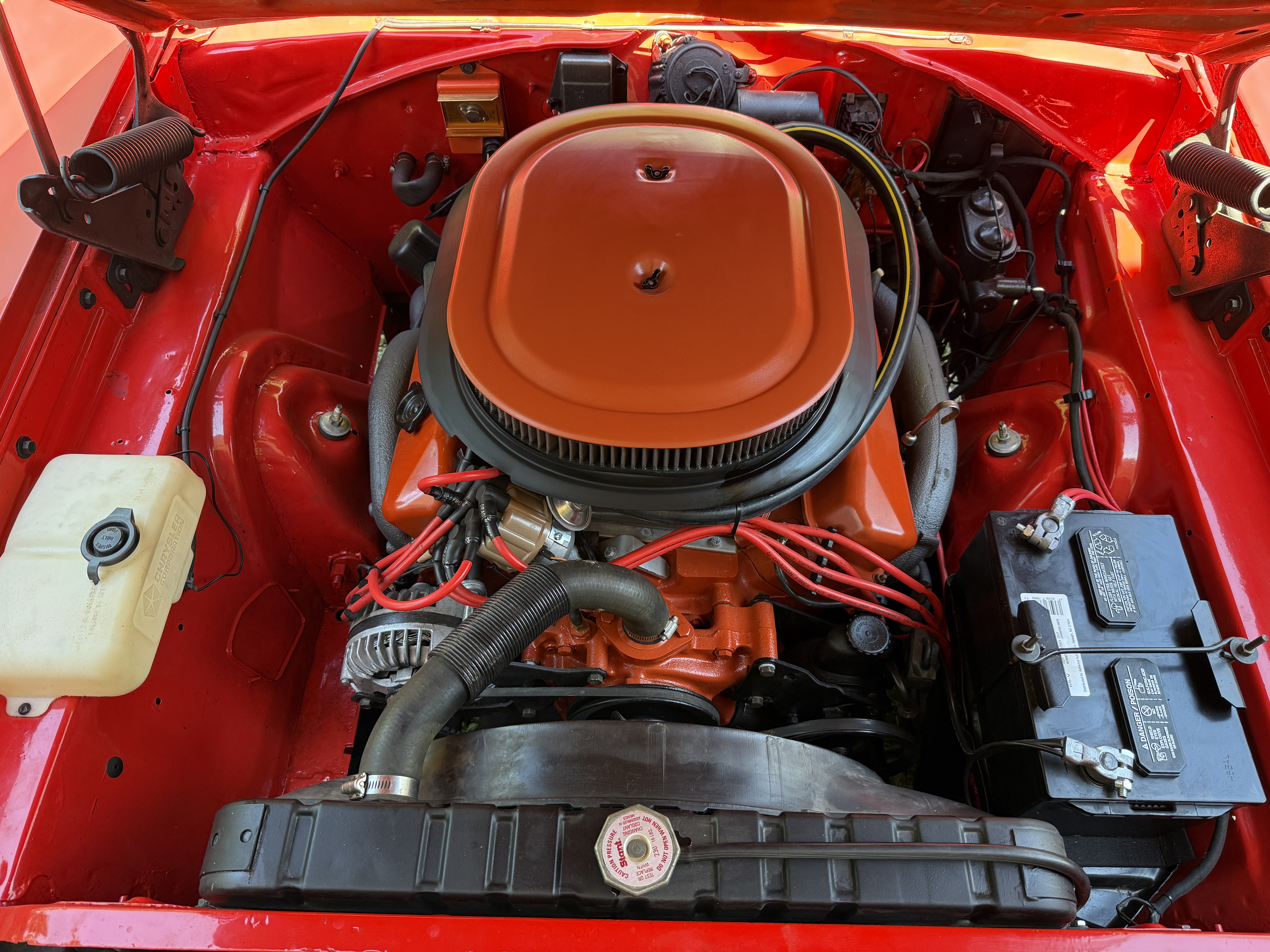
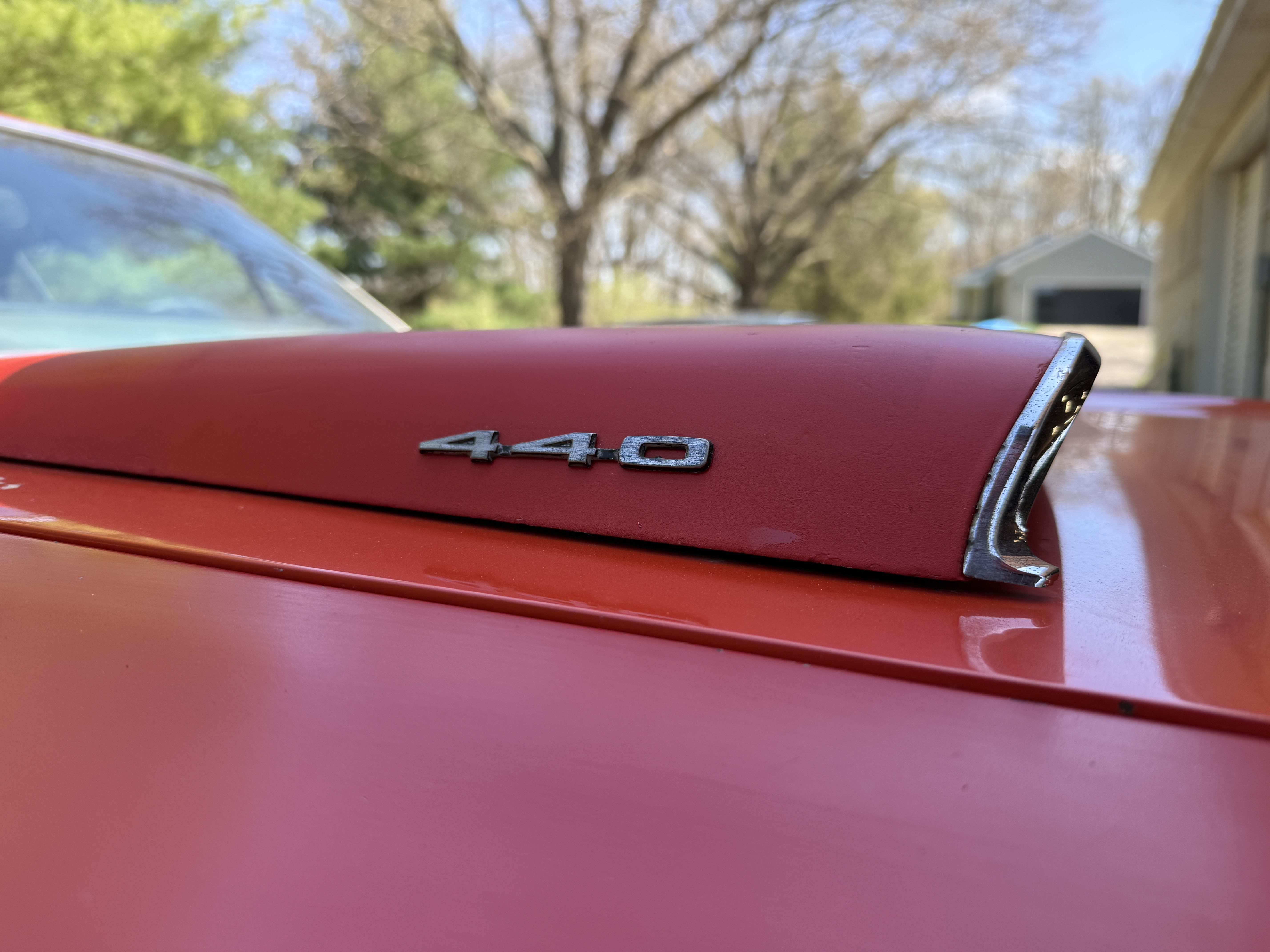
The 440 Six-Pack is a 440-cubic-inch Chrysler RB engine — a member of the Raised Block (RB) big-block family that also produced the 413 and 426 wedges — fitted with three two-barrel Holley 2300-series carburetors atop an aluminum Edelbrock intake manifold. Total carburetor airflow on a tuned-up Six-Pack is around 1,375 cfm; for context, a single Carter Thermo-Quad on a regular four-barrel 440 is rated about 800 cfm. The engine made 390 horsepower gross at 4,700 rpm and 490 lb-ft of torque at 3,200 rpm, in the period rating system.
Mechanically the V-code engine differs from a U-code (single 4-barrel) 440 in valve springs, pushrods, the connecting rods (forged in 1970, with reinforced beams), the harmonic balancer, and of course the induction system. The center carburetor handles part-throttle operation; the outboard carbs are vacuum-actuated and open progressively as throttle and engine load demand. Properly tuned, the engine runs as a tractable street engine until the secondaries open, at which point all 1,375 cfm of carburetion is on tap.
In 1970 the Six-Pack was available in the B-body Super Bee, Coronet R/T, Charger R/T, GTX, and Road Runner, and in the E-body Challenger R/T and 'Cuda. It was less expensive than the 426 Hemi (the Hemi was an $800–900 option in 1970 dollars; the Six-Pack ran $250 less or thereabouts) and most road tests rated it as nearly as quick at the strip while being substantially more streetable. Several thousand were built across all body styles and divisions; precise per-VIN counts come from the Super Bee Registry, the 1970 Charger Registry, and Galen Govier's binders.
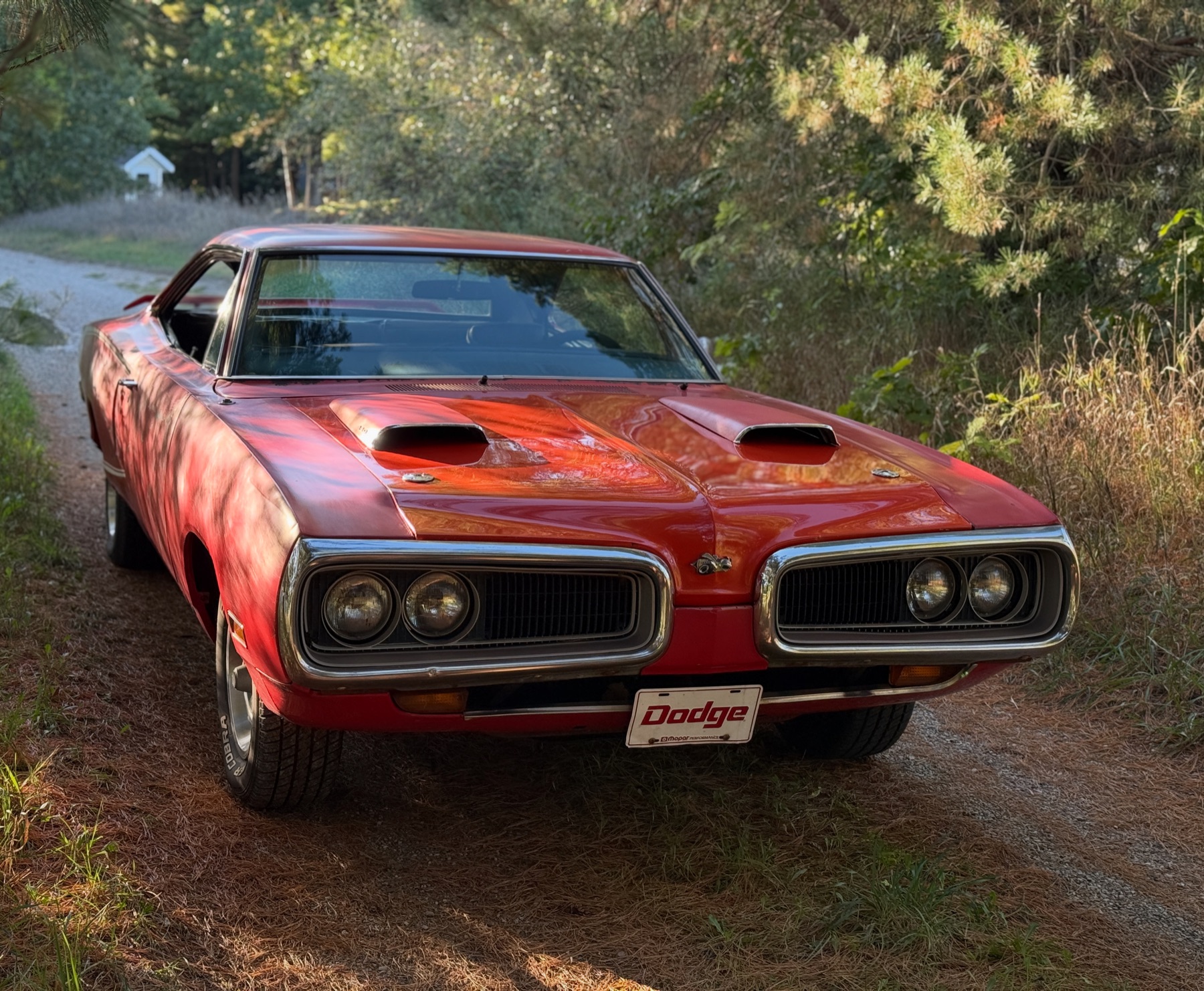
The V-code is the engine in Phil's 1970 Super Bee.