Ruby (Synthetic, Verneuil Flame-Fusion)
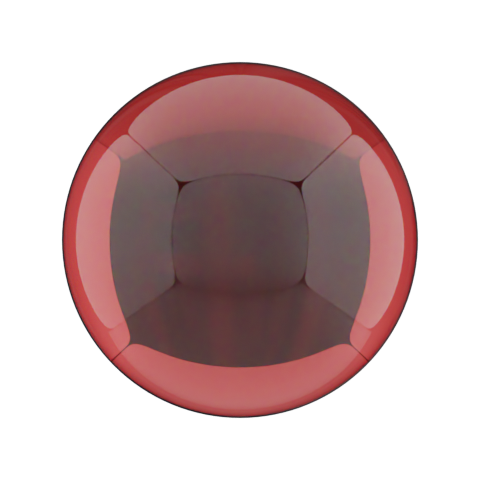
Cycles render · authored materials + studio HDR
The first commercially mass-produced synthetic gem — Verneuil flame-fusion ruby has been on the market since the early 1900s (process publicly announced 1902, published 1904). Same chemistry as natural ruby, same hardness, same fluorescence — it was Maiman's choice for the first laser in 1960 because synthetic ruby boules grow large enough and pure enough to lase. Distinguishable from natural ruby by curved growth striae and an absence of natural-mineral inclusions. The default substrate for ruby watch jewels and many decorative-jewelry rubies.
α-Al₂O₃:Cr by Verneuil method — Cr-doped alumina powder fed into oxy-hydrogen flame (~2050 °C), molten droplets accumulate on a slowly-lowered ceramic / sintered-corundum support to form a pear-shaped boule (modern systems often use a seed crystal with rotation; original Verneuil method used a fire-clay rod). Identifiable from natural by curved striae, gas bubbles, and absence of geologically-meaningful inclusions. Same crystal structure, fluorescence behavior, and physical properties as natural ruby.
Mechanical
- Mohs hardness9
- specific gravity3.99
Optical
- refractive index omega1.77
- refractive index epsilon1.762
- fluorescence r line · nm694
Sustainability
- embodied carbon · kg CO₂e/kg12
- recyclabilitymoderate
- biodegradableFalse
- visual
- saturated red, often visibly more uniform than natural ruby
- tactile
- indistinguishable from natural ruby by hand
PBR starter values
finish · crystalline — open for table, JSON, host snippets, downloads
Principled BSDF defaults derived from the sphere crystalline finish. Reasonable seed for Blender, Substance, Keyshot, Rhino — tune per material. Or grab the whole library at once: ForMaterials library →
# finish:                   crystalline
albedo                      #b81a30
metallic                    0.00
roughness                   0.05
ior                         2.42
transmission                1.00
clearcoat                   0.00
sheen                       0.00
anisotropic                 0.00
thickness                   0.80
attenuation_distance        1.50
copy as JSON
{
  "albedo": "#b81a30",
  "metallic": 0.0,
  "roughness": 0.05,
  "ior": 2.42,
  "transmission": 1.0,
  "clearcoat": 0.0,
  "sheen": 0.0,
  "anisotropic": 0.0,
  "thickness": 0.8,
  "attenuation_distance": 1.5
}
Blender 4.x Python
# Blender 4.x — Principled BSDF
# Ruby (Synthetic, Verneuil Flame-Fusion) · finish: crystalline
import bpy
mat = bpy.data.materials.new(name="mat_gem_ruby_synthetic_verneuil")
mat.use_nodes = True
bsdf = mat.node_tree.nodes["Principled BSDF"]
bsdf.inputs["Base Color"].default_value         = (0.4793, 0.0103, 0.0296, 1.0)
bsdf.inputs["Metallic"].default_value           = 0.000
bsdf.inputs["Roughness"].default_value          = 0.050
bsdf.inputs["IOR"].default_value                = 2.420
bsdf.inputs["Transmission Weight"].default_value = 1.000
bsdf.inputs["Coat Weight"].default_value        = 0.000
bsdf.inputs["Sheen Weight"].default_value       = 0.000
bsdf.inputs["Anisotropic"].default_value        = 0.000
KeyShot Python (lux)
# KeyShot 11+ — lux Python API, Generic material
# Ruby (Synthetic, Verneuil Flame-Fusion) · finish: crystalline
# Run from Window → Scripting Console
import lux
mat = lux.createMaterial(name="mat_gem_ruby_synthetic_verneuil", materialType="Generic")
mat.setProperty("diffuse",      (184, 26, 48))   # 8-bit sRGB
mat.setProperty("metallic",     0.000)
mat.setProperty("roughness",    0.050)
mat.setProperty("indexOfRefraction", 2.420)
mat.setProperty("transparency", 1.000)
mat.setProperty("coatingWeight", 0.000)
Substance pbrMetalRough
{
  "_format": "Substance Designer / Painter \u2014 pbrMetalRough constants",
  "_about": "Ruby (Synthetic, Verneuil Flame-Fusion) \u00b7 finish: crystalline",
  "baseColor": {
    "r": 0.4793,
    "g": 0.0103,
    "b": 0.0296
  },
  "metallic": 0.0,
  "roughness": 0.05,
  "ior": 2.42,
  "opacity": 0.0,
  "anisotropyLevel": 0.0,
  "_notes": "Channels listed are the standard Substance pbrMetalRough output. Drop into a Uniform Color node per channel, or as the constant input on a layered stack."
}
glTF 2.0 Metallic-Roughness
{
  "asset": {
    "version": "2.0",
    "generator": "ForMatter"
  },
  "materials": [
    {
      "name": "mat_gem_ruby_synthetic_verneuil",
      "pbrMetallicRoughness": {
        "baseColorFactor": [
          0.4793,
          0.0103,
          0.0296,
          1.0
        ],
        "metallicFactor": 0.0,
        "roughnessFactor": 0.05
      },
      "extensions": {
        "KHR_materials_ior": {
          "ior": 2.42
        },
        "KHR_materials_transmission": {
          "transmissionFactor": 1.0
        }
      }
    }
  ]
}
USD Preview Surface
# USD Preview Surface — UsdShade.MaterialLook prim attributes
# Ruby (Synthetic, Verneuil Flame-Fusion) · finish: crystalline
def Material "mat_gem_ruby_synthetic_verneuil" {
    token outputs:surface.connect = </mat_gem_ruby_synthetic_verneuil/PreviewSurface.outputs:surface>

    def Shader "PreviewSurface" {
        uniform token info:id = "UsdPreviewSurface"
        color3f inputs:diffuseColor = (0.4793, 0.0103, 0.0296)
        float   inputs:metallic     = 0.000
        float   inputs:roughness    = 0.050
        float   inputs:ior          = 2.420
        float   inputs:opacity      = 0.000
        float   inputs:clearcoat    = 0.000
        token   outputs:surface
    }
}
Second life
- curved striae (identification signature)
- cleavage
GIA synthetic ruby; Auguste Verneuil 1902 historical literature.