
"Materials and processes for people who design and make things."
currentv0.6.84
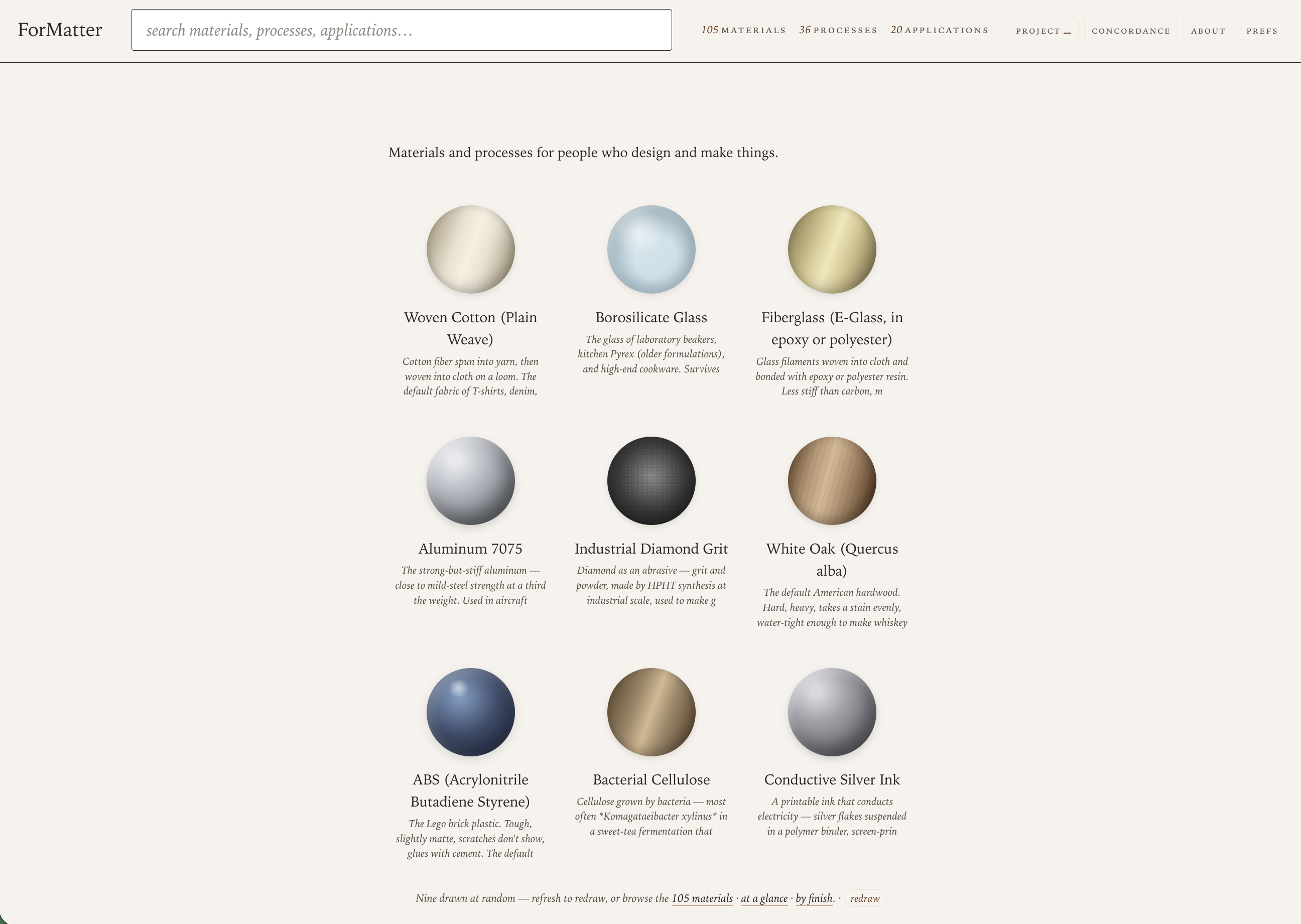
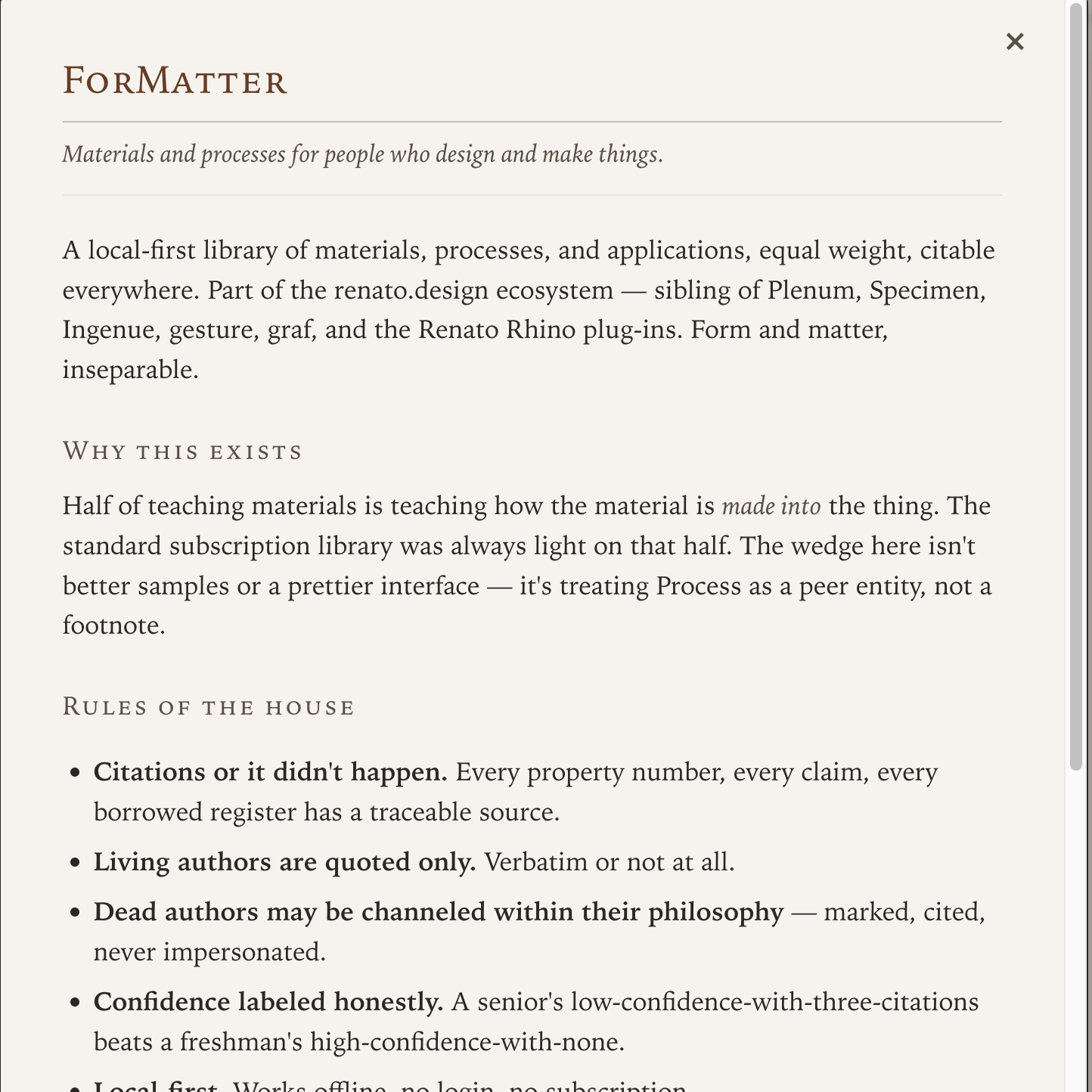
ForMatter is a local-first library of materials, processes, applications, and CMF finishes, sized for an early product-design student to find what they need and a senior material-science student to really sit with. Same database, two registers, no subscription.
Half of teaching materials is teaching how the material is made into the thing. The standard subscription-paid reference was often light on that half. The wedge here isn't better samples or a prettier interface — it's treating Process as a peer entity, not a footnote.
We try to keep a balance between the matter, how the matter is given form, and what other people have done with these processes and materials.
Counts are a snapshot — every number below moves while you read this. The library is young; entries land daily.
What the thing is made of. Metals, polymers, woods, glass, ceramic, textile, composite, biomaterial, paper, smart, gemstone, stone, paint, other. Every entry carries a freshman tier, a technical tier, a sensorial paragraph, PBR starter values, citations, and links to the processes that work it.
How the material becomes the thing. Subtractive, additive, formative, joining, finishing, treatment, hybrid. A peer entity, not a footnote — the same depth as a material, the same citation discipline, linked back to the materials it consumes and the applications it serves.
What the thing IS, in the world. A bicycle frame, a chair, a water bottle, an architectural facade panel, a brooch. Each application links through to the materials and processes that build it, and to the substitutions worth knowing.
The surface treatment that decides how the material reads — anodize, plate, patina, polish, glaze, mold finish, coating, cut, texture, stone finish. Treated as a peer entity since v0.5.6, each finish carries pairings to materials, character notes, sphere palettes, and citations. Sparke names the move on chromed steel: a finish that turns mass-produced goods into decorative items.
Form and matter, inseparable.
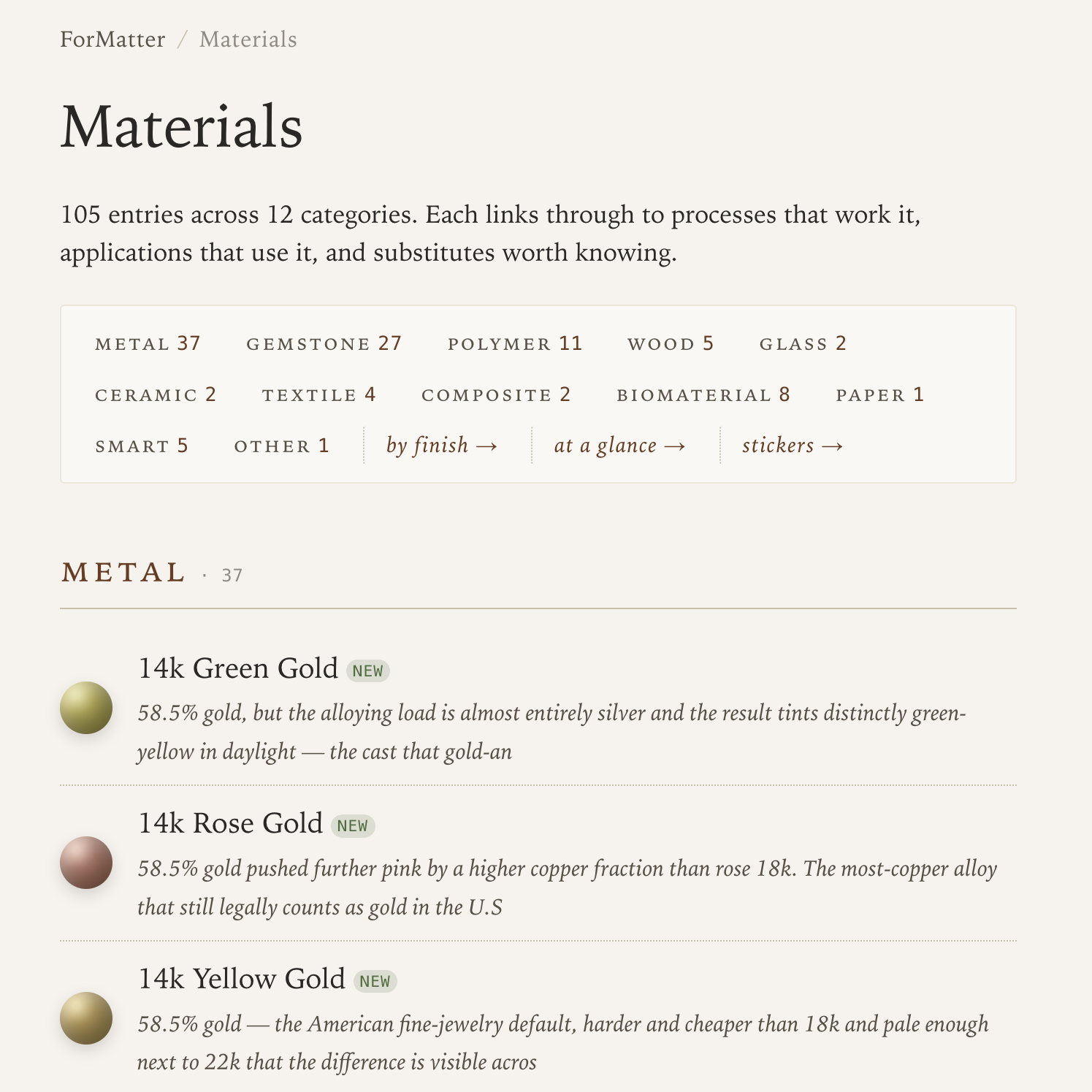
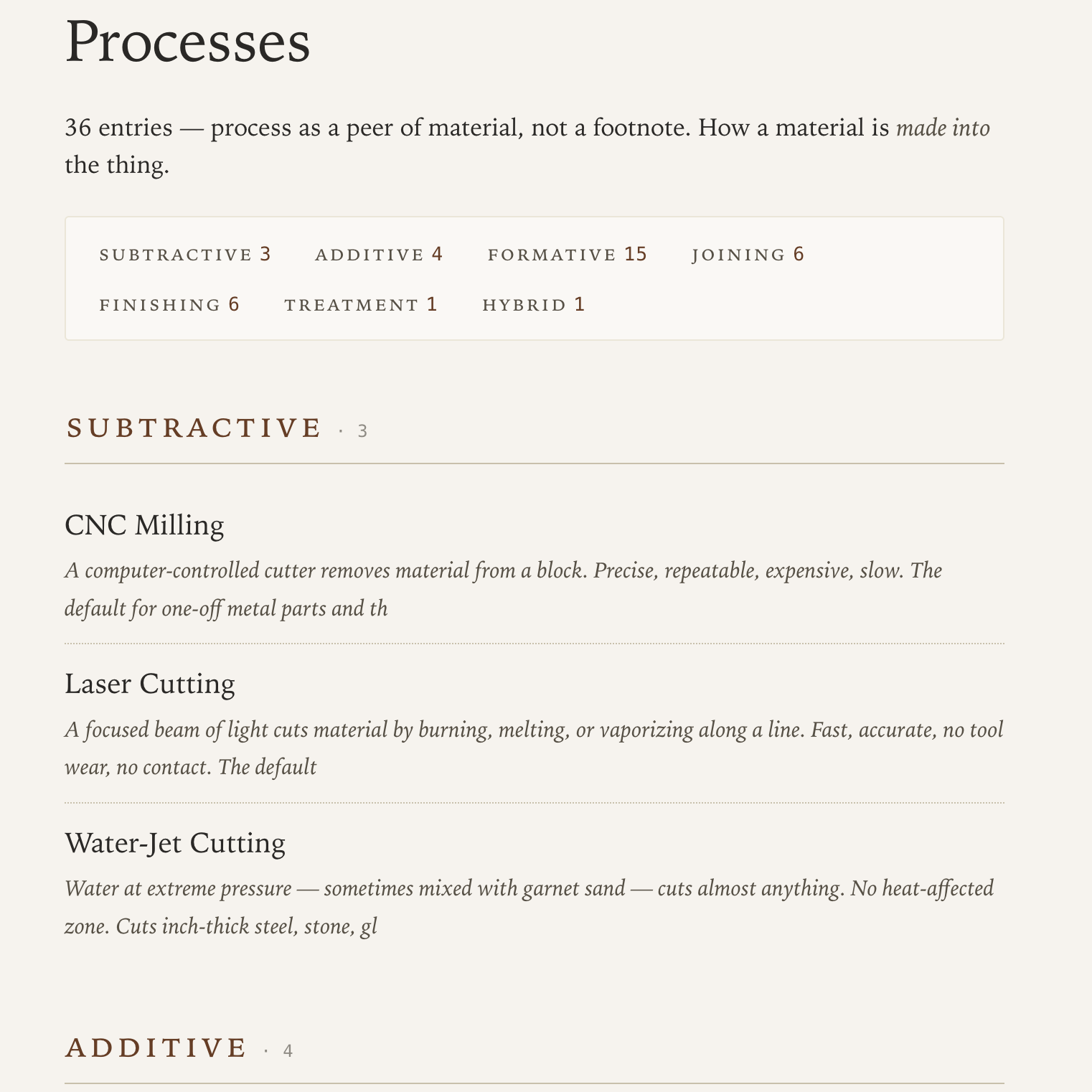
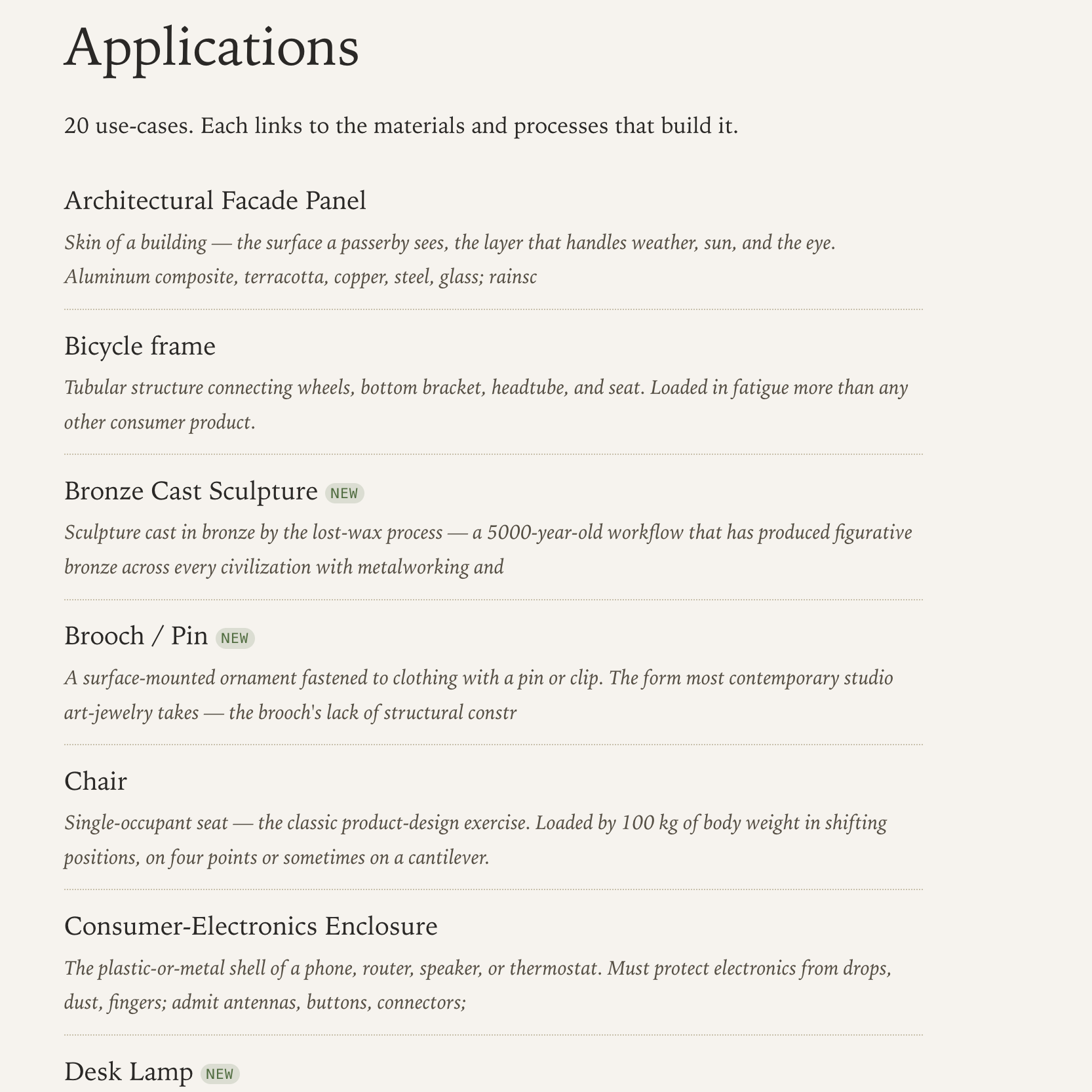
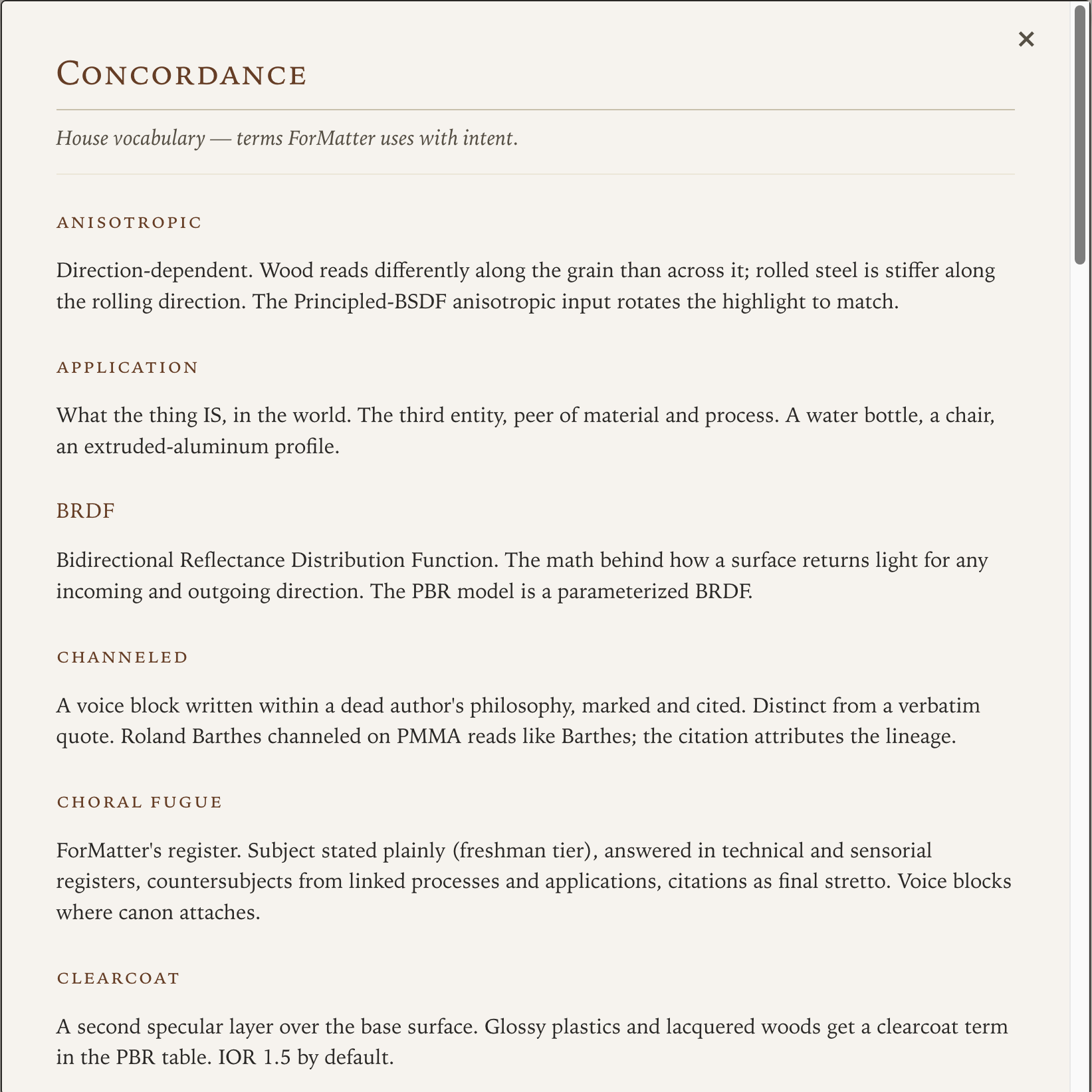
Every entry is built like a small choral fugue. The subject is the material — or the process, or the application — stated plainly. That's the freshman tier. The answer enters in technical register, with property tables and PBR starter values for the readers who render in 3D. The countersubjects come in from the linked processes, applications, and sustainability profile. Citations are the final stretto.
Where a real authored voice attaches to the material, a marked versal block sounds. The voice is named, dated, mode-tagged, and cited. It does not pretend to be the material's own voice. It knows it's a voice in the chorus.
The architecture: archival cabinet on the outside (browse, index pages, sphere wall, by-finish gallery, at-a-glance). Working bench inside the entries (dense, photographic, big property tables, the sensorial paragraph as italic block-quote). Shell carries the identity; the page does the work.
Today's distribution across the fourteen categories — a snapshot, not a budget. Numbers move daily.
Polyphony grows where the canon attaches. Nothing faked to fill empty staves. Voice rule, suite-wide: living authors are quoted only — verbatim or not at all. Dead authors may be channeled within their philosophy — marked as channeled, dated to the source work, never impersonated. Citations for everyone and everything.
On PMMA, and on injection molding — channeled within his philosophy of "Plastic," Mythologies, 1957. The block sounds when the material enters the chorus; the citation closes the stretto.
On white oak — channeled within his philosophy of The Beauty of Everyday Things, Penguin Modern Classics 2017. A craftsman's register; the wood as participant.
On soda-lime glass, on the cast bronze sculpture, on the gold leaf in the arcade — channeled within his philosophy of The Arcades Project and The Work of Art in the Age of Mechanical Reproduction. Six entries carry him.
On forging iron — channeled within his philosophy of The Two Paths Lecture V "The Work of Iron" (1858) and The Stones of Venice Vol. II Chapter VI "The Nature of Gothic" (1853). "The cast bowl tells you only of the mould; the forged bowl tells you of every blow."
On twining (the textile-derived metalsmith structure Mary Lee Hu adapted to drawn wire) — channeled within her philosophy of On Weaving, Wesleyan 1965. "The hand twined before it wove. To twine is to lock by twist, not by beat."
On Mannesmann seamless tubular steel, on phenolic resin / Bakelite, on porcelain (Wedgwood), on chromed steel as the 1930s utility-to-decoration shift, on lounge lighting at the Triennale — quoted verbatim from Design in Context (Bloomsbury, 1991). Nine entries carry her.
On the Bauhaus tubular-steel chair as social-stratum marker, on Rams' Braun "less design is more design," on the Monobloc plastic chair (one billion units, three dollars apiece), on Apple as "the example par excellence" of product-as-style — quoted verbatim from Design (Birkhäuser, 2015).
On concrete formwork as the Achilles heel of concrete's claim to need no skill, on the negative-positive lineage between concrete and photography ("a concrete structure is very like a photograph") — quoted verbatim from Concrete and Culture (Reaktion, 2012). UCL Bartlett emeritus, very much alive.
On photographic concrete (Eberswalde, Herzog & de Meuron), on Greg Lynn's Predator vacuum-formed shred, on stainless mesh (NOX Maison Folie), on basalt (Kuma Stone Museum), on Cloud Gate's continuous TIG welding — quoted verbatim from Material Design (Birkhäuser, 2011). SUTD Singapore.
On silicon (after oxygen the most common element), on lithium ("a magical metal"), on polypropylene (the flip-top bottle and the chair), on the historical environmental case for plastics — quoted verbatim from Material World (Knopf, 2023). Sky News Economics Editor, alive 2026.
On the twenty-thousand-kilometre journey of a commuter bicycle, on Strix's metal-bashing kettle factory, on lithium-ion's enabling chemistry, on cotton's three-centuries-ago supply chain — quoted verbatim from Your Life Is Manufactured (Faber, 2025). Cambridge IfM Head, Dr John C. Taylor Professor of Innovation.
On the matter-versus-material distinction (the source of ForMatter's name), on engineered wood as shortcut, on industrial sewing — designers "treat their materials as they treat their laborers" — quoted verbatim from Making Trouble: Design and Material Activism (Bloomsbury, 2022). Parsons / Konstfack.
On lost-wax casting ("the wax knows what it is going to become before the metal does"), on the temperature-ladder of brazing, on the chasing hammer-mark as a record of decision, on the bezel as the older argument, on pavé as "the metal pulls back so the stones can do all the speaking," on the Tiffany prong as engineering-and-marketing — channeled within the philosophy of Jewelry Concepts and Technology (Doubleday, 1982). Six entries carry him.
On welded steel architecture as a different cultural register from concrete — "made by other men, men of a different race, a race of smiths, of metallurgical, industrial men... welds, with hammers that do not chisel but pound." From In Praise of Architecture (1957) as quoted in Forty's Concrete and Culture. Architect, founder of Domus, designer of the Pirelli Tower (1891–1979).
Fourteen voices today, more arriving as the canon attaches. Each marked living or dead, each mode-tagged quote or channeled, each cited. Polyphony grows where the canon attaches. Nothing faked to fill empty staves.
Not a substitute for ASM, ASTM, ISO, or a primary supplier datasheet — use those for any number you'd design against. The library lives on disk, the build emits static HTML, no server behind any of it, useful to a teacher rather than replacing one. Still not finished — v0.6.84 today, the entry count climbing while you read this.
Nothing leaves your browser. No analytics, no account, no server. Saved projects, preferences, last-seen entries — all live in localStorage under formatter:. Prefs → Reset clears all of it. Print as brief renders a one-page summary you can save as PDF; that PDF is the only copy that leaves the browser, and only if you ask for it.
Sibling of Plenum, Specimen, Ingenue, gesture, graf, and the Renato Rhino plug-ins. Part of the renato.design ecosystem — same voice rule, same citation discipline, same local-first stance.