
"Describe what you want to do. ingenue parses it in nerd, gives you an initial recipe, and five fabrication voices argue about whether you should build it at all."
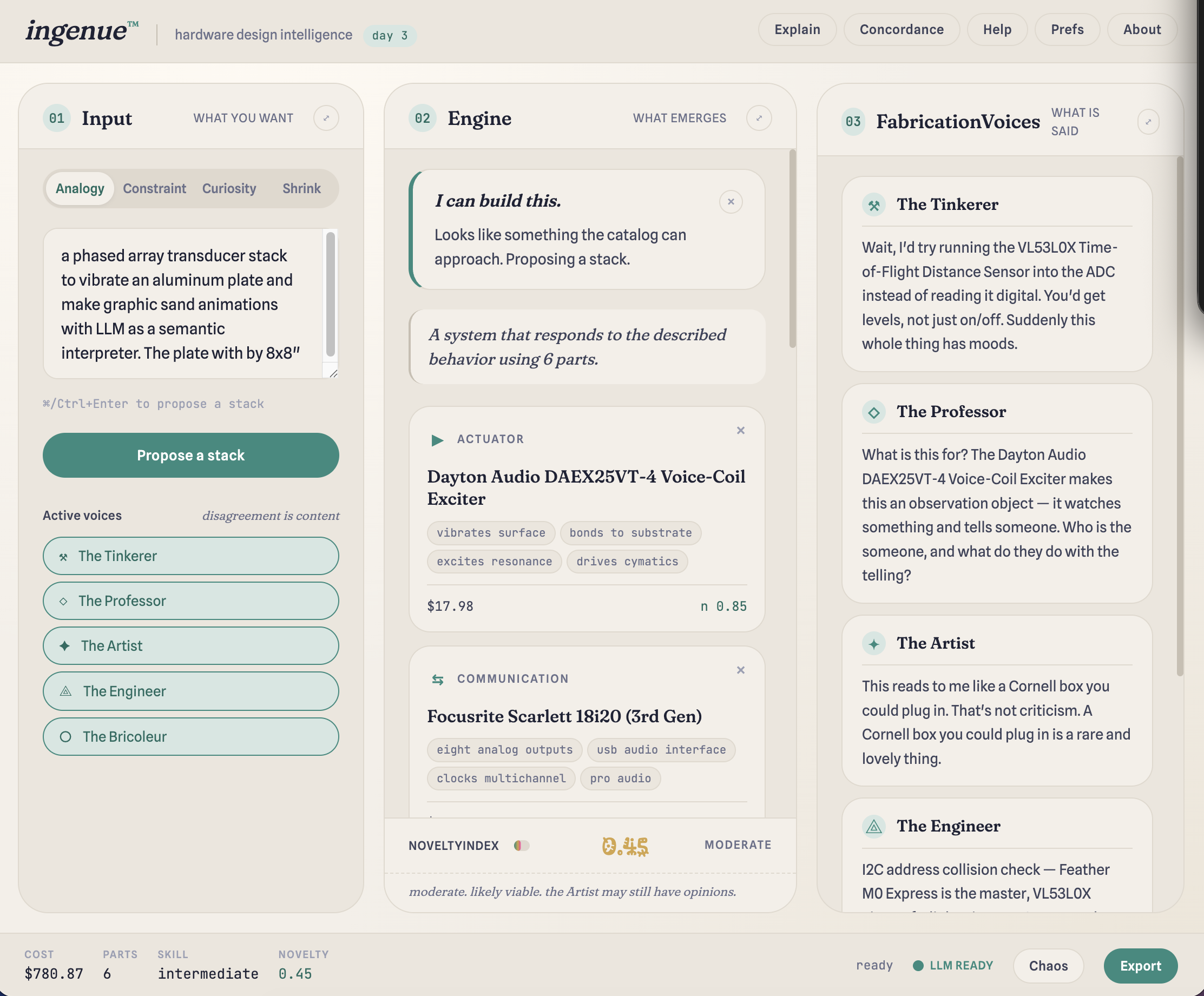
ingenue is a browser-based hardware "design" tool. You describe, in plain language, what you want a thing to do. ingenue proposes a set of parts that exist, wired together, that could do the thing. It draws the envelope the parts would fit inside. It names the closest everyday object that envelope resembles. It hands you a report you can print, email to yourself, or throw into a cart.
Not a schematic generator, not a CAD program, and it doesn't solve for everything it might need to be. The wiring is described in prose, not pads. The skill path names what you'd have to learn to build the thing, not how to learn it. The rest of the work is yours.
It treats a supplier catalog as a behavioral vocabulary. A PIR sensor isn't a motion detector - it is a part that waits. An e-ink display isn't 2.13 inches at 250dpi - it is a part that remembers. Every part in the library carries experiential tags alongside its datasheet numbers. Those tags are what the engine searches against.
Three modes, plus a fourth that runs in the other direction.
The catalog is the grammar. You are writing a sentence in it.
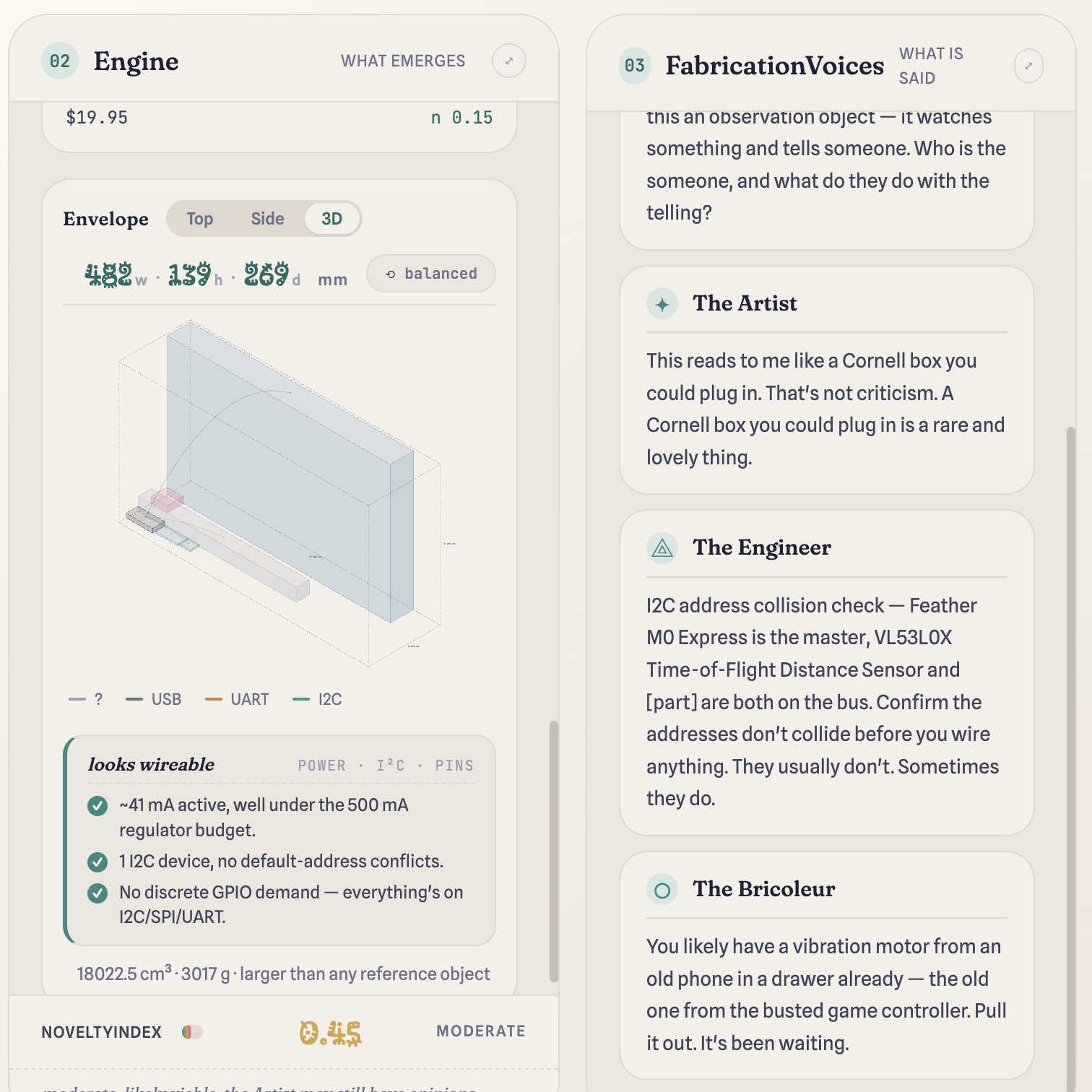
The engine proposes. Five FabricationVoices argue. Each one has a different thing to say, and more importantly, a different thing to refuse to say. Disagreement is the content. You can turn any of them off; you cannot turn all of them off.
Associative, bottom-up, slightly chaotic. Has a lot of components in bins and is specific about what could go with what. Proposes one substitution you did not ask for. Thinks with her hands.
Systems-first. Fab Lab lineage. Does not suggest until she understands what problem is being solved. Begins with a question about intent or audience. Socratic in the patient way, not the annoying way.
Metaphor-first. Suspicious of efficiency. Will reject a technically correct stack on poetic grounds. Sometimes insufferable. Usually right.
Failure modes, power budgets, tolerances, protocol conflicts. Names the specific thing that will break first. Honest about tradeoffs in a way that feels almost rude until someone realizes it isn't.
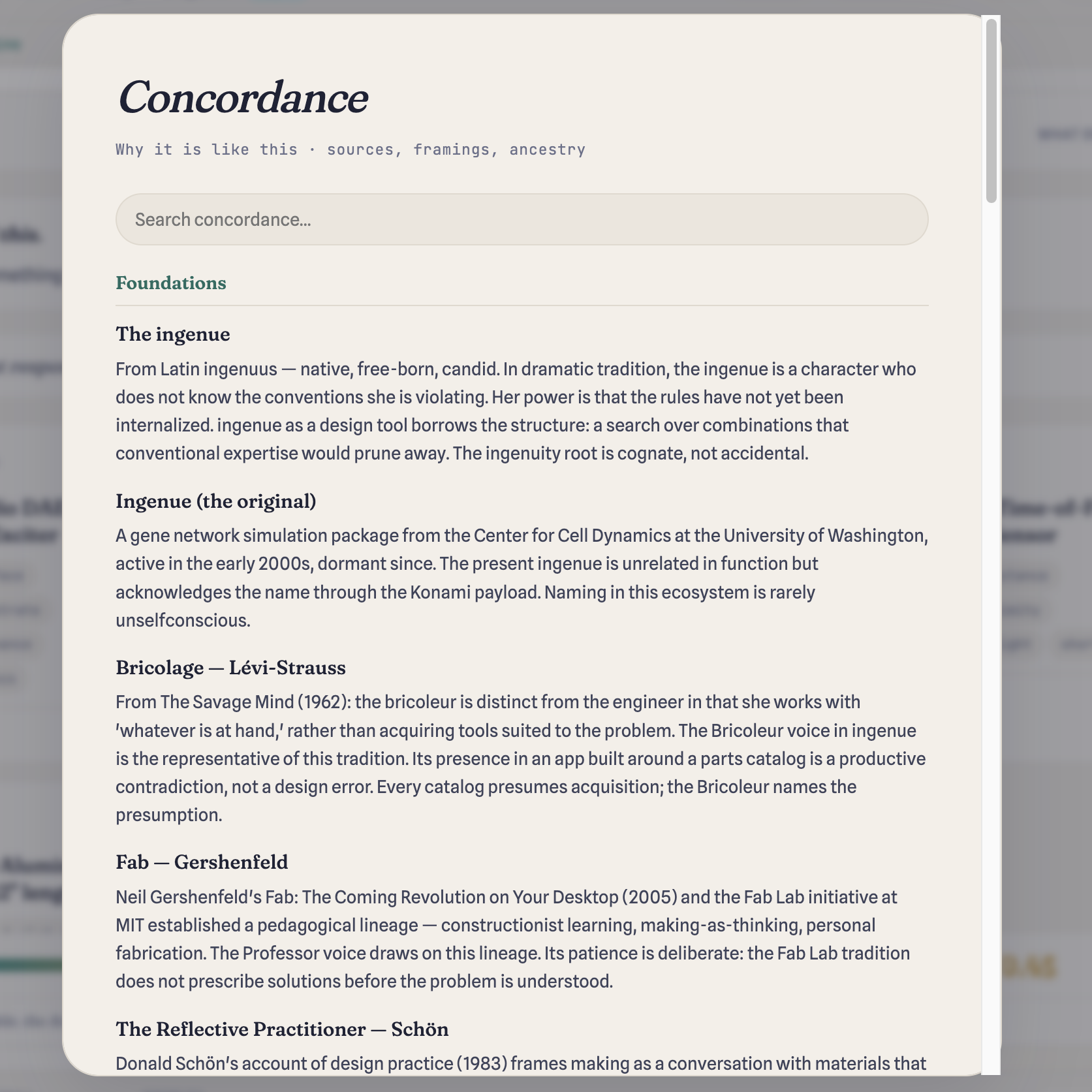
Works only with what you already have. Asks what is in the drawer before suggesting you buy anything. The most philosophically inconvenient voice in an app built around a parts catalog. That tension is the point.
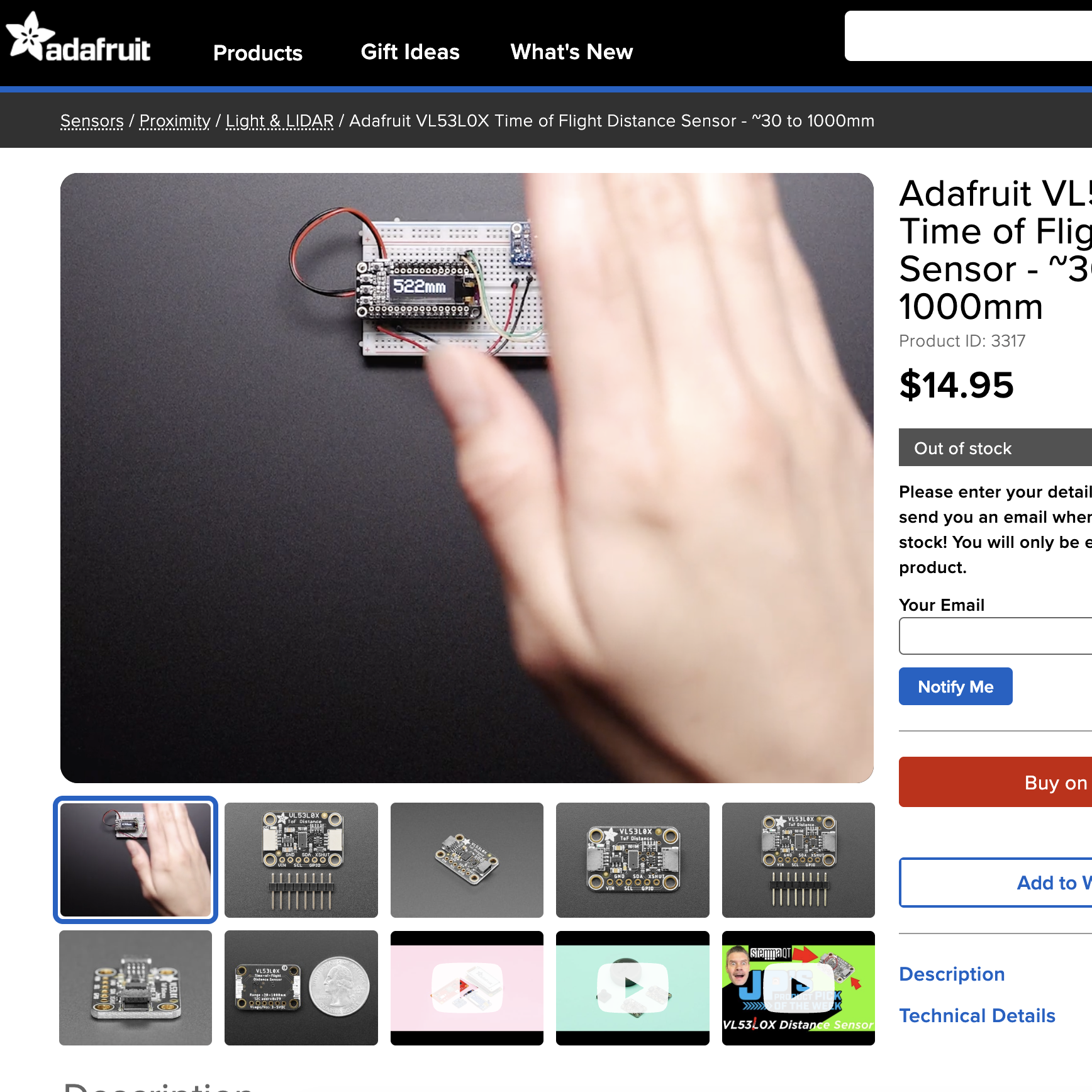
Adafruit is the default because Adafruit treats documentation as the product. Their product pages teach. The illustrations are useful. A beginner can land on a PIR sensor page and come away with a working mental model. That's rare, and it's what makes the catalog usable as a teaching surface rather than a lookup table.
The library reaches beyond Adafruit - a handful of parts each from Parts Express (voice-coil exciters, amps), Pololu (steppers, drivers, regulators), PJRC (Teensy), Sweetwater (audio interfaces), Digi-Key, McMaster-Carr, SparkFun, 80/20 Inc., Amazon. Enough to propose a phased cymatics plate or a stepper-driven instrument without leaving the catalog. Everything is behavioral-tagged the same way; hardware doesn't end at the hobby electronics aisle.
Honest scale: 142 parts total - Adafruit's full catalog is ~3,500 products and Digi-Key's is in the millions, so this is still a sliver. The pitch is not coverage; it's behavior. Sensors that wait, actuators that vibrate a surface, displays that remember. A small catalog with the right metadata proposes stacks that a big catalog without it cannot. A future version will go live to the supplier APIs; this one curates the vocabulary first.
Every part carries dimensions, weight, mount type, real datasheet URL, and a behaviorally-tagged description. Dimensions are editorial estimates - accurate to a millimeter or two, meant for envelope plausibility, not fabrication. No invented parts. No hallucinated SKUs. If a request would need a part the library doesn't have, ingenue says so rather than making one up.
The catalog is the corpus.
The voices can run three ways - against the Anthropic API (bring your own key), against a local model running on your machine through Ollama or LM Studio, or from authored response banks if you have neither. None of these paths leaves your browser for any server of ours. There is no server of ours.
If you want the local path and haven't used Ollama before, three commands and you're done.
brew install --cask ollama. Or download the installer from ollama.com. Linux and Windows work too.ollama pull llama3.1:8b is a good first choice - small, fast, competent for this work. qwen2.5:7b is a stronger reasoner if you can spare the RAM.launchctl setenv OLLAMA_ORIGINS "*" once, then restart Ollama. This is the CORS permission your browser needs to fetch from the local server.Then open ingenue, go to Prefs → LLM backend, pick Ollama, probe. If your model dropdown populates, you're live. The voices get sharper and more specific when a real model is on the other end. Without one, they still speak, from authored response banks tuned to the stack's characteristics, just in a smaller vocabulary.
Every session produces an ArtifactSpec. Export it four ways - copy Markdown to the clipboard, download the Markdown file, download the full report as plain text, or download a supplier BOM as CSV for every proposed part.
A ConceptStatement - one paragraph, voiced. What the artifact is, what it does, what it isn't.
A ComponentStack - every proposed part with its real SKU, real price, real supplier URL, real dimensions. Click through and you land on the product page. Sometimes these links break, you'll have to be flexible.
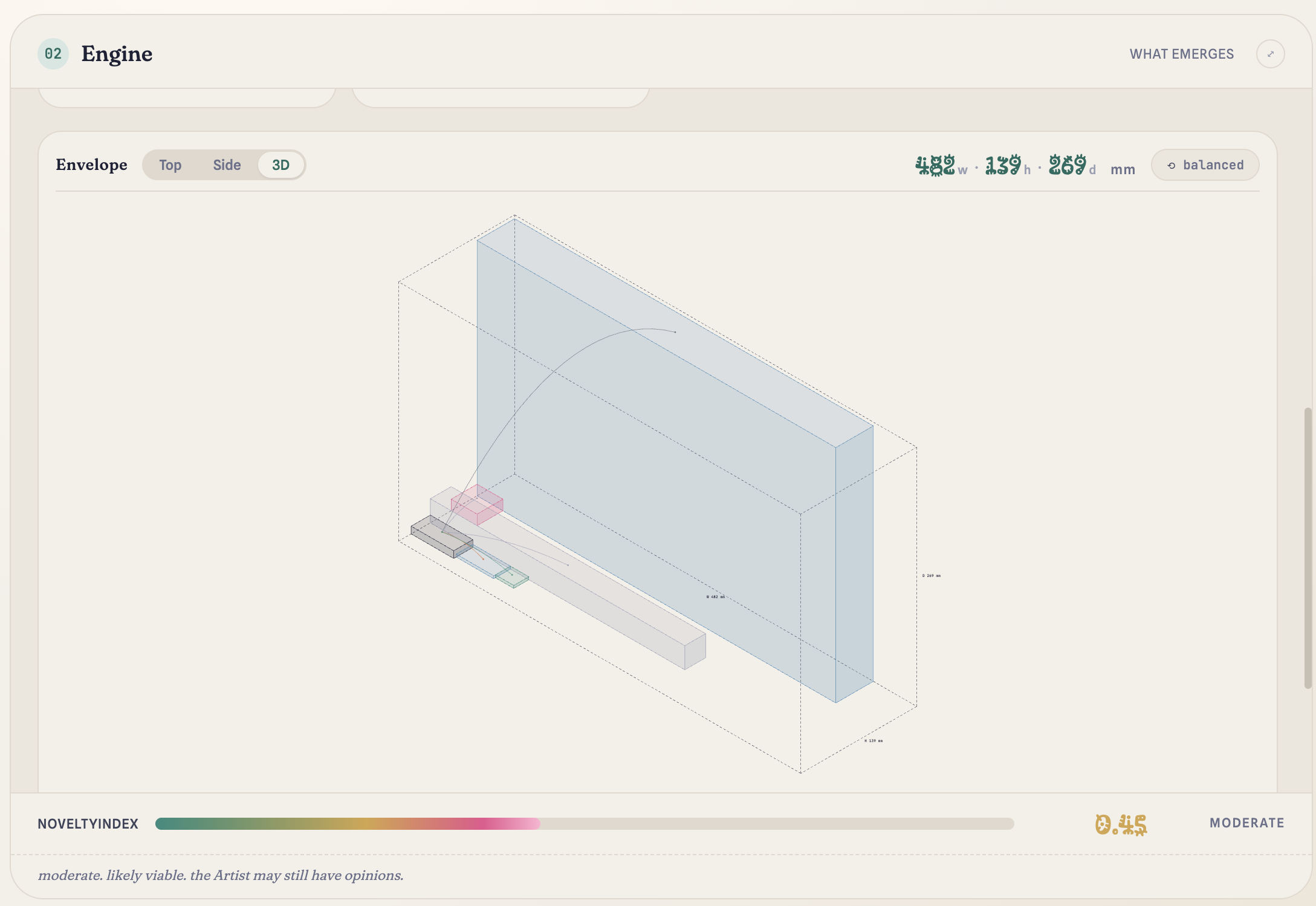
A PackingEnvelope - top view, side view, and a pure-SVG isometric. Dimensions on all three axes. The closest everyday object the stack fits inside, named: watch face, Tic Tac box, pack of gum, wallet card, AirPods case, Altoids tin, deck of cards, phone, paperback, VHS tape, shoebox.
A WiringMap in prose, a SkillPath naming what you'd learn in order to build it, a NoveltyIndex with a tier and a readout, and VoiceNotes - the verbatim commentary of whichever voices were on when you generated. Plus OpenQuestions: what the artifact doesn't yet answer. That last one matters.
Not an AI product designer - you are the designer; it is the catalog, arguing. Supplier links are pointers, not checkout flows, and it’s willing to be useful to a teacher without pretending to be one. Not finished - the catalog grows, the voices sharpen, the envelope will learn mechanical mates.
Nothing leaves your browser. No analytics, no server. Your API key lives in localStorage. So do your saved stacks, your novelty floor, your voice selection, your history. Prefs → Reset clears all of it.