
a concinnitas instrument
chamber musicSeven paradigmatic critics read your brief in the first person, argue with each other, and hand you back a building you can consider defending.
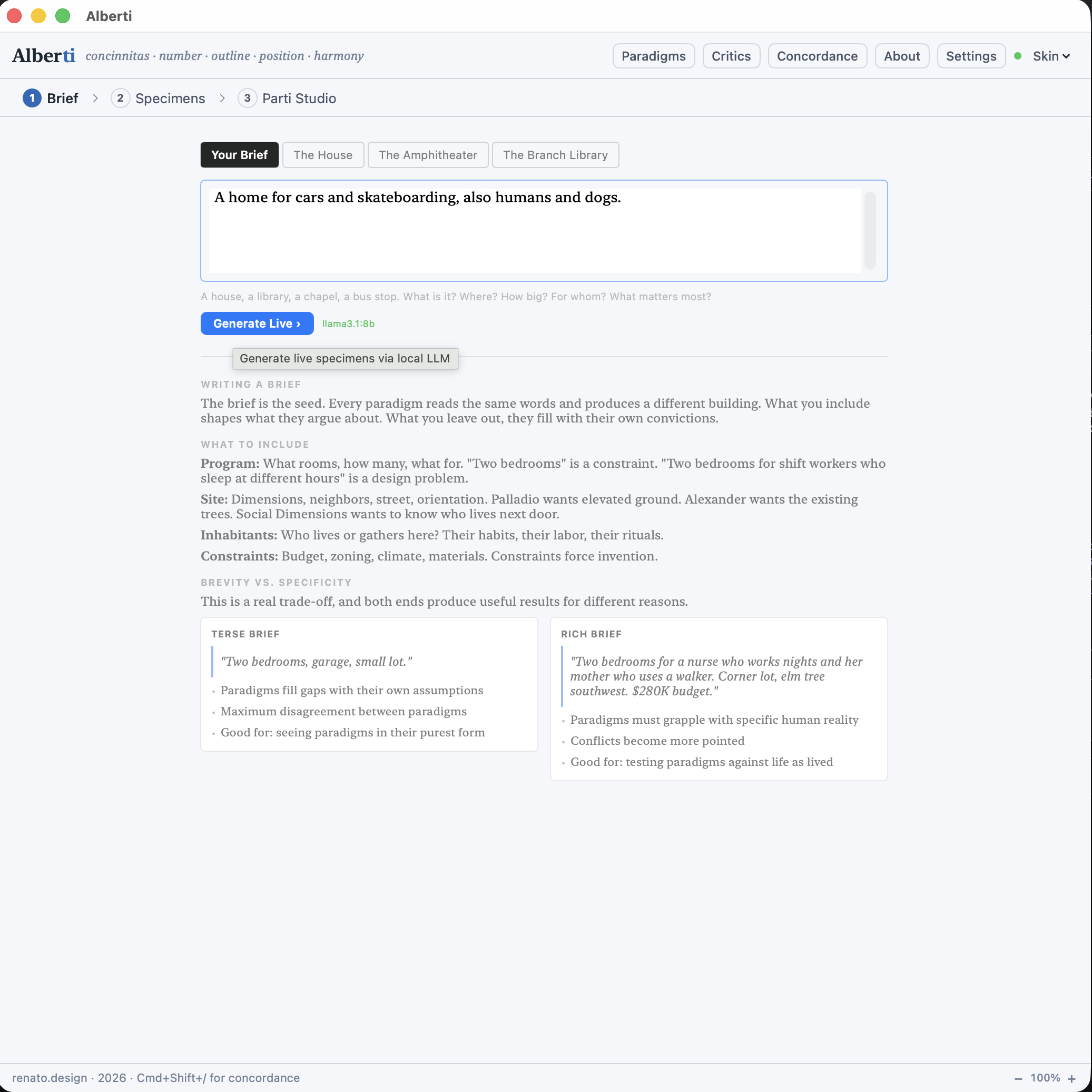
An architectural pedagogy instrument. You give it a design brief. Seven paradigms, each one a real position from the discipline's literature, respond. Each one in the first person. Each one citing the source. Each one with a different idea about what your building should be.
You then take the parts you want from each, axis by axis, and watch the building that results. Where the paradigms agree, the building is calm. Where they disagree, the system flags the conflict and shows you what each side stands to lose. You can run the brief once and read what came back, or you can spend an hour blending and re-blending and listening to the seven critics talk past each other.
The point is not to find the right answer. The point is to be made aware that there is more than one position, that those positions have history, and that the choice you make is a choice.
The collision is the pedagogy.
Seven voices. Each one anchored in primary literature. Each one argued from inside the position, not summarized from outside it.
Leon Battista Alberti (1404–1472) makes the case for concinnitas - harmony so taut that nothing can be added or removed. Proportions from musical ratios; the column as principal ornament. Robert Venturi argues from Complexity and Contradiction (1966) - both/and, not either/or; the decorated shed; the pleasure of the conventional applied unconventionally. Adolf Loos brings Raumplan - rooms at the height their use demands, ornament as crime, plain surface and rich material.
Social Dimensions reads the program as a labor question first - who occupies the space, when, under what asymmetry of authority. Andrea Palladio answers in Quattro Libri proportion, bilateral symmetry, the central hall, the temple front. Christopher Alexander brings the Pattern Language and the Quality Without a Name - the building must arrive at a state where you cannot say what is wrong. Zaha Hadid argues from parametric continuity - thresholds dissolved, geometry given over to topology, the surface is the room.
Each one says a sentence about your brief. Each one cites where the sentence came from.
Seven axes, seven paradigms. Proportion. Hierarchy. Circulation. Solid/Void. Ornament. Threshold. Site. Under each axis, you choose which paradigm owns it. Want Palladio's proportion and Loos's solid/void and Alexander's circulation? Assign them. The mixer flags every place those positions disagree and pulls a quote from each side so you can see the disagreement in their own words.
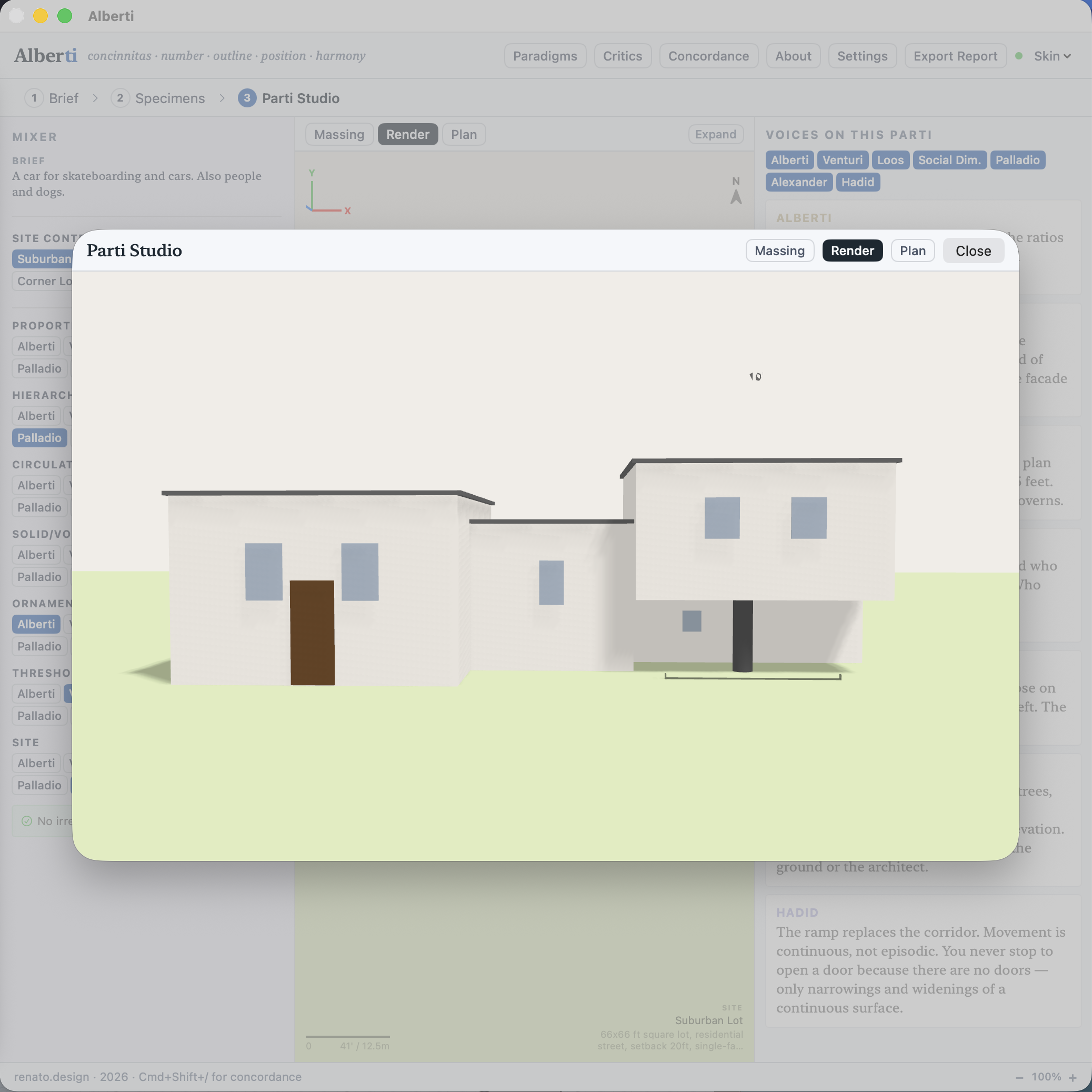
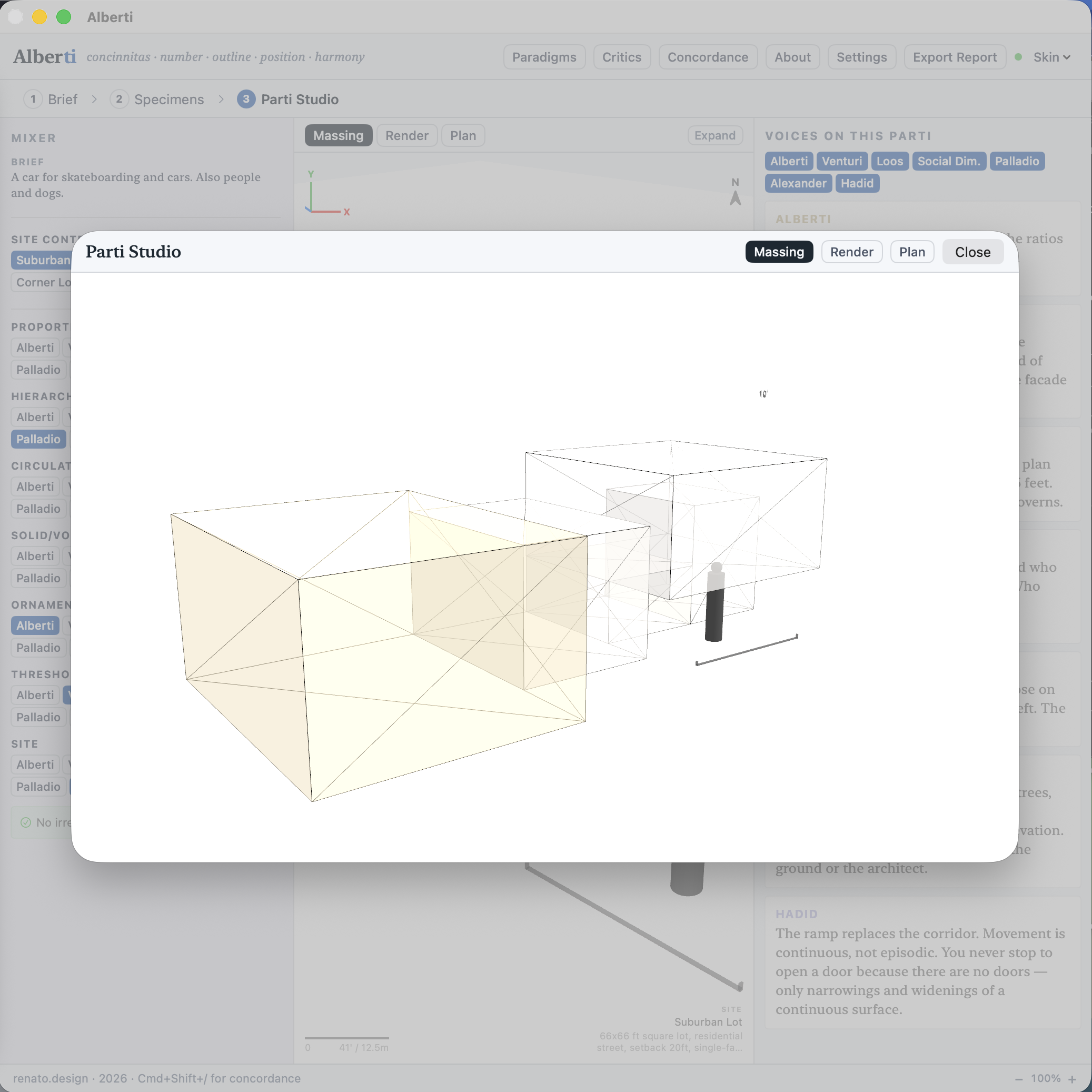
The viewport renders the result three ways. Massing is translucent volumes with a wireframe overlay and a 5'8″ figure for scale - orbit it, walk around it. Render is the same building with roofs, windows, doors, and shadows; whichever paradigm owns the most axes is the one whose architecture you see most plainly. Plan is the building from above with rooms labeled and proportional ratios called out.
Move a slider. The building changes. The voices in the right panel rewrite their commentary in real time. Nothing is precious; nothing is hidden.
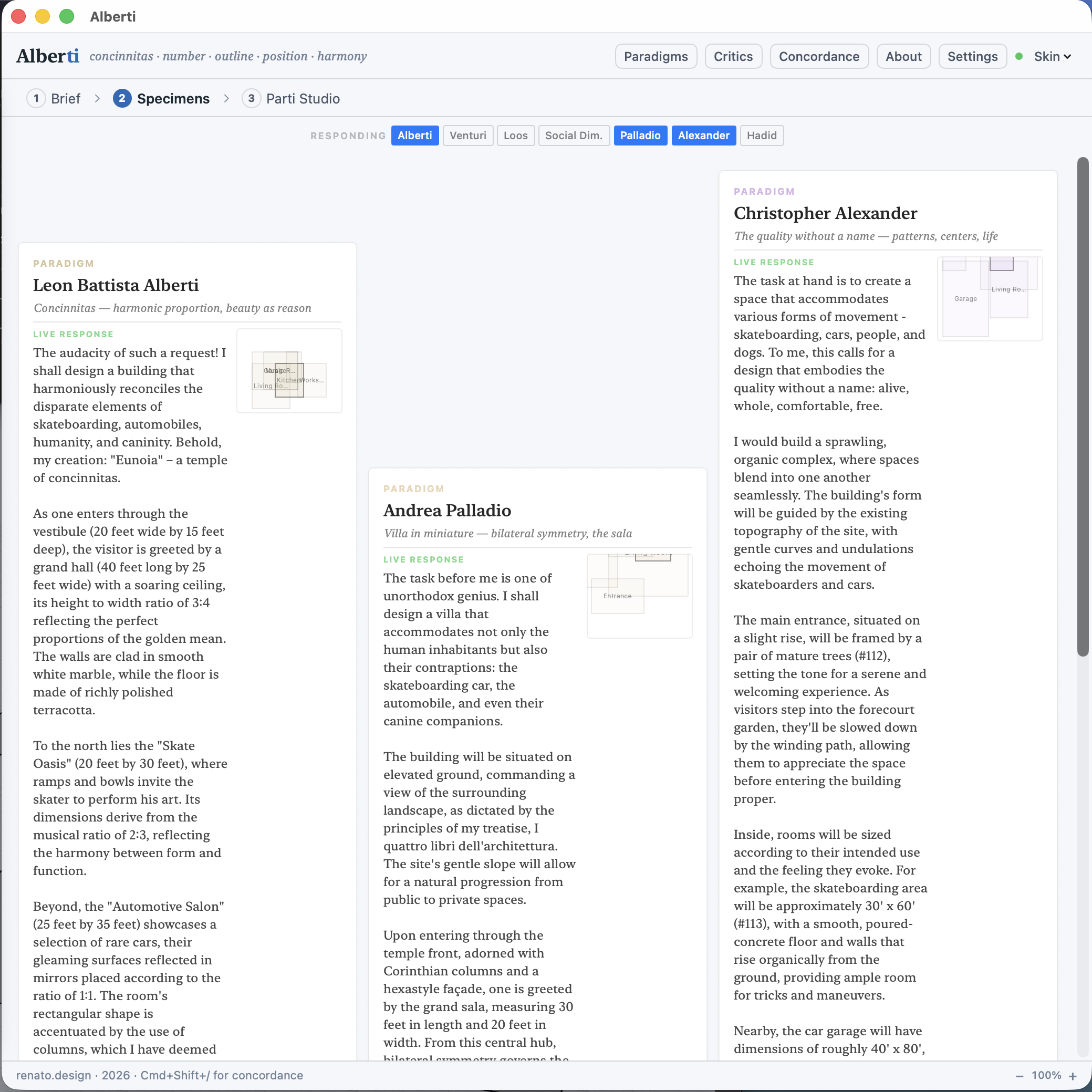
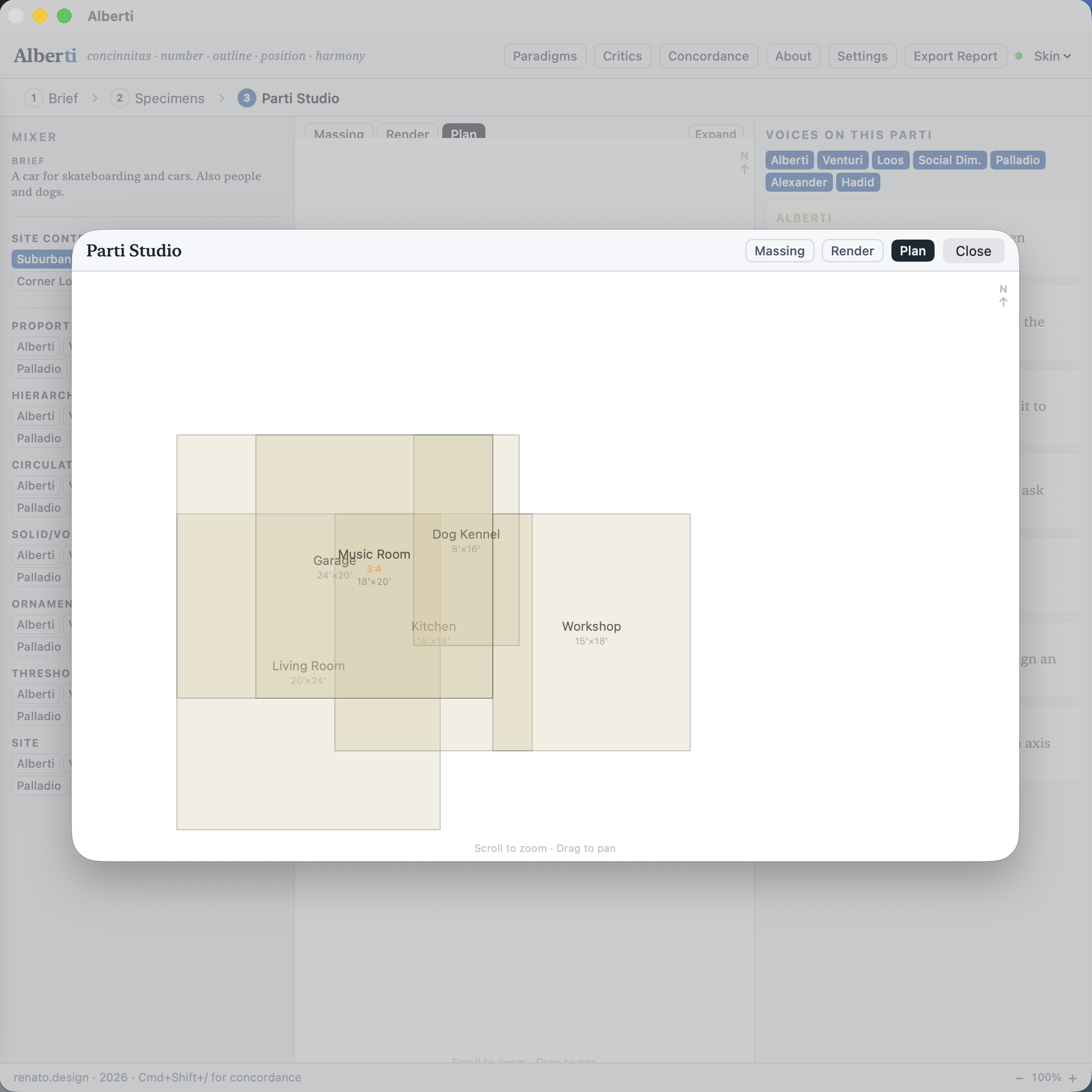
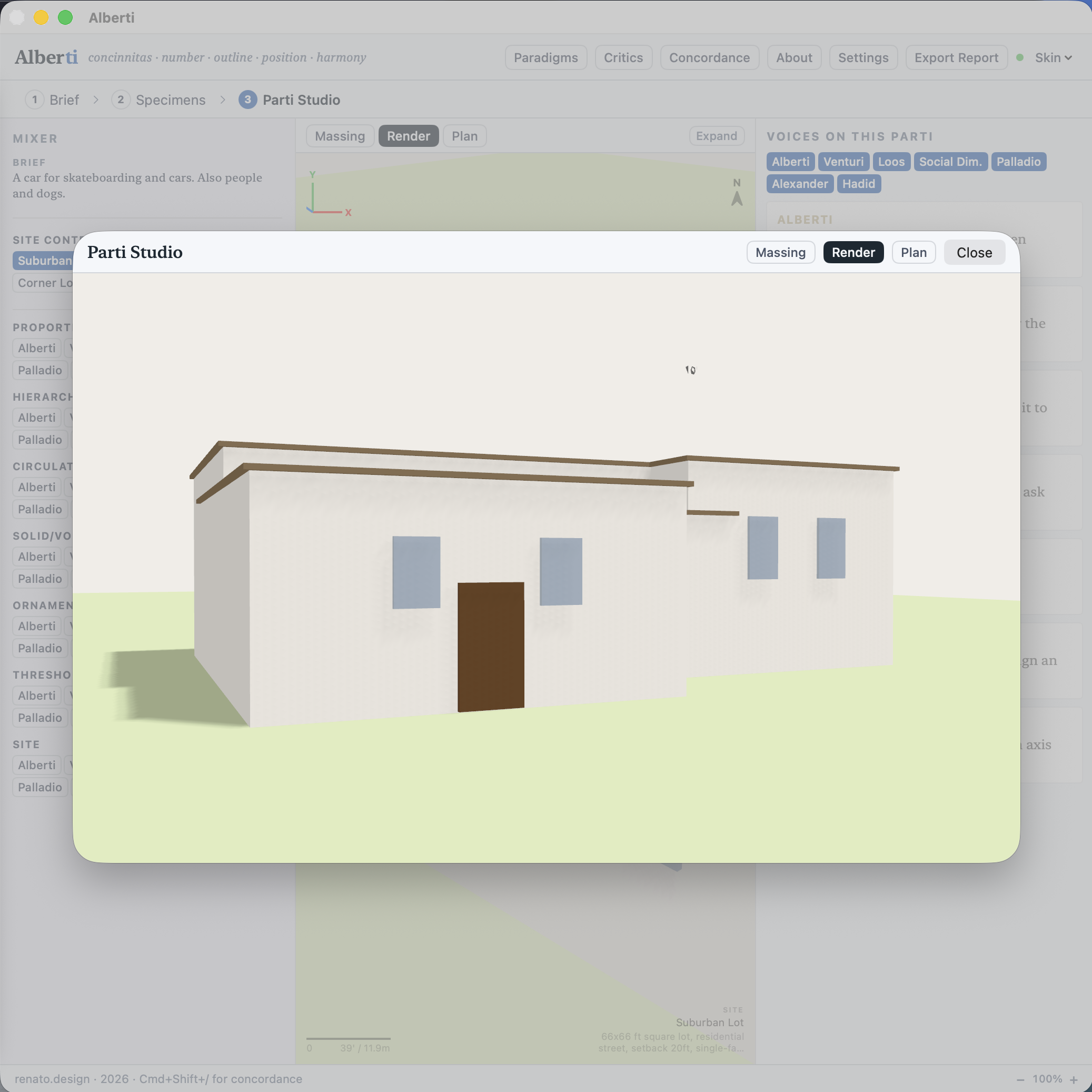
The paradigm voices are not quite chatbots. They are authored - structured arguments scored in advance, drawn from primary sources, written so that each one reacts in character to whatever blend of axes you have built. When the mixer changes, each voice re-evaluates and writes a new short response. They do not agree. They do not pretend to. Loos will tell you that ornament is wrong. Hadid will tell you that the rectangle was always a compromise. Alexander will quietly note that the corner has no quality. The seven of them, together, are not a panel. They are a chamber.
Above and around the seven, ten external critics read the result - voices borrowed from ekphrasis and provoc, four-part response per critic: reaction, principle, citation, what is lost. The last part is the one that matters. Every position costs something. Naming the cost is part of taking the position seriously.
The Mac version generates these responses live against a local language model (Ollama, llama3.1:8b) so each session is its own. The web demo plays back a fixed library of pre-authored responses for three sample briefs (The House, The Amphitheater, The Branch Library) so you can hear what the instrument sounds like without running it.
Alberti exists in two forms - the same instrument, scaled to two different commitments.
The web demo runs in your browser. No install, no account. You can pick one of the three sample briefs, see how all seven paradigms respond, blend them in the mixer, watch the building change. The responses are pre-written. The interaction is real. It is enough to understand what the instrument does and why it matters.
The Mac version is the full instrument. Custom briefs - type your own program, your own site, your own constraints. Live LLM responses against a local model on your machine; the paradigm voices write fresh prose for whatever you give them. The full mixer with all seven axes editable. The full viewport with massing, render, and plan all running. Seven visual themes (Editorial, Brutal, LaTeX, Concrete, Grimoire, YoRHa, Water) that change the chrome but not the content. Concordance and Help panels. Export Report. The whole quartet.
The Mac version uses Ollama running llama3.1:8b locally. The model lives on your machine; nothing leaves it. If Ollama is not installed, the app still runs - the voices fall back to the same authored library the web demo uses. With Ollama running, the voices write live.
Not parametric CAD, and not a style guide - there’s no constraint solver or fabrication output, and the paradigms argue the why, not the look. It won’t hand you a finished design: every paradigm has a position, built to stay legible rather than cancel each other out, and the seven voices are authored, never improvised like a chatbot. Not for production drawings - it’s for the moment before, when the position is still being chosen.
Alberti is a chamber. The voices are seven, the brief is one, and the room you walk out with is a building that might be defensible - because every move it makes can be traced to a literature.
Aesthetic is argument.
The Mac version is signed with the renato.design Developer ID, notarized by Apple, and stapled. Both the .app and the .dmg pass Gatekeeper as “Notarized Developer ID.” On first launch you should see exactly one prompt - “Alberti is from Phillip Renato. Open?” - and then it runs.
The web demo runs entirely in your browser. There is no analytics script and no server. There is no LLM call either - the demo plays back authored responses against the three sample briefs. Custom briefs and live responses live in the Mac version, where the model runs on your machine.