Automotive Paint — Acrylic Enamel (single-stage)
The chemistry that painted American muscle cars. Single-stage acrylic enamel — pigment + acrylic resin + solvent + (sometimes) a hardener — sprayed in two coats, baked, done. The color and the gloss are the same film: there's no clearcoat over the top. This is the chemistry behind every Chrysler high-impact paint code (FE5 Bright Red / Rallye Red, FJ5 Sublime / Limelight, EV2 HEMI Orange / TorRed, FC7 Plum Crazy / In-Violet, FY1 Top Banana / Lemon Twist), GM's late-1960s and 1970s passenger-car paint codes, and Ford's M-codes from the same era. Acrylic enamel reads softer and slightly chalkier than modern basecoat-clearcoat — a 1970 Plum Crazy looks like a 1970 photograph for a reason. UV chalking and fade are the canonical failure modes; a 1972 paint job that's been outside since 1972 looks dramatically different from one that was repainted in 2005, even if the formula is the same.
Solvent-borne single-stage pigmented enamel. Binder is thermosetting acrylic resin (often modified with melamine for crosslink), pigment 25–45 percent by weight, solvent (xylene / mineral spirits / butyl cellosolve blend) 35–50 percent. Cure mechanism: solvent flash + oxidative or melamine crosslink at bake temperature (140–160 °C OEM bake; refinish air-dry or 60 °C low-bake with isocyanate hardener). Two-coat application typical at OEM, three coats common in refinish; dry film 50–80 µm total. VOC content high (450–600 g/L); largely phased out of US OEM by ~1985 in favor of basecoat-clearcoat; retained in industrial / agricultural / fleet refinish where the trade-off favors color-and-gloss-in-one-film. Single-stage means no clearcoat — touching the cured film touches the pigmented coat directly; spot repair is straightforward (no clearcoat to blend) but UV protection lives in the same film as the pigment, so chalking eventually dulls the gloss and fades the color. The 1970 Mopar high-impact program is the best-documented application of this chemistry: vivid pigments (often containing lead-chromate yellows, organic reds, phthalocyanine blues — the period chemistry that gave the colors their saturation) sprayed as single-stage enamel and never refinished today without changing the chemistry to BC/CC. Restoration suppliers maintain code-matched single-stage formulas (PPG Deltron DCC, Sherwin-Williams Dimension, Glasurit Series 22) for concours-faithful refinish.
Chemistry
- binderthermosetting acrylic resin, often melamine-crosslinked
- cure mechanismbake-cure (OEM 140–160 °C) or air-dry / hardener-catalyzed (refinish)
- VOC (typical) · g/L525
- stages1
History
- OEM introductionearly 1960s (acrylic enamel on Chrysler / GM bodies — 1957 is DuPont's acrylic *lacquer* Lucite date, a separate chemistry often conflated with acrylic enamel in restoration literature)
- muscle era peak1968–1972 (the Mopar high-impact program; Ford's M-codes; GM's saturated-color era)
- OEM phase outearly-to-mid 1980s (replaced by BC/CC for clearcoat depth + chip resistance)
PBR starter values
finish · glossy — open for table, JSON, host snippets, downloads
Principled BSDF defaults derived from the sphere glossy finish. Reasonable seed for Blender, Substance, Keyshot, Rhino — tune per material. Or grab the whole library at once: ForMaterials library →
# finish:                   glossy
albedo                      #8a2825
metallic                    0.00
roughness                   0.15
ior                         1.45
transmission                0.00
clearcoat                   0.30
sheen                       0.00
anisotropic                 0.00
copy as JSON
{
  "albedo": "#8a2825",
  "metallic": 0.0,
  "roughness": 0.15,
  "ior": 1.45,
  "transmission": 0.0,
  "clearcoat": 0.3,
  "sheen": 0.0,
  "anisotropic": 0.0
}
Blender 4.x Python
# Blender 4.x — Principled BSDF
# Automotive Paint — Acrylic Enamel (single-stage) · finish: glossy
import bpy
mat = bpy.data.materials.new(name="mat_automotive_paint_acrylic_enamel")
mat.use_nodes = True
bsdf = mat.node_tree.nodes["Principled BSDF"]
bsdf.inputs["Base Color"].default_value         = (0.2542, 0.0212, 0.0185, 1.0)
bsdf.inputs["Metallic"].default_value           = 0.000
bsdf.inputs["Roughness"].default_value          = 0.150
bsdf.inputs["IOR"].default_value                = 1.450
bsdf.inputs["Transmission Weight"].default_value = 0.000
bsdf.inputs["Coat Weight"].default_value        = 0.300
bsdf.inputs["Sheen Weight"].default_value       = 0.000
bsdf.inputs["Anisotropic"].default_value        = 0.000
KeyShot Python (lux)
# KeyShot 11+ — lux Python API, Generic material
# Automotive Paint — Acrylic Enamel (single-stage) · finish: glossy
# Run from Window → Scripting Console
import lux
mat = lux.createMaterial(name="mat_automotive_paint_acrylic_enamel", materialType="Generic")
mat.setProperty("diffuse",      (138, 40, 37))   # 8-bit sRGB
mat.setProperty("metallic",     0.000)
mat.setProperty("roughness",    0.150)
mat.setProperty("indexOfRefraction", 1.450)
mat.setProperty("transparency", 0.000)
mat.setProperty("coatingWeight", 0.300)
Substance pbrMetalRough
{
  "_format": "Substance Designer / Painter \u2014 pbrMetalRough constants",
  "_about": "Automotive Paint \u2014 Acrylic Enamel (single-stage) \u00b7 finish: glossy",
  "baseColor": {
    "r": 0.2542,
    "g": 0.0212,
    "b": 0.0185
  },
  "metallic": 0.0,
  "roughness": 0.15,
  "ior": 1.45,
  "opacity": 1.0,
  "anisotropyLevel": 0.0,
  "_notes": "Channels listed are the standard Substance pbrMetalRough output. Drop into a Uniform Color node per channel, or as the constant input on a layered stack."
}
glTF 2.0 Metallic-Roughness
{
  "asset": {
    "version": "2.0",
    "generator": "ForMatter"
  },
  "materials": [
    {
      "name": "mat_automotive_paint_acrylic_enamel",
      "pbrMetallicRoughness": {
        "baseColorFactor": [
          0.2542,
          0.0212,
          0.0185,
          1.0
        ],
        "metallicFactor": 0.0,
        "roughnessFactor": 0.15
      },
      "extensions": {
        "KHR_materials_ior": {
          "ior": 1.45
        },
        "KHR_materials_clearcoat": {
          "clearcoatFactor": 0.3
        }
      }
    }
  ]
}
USD Preview Surface
# USD Preview Surface — UsdShade.MaterialLook prim attributes
# Automotive Paint — Acrylic Enamel (single-stage) · finish: glossy
def Material "mat_automotive_paint_acrylic_enamel" {
    token outputs:surface.connect = </mat_automotive_paint_acrylic_enamel/PreviewSurface.outputs:surface>

    def Shader "PreviewSurface" {
        uniform token info:id = "UsdPreviewSurface"
        color3f inputs:diffuseColor = (0.2542, 0.0212, 0.0185)
        float   inputs:metallic     = 0.000
        float   inputs:roughness    = 0.150
        float   inputs:ior          = 1.450
        float   inputs:opacity      = 1.000
        float   inputs:clearcoat    = 0.300
        token   outputs:surface
    }
}
An example from this chemistry
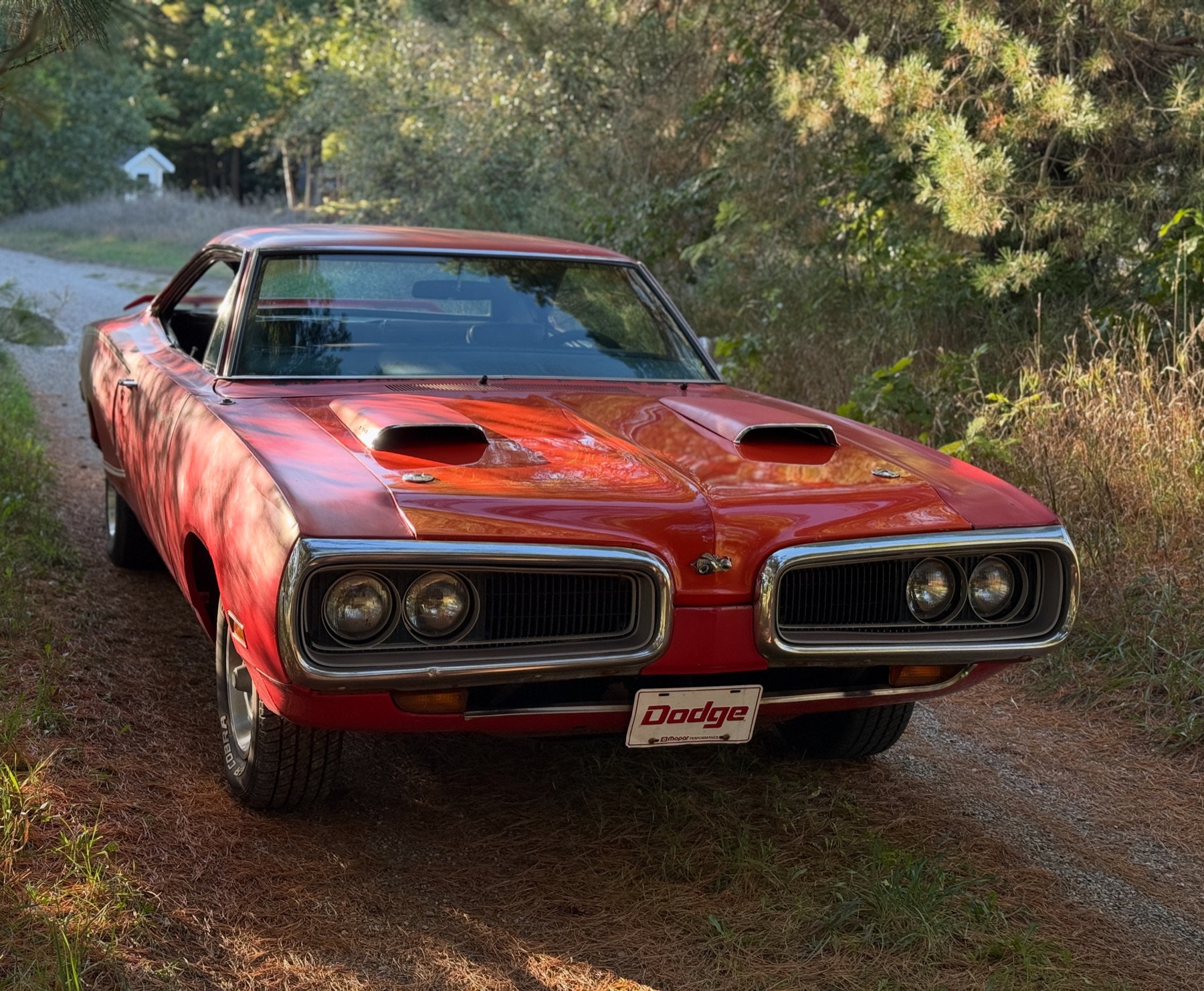
1970 Dodge Super Bee (Phil's car)
FE5 Bright Red
How it was painted — Hamtramck Assembly downdraft booth, body hung on conveyor, sprayed by line operators with siphon-feed guns at ~50 psi. Single-stage acrylic enamel from PPG / DuPont in 2 coats, 50–60 µm total dry film, no clearcoat. Bake at 150 °C for ~25 min in the line oven. Color and gloss are the same film. Polish was minimal — the gun finish was the production finish. Body shell got a phosphate dip and a single primer coat before color; no e-coat (electrocoat had been pioneered by Ford in 1963 but wasn't yet universal).
What it means for owners — A 1970 Super Bee paint job that has been outdoors since 1970 has a distinctive soft chalk and minor fade — the UV stabilization in 1970 enamel was much weaker than modern coatings. Fresh repaints (1990s+) frequently use BC/CC chemistry under the original FE5 color formula, which reads visibly different from a survivor car: deeper, glossier, more obviously modern. The concours community has split on which is correct — a chemistry-faithful single-stage enamel respray, or a BC/CC respray that holds up better in service.
Source: Plenum encyclopedia (paint-fe5); Galen Govier registry; Hagerty 'How muscle cars were painted'.
Colors in this chemistry · 61
Chrysler B-body / E-body / A-body factory paint codes 1968-1974, single-stage acrylic enamel chemistry. Sourced from Plenum's Chrysler decode vocabulary; codes are facts (not copyrightable). The famous high-impact set (FE5, FJ5, EV2, FC7, FY1, FM3, FJ6, EK2) and the surrounding palette of metallic and solid colors.
The famous codes
High-impact orange. Per Dodge Garage's high-impact retrospective, Plymouth's name is 'TorRed' (one word, no hyphen), Dodge's is 'HEMI Orange' (capitalized). Spans 1969–1972 in production.
High-impact purple. Per Dodge Garage's high-impact retrospective.
Historic Ditzler/PPG cross-reference per mymopar.com paint chart. Verify against your supplier's current Concept / OneChoice formulary.
High-impact lime green, mid-1970 introduction, 1970-only code. Per Dodge Garage's own retrospective on the 1970 high-impact program: Dodge marketed FJ5 as 'Sublime', Plymouth as 'Limelight'. Often confused with FJ6 (Sassy Grass / Green Go), which is a deeper saturated green; in person FJ5 reads as a luminous citrus-lime where FJ6 reads as a meadow green.
High-impact saturated green, the deeper sibling to FJ5. Dodge marketed FJ6 as 'Green Go' (after the color of a traffic light), Plymouth as 'Sassy Grass Green'. F-prefix marks 1970 as the formula's first use; the code carried into 1971 unchanged (not renamed).
Per mymopar.com paint chart.
Per Dodge Garage's high-impact retrospective, the EV2 Hemi Orange / TorRed family spans 1969–1972. 1969 builds may carry an older 'M6' code form; 1970 standardized on EV2 across Chrysler. The previous Plenum claim that M6 and EV2 were used 'interchangeably across plants' overstates what's directly documented and was rolled back. Confidence demoted to registry-attested pending a primary 1969 Fact Data Book scan.
The full palette
- GF7
- A4
- B5
- B7
- BL1
- DY3
- EK2
- F5
- F8
- FF4
- FK2
- FK5
- FM3
- FT6
- GA4
- GA8
- GB5
- GB7
- GF3
- GT2
- GT5
- GW3
- GY3
- GY8
- HA4
- HB1
- HF8
- HT5
- HY1
- HY3
- JA5
- JB5
- JF8
- JT9
- JY3
- JY9
- KA4
- KB5
- KF8
- KT5
- KY4
- KY9
- PP1
- Q5
- R4
- R6
- T5
- T7
- TX9
- W1
- X9
- Y2
- Y3
Further reading
- en.wikipedia.org — Automotive paint
- dodgegarage.com
- renato.design — plenum app
- datasheet · PPG Deltron DCC / Sherwin-Williams Dimension acrylic enamel technical datasheets.