Automotive Paint — Basecoat / Clearcoat (BC-CC, 2K Urethane)
The chemistry behind every modern car's paint job, and the deep wet-mirror gloss everyone associates with 'a really nice paint job.' BC/CC is two layers, sprayed wet-on-wet: a thin colored basecoat that carries the color (and the metallic flake or pearl, if any), then a thick two-component urethane clearcoat that mixes a polyol resin and an isocyanate hardener at the gun and cures into a hard, glossy, UV-stable, chip-resistant film. The basecoat looks matte on its own — the depth comes entirely from the clearcoat. The 1991 GM third-gen F-body GTA's WA-8555 Black, modern Tesla Pearl White Multi-Coat — all BC/CC. Replaced single-stage acrylic enamel as the OEM standard from roughly 1980 (GM led, Ford and Chrysler followed) through 1992 across the global passenger-car market; still the dominant solvent-borne system in the US refinish trade.
Two-coat solvent-borne system. BASECOAT: thin pigmented film (15–25 µm dry) carrying color, often metallic aluminum flake or mica pearl, on an acrylic / polyester / cellulose-acetate-butyrate (CAB) binder. Sprays in 2–3 light coats, flashes off in 5–15 minutes. The basecoat alone is matte, soft, and not weatherable — it requires the clear over the top. CLEARCOAT: 2K (two-component) polyurethane — polyol resin + isocyanate hardener mixed at 4:1 to 2:1 ratio at the gun, applied within ~4 hr pot life. Cures by isocyanate crosslinking at room temperature in 12–24 hr (refinish), force-cure at 60 °C in ~30 min, or OEM-bake at 140 °C in 20 min. Dry film 40–60 µm. Hardness ~3H pencil after full cure. UV-stable when formulated with HALS (hindered-amine light stabilizers) + UV absorbers. Read levels: gloss (>90 GU at 20°), satin / semi-gloss (40–70 GU), deliberate matte (<10 GU — Tesla Stealth Grey, BMW Frozen series). Total stack: e-coat primer (15–25 µm) + primer-surfacer (25–35 µm) + basecoat (15–25 µm) + clearcoat (40–60 µm) = 95–145 µm dry. Isocyanate hazard demands supplied-air respirators in spray application; banned for at-home spraying in some EU jurisdictions. Spot-repair-without-blending is harder than single-stage because the clearcoat has to be wrapped around an entire panel for invisible repair.
Chemistry
- basecoat binderacrylic / polyester / CAB
- clearcoat binder2K polyurethane (polyol + isocyanate)
- cure mechanismBC: solvent flash; CC: isocyanate crosslink (room-temp 12–24 hr / 60 °C 30 min / OEM bake 140 °C 20 min)
- VOC (typical) · g/L420
- stages2
History
- OEM introduction~1979–1982 (GM led on premium lines, Mercedes-Benz adopted same window in Europe)
- OEM dominanceby 1992 BC/CC was the OEM standard across global passenger-car production
PBR starter values
finish · glossy — open for table, JSON, host snippets, downloads
Principled BSDF defaults derived from the sphere glossy finish. Reasonable seed for Blender, Substance, Keyshot, Rhino — tune per material. Or grab the whole library at once: ForMaterials library →
# finish:                   glossy
albedo                      #1a3a78
metallic                    0.40
roughness                   0.05
ior                         1.45
transmission                0.00
clearcoat                   0.95
sheen                       0.00
anisotropic                 0.00
copy as JSON
{
  "albedo": "#1a3a78",
  "metallic": 0.4,
  "roughness": 0.05,
  "ior": 1.45,
  "transmission": 0.0,
  "clearcoat": 0.95,
  "sheen": 0.0,
  "anisotropic": 0.0
}
Blender 4.x Python
# Blender 4.x — Principled BSDF
# Automotive Paint — Basecoat / Clearcoat (BC-CC, 2K Urethane) · finish: glossy
import bpy
mat = bpy.data.materials.new(name="mat_automotive_paint_basecoat_clearcoat")
mat.use_nodes = True
bsdf = mat.node_tree.nodes["Principled BSDF"]
bsdf.inputs["Base Color"].default_value         = (0.0103, 0.0423, 0.1878, 1.0)
bsdf.inputs["Metallic"].default_value           = 0.400
bsdf.inputs["Roughness"].default_value          = 0.050
bsdf.inputs["IOR"].default_value                = 1.450
bsdf.inputs["Transmission Weight"].default_value = 0.000
bsdf.inputs["Coat Weight"].default_value        = 0.950
bsdf.inputs["Sheen Weight"].default_value       = 0.000
bsdf.inputs["Anisotropic"].default_value        = 0.000
KeyShot Python (lux)
# KeyShot 11+ — lux Python API, Generic material
# Automotive Paint — Basecoat / Clearcoat (BC-CC, 2K Urethane) · finish: glossy
# Run from Window → Scripting Console
import lux
mat = lux.createMaterial(name="mat_automotive_paint_basecoat_clearcoat", materialType="Generic")
mat.setProperty("diffuse",      (26, 58, 120))   # 8-bit sRGB
mat.setProperty("metallic",     0.400)
mat.setProperty("roughness",    0.050)
mat.setProperty("indexOfRefraction", 1.450)
mat.setProperty("transparency", 0.000)
mat.setProperty("coatingWeight", 0.950)
Substance pbrMetalRough
{
  "_format": "Substance Designer / Painter \u2014 pbrMetalRough constants",
  "_about": "Automotive Paint \u2014 Basecoat / Clearcoat (BC-CC, 2K Urethane) \u00b7 finish: glossy",
  "baseColor": {
    "r": 0.0103,
    "g": 0.0423,
    "b": 0.1878
  },
  "metallic": 0.4,
  "roughness": 0.05,
  "ior": 1.45,
  "opacity": 1.0,
  "anisotropyLevel": 0.0,
  "_notes": "Channels listed are the standard Substance pbrMetalRough output. Drop into a Uniform Color node per channel, or as the constant input on a layered stack."
}
glTF 2.0 Metallic-Roughness
{
  "asset": {
    "version": "2.0",
    "generator": "ForMatter"
  },
  "materials": [
    {
      "name": "mat_automotive_paint_basecoat_clearcoat",
      "pbrMetallicRoughness": {
        "baseColorFactor": [
          0.0103,
          0.0423,
          0.1878,
          1.0
        ],
        "metallicFactor": 0.4,
        "roughnessFactor": 0.05
      },
      "extensions": {
        "KHR_materials_ior": {
          "ior": 1.45
        },
        "KHR_materials_clearcoat": {
          "clearcoatFactor": 0.95
        }
      }
    }
  ]
}
USD Preview Surface
# USD Preview Surface — UsdShade.MaterialLook prim attributes
# Automotive Paint — Basecoat / Clearcoat (BC-CC, 2K Urethane) · finish: glossy
def Material "mat_automotive_paint_basecoat_clearcoat" {
    token outputs:surface.connect = </mat_automotive_paint_basecoat_clearcoat/PreviewSurface.outputs:surface>

    def Shader "PreviewSurface" {
        uniform token info:id = "UsdPreviewSurface"
        color3f inputs:diffuseColor = (0.0103, 0.0423, 0.1878)
        float   inputs:metallic     = 0.400
        float   inputs:roughness    = 0.050
        float   inputs:ior          = 1.450
        float   inputs:opacity      = 1.000
        float   inputs:clearcoat    = 0.950
        token   outputs:surface
    }
}
An example from this chemistry
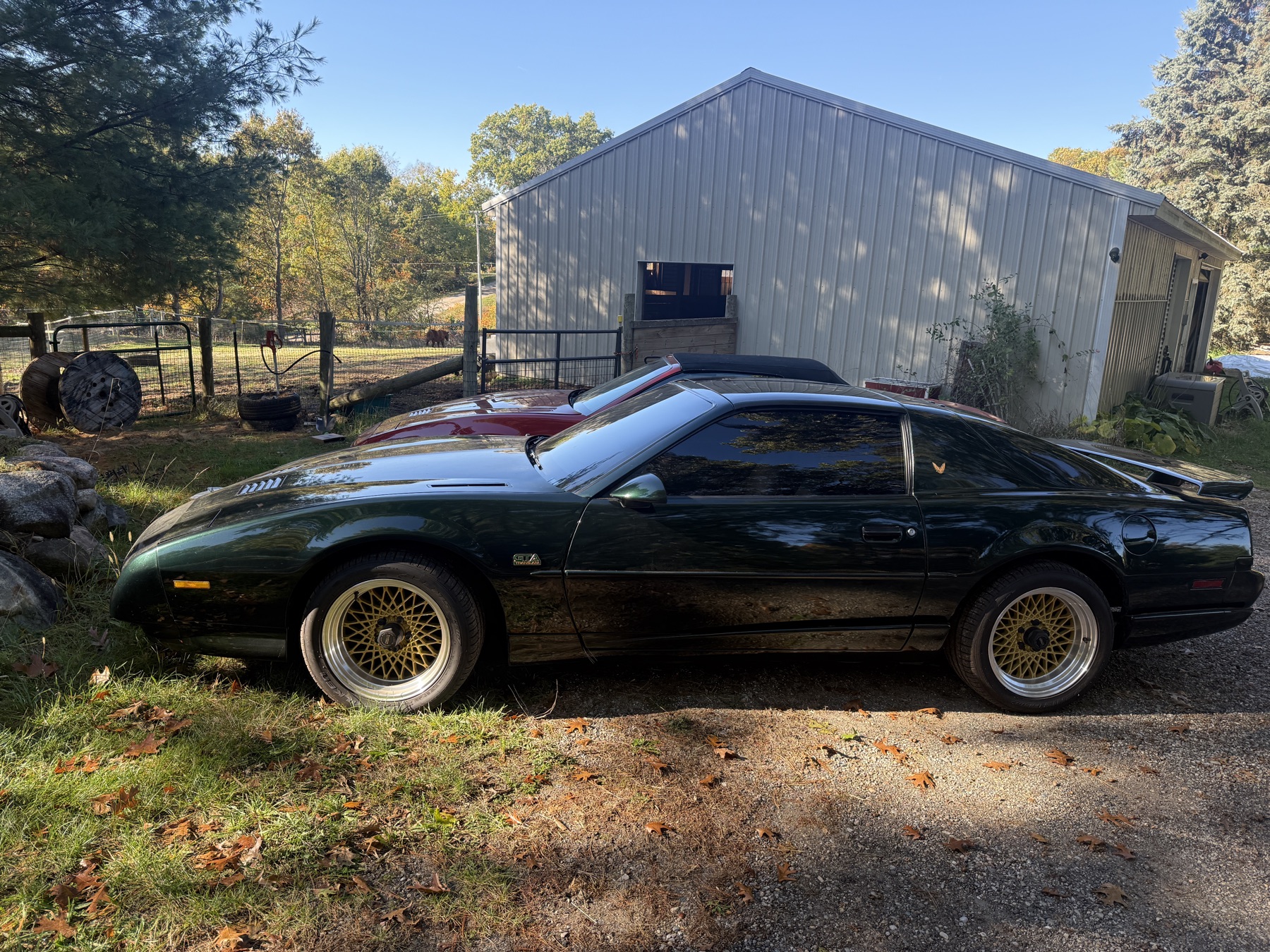
1991 Pontiac Trans Am GTA (Phil's car)
WA-8555 Black (the GTA palette ran tight, mostly black, white, and the metallic blue / charcoal range)
How it was painted — Norwood (1982-1987) and Van Nuys (1982-1992) F-body lines — Van Nuys was the sole producer after Norwood closed in 1987, and built the 1991 GTA. Body shell e-coat-primed by cathodic dip (15–25 µm epoxy), primer-surfaced (25–35 µm), then sprayed in a downdraft booth with electrostatic robotic guns: basecoat in 2 coats (15–25 µm total dry, with metallic flake on the metallic colors; carries the color but matte by itself), 5-min flash, then 2K urethane clearcoat in 2 coats (40–60 µm dry, carries all the gloss + UV protection + chip resistance). Bake at 140 °C for ~20 min. Total stack 95–145 µm dry. The transition from the 1970-era line was complete by the late 1980s on GM premium platforms; the 1991 GTA represents BC/CC at its '90s peak.
What it means for owners — A 1991 GTA paint job is much more durable than a 1970 single-stage car — the clearcoat is the UV barrier and the chip layer, and metallic colors don't oxidize the way single-stage metallics did. The classic 1990s GM clearcoat-failure story (clear delamination from the base, peeling off in sheets) hit some lines but the F-body Van Nuys runs were largely spared. Refinish today uses the same BC/CC chemistry; spot repair is harder than on a 1970 car because the clearcoat has to be wrapped around the entire panel for invisible blend.
Source: Plenum GM 3rd-gen F-body vocabulary; thirdgen.org paint-history threads; PPG / BASF OEM paint-line documentation.
Colors in this chemistry · 19
GM 3rd-generation F-body (Camaro / Firebird / Trans Am / GTA) WA-format paint codes 1982-1992. Sourced from Plenum's GM decode vocabulary. Note: GM transitioned from single-stage acrylic enamel to basecoat-clearcoat around 1986; the 1982-1985 codes in this list were originally single-stage. ForMatter assigns them to the BC/CC chemistry as a simplification — most modern restoration uses BC/CC chemistry to refinish them.
The famous codes
- WA-8554 White (Bright White)
- WA-8555 Black
- WA-8557 Bright Blue Metallic
- WA-8625 Dark Smoke Metallic
- WA-8631 Diamond White (1989 TTA)
- WA-8688-unverified Brilliant Blue Metallic (code unverified — possible confusion with WA9591 Ultra Blue Metallic)
WA-8688 does not resolve against paintref.com or other GM F-body paint-code references consulted. The verified 1991 Firebird/Trans Am metallic blue is WA9591 Ultra Blue Metallic (RPO 98). Demoted pending a primary-source check; do not treat WA-8688 as a real factory code.
- WA-8728 Yellow
- WA-8746 Aqua / Aqua Metallic
- WA-8779 Bright Red
- WA-8961 Medium Quasar Blue Metallic
- WA-8983 Charcoal Gray Metallic
- WA-9258 Bright Aqua Metallic (1992)
- WA-9523 Light Beige Metallic
- WA-9560 Bright Teal Metallic
- WA-9568 Medium Gray Metallic
- WA-9779 Dark Maroon Metallic
- WA-9839 Salmon Metallic (1991–92 F-body — NOT documented on Y84 GTA)
Earlier Plenum versions attributed WA-9839 as a 'rare GTA' color. Per Phil's GTA-registry knowledge (2026-04-29), no Y84 GTA was built in Salmon — the color appears on Camaro RS / regular Firebird in 91–92 but not on the GTA trim. Demoted to single-source pending a primary registry counter-example.
- WA-9967 Sterling Silver Metallic
- WA-TBD-medium-green-metallic Medium Green Metallic (1991–1992 F-body — owner-confirmed on Phil's Y84 GTA; WA-NNNN code pending SPID verification)
Owner-confirmed 2026-04-29: 'that is the color of my car' (1991 Pontiac Trans Am GTA). Reference photo at assets/cars/phil-gta-1991.jpg confirms a deep forest-green metallic. The WA-NNNN factory code is pending verification against the car's actual SPID label — placeholder identifier here is intentionally non-OCR-matching (TBD) so it cannot be falsely decoded from a real label. Update this entry's code field once a primary-source SPID reading is available.
Further reading
- en.wikipedia.org — Automotive paint
- ppgrefinish.com
- glasurit.com
- datasheet · PPG DC4000 / Glasurit 923 / Sherwin-Williams Genesis 2K clearcoat technical datasheets.